Space and Physics
 PUBLISHED






Diamondiyne, a porous assemblage of carbon atoms first theoretically described 35 years ago, has finally been produced. Despite the long delay, the relatively simple synthesis suggests the substance could be an interesting alternative to metal-organic frameworks (MOFs), a hot topic in chemical research.
Because carbon atoms can form four bonds, they are incredibly adaptable, which is why all life on Earth is based around carbon chemistry. Life depends on molecules formed of carbon bonded with other elements, but carbon also has an unusually large number of ways it can bond with itself, producing different substances called allotropes.
The list of carbon allotropes includes graphite, where the atoms form stacked sheets, and diamonds, where they are arranged as pyramids or tetrahedra. There have also been more recent discoveries like buckyballs, nanotubes, and graphene. Beyond these, chemists have come up with numerous other ways carbon could bond with itself, creating theoretical allotropes no one has yet seen in the real world.
It was on a website hosting a list of these hypothetical allotropes that Professor Karl Börjesson at the University of Gothenburg first became inspired to make diamondiyne, whose tetrahedral crystal structure he and his co-authors call “an expanded diamond-topology network.”
The structure is described as carbon atoms arranged in tetrahedra connected corner to corner in all three dimensions, and it is built from a mixture of single-bonded and triple-bonded carbon. In chemistry, a "-diyne" suffix indicates the presence of two triple bonds.
“It has taken us an incredibly long time, but we finally succeeded. I am very pleased,” Börjesson said in a statement. “The structure creates voids between the tetrahedra. The carbon allotrope can therefore be compared to a porous diamond. But unlike diamonds, diamondiyne does not require high pressure to make the carbon atoms bond to one another.”
Instead, Börjesson and his colleagues found, if two liquids, tetra(triethylsilylethynyl)methane and copper fluoride, are brought together, a thin film of diamondiyne forms at the interface.
That’s not great for producing bulk quantities, but if you don’t need much of it, the cost should be a small fraction of that of artificial diamonds. The copper fluoride is a catalyst that should be endlessly reusable.
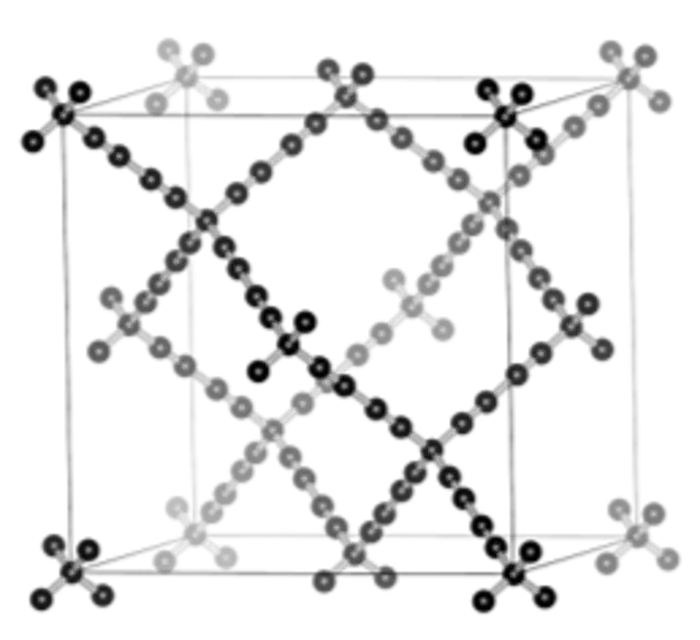
There’s a way to go to reach commercial diamondiyne production, however. While electron microscopy confirmed the distinctive diamondiyne structure on a film produced from the interface, the presence was patchy, indicating that even slight disturbances caused the carbon atoms to arrange themselves in other ways.
Nevertheless, all such work must start somewhere. “We have at least managed to produce repeating patterns of diamondiyne in a volume measuring 10 nanometres on each side, 10 × 10⁻⁹ metres, and the images of the patterns correspond well with the theoretical models,” Börjesson said.
The thing that makes diamondiyne stand out from several other recently produced carbon allotropes is that, small as the sample is, it’s nevertheless three-dimensional. Other recent allotropes, including graphene, have been two-dimensional, i.e. a single layer of atoms thick.
Diamondiyne could unite projects that led to Nobel prizes for chemistry in 1996, 2010, and 2025. The first two of these were for the creation of graphene and fullerene. The 2025 prize was for work in MOFS, cage-like structures that have vast surface areas compared with their volumes, allowing them to act as chemical sponges.
Ideally, diamondiyne might do something similar, allowing it to trap and transport atoms or small molecules without the need for metals. “We will now investigate the properties of diamondiyne and how it might be used. One exciting aspect of the porous structure is that several diamondiyne structures could potentially be interwoven through each other’s voids,” Börjesson said.
Neal Stephenson’s influential novel The Diamond Age took its name from the idea that manipulation of carbon bonds would be the basis of a future society. Perhaps Diamondiyne will prove him right.
The announcement is open access in the journal Angewandte Chemie.