


 Space and Physics
 PUBLISHED





Across the universe, galaxies can often be found in clusters of hundreds and sometimes thousands. In the space between those galaxies, we find what is known as intracluster medium. This is extremely rarefied gas that is tens of millions of degrees hot.
Now, in two new studies astronomers report exciting observations about this material, providing insights into how it is formed.
The intracluster medium, or simply ICM, is fairly significant and accounts for around 15 percent of the cluster mass. It is thought to have been heated up through, for example, supermassive black holes releasing high-energy jets, gravitational shocks, and collisions between clusters.
But to know how it all started, we need to look far into the universe and back in time.
Astronomers observed the MUSE Quasar Nebula 01 (MQN01) on a large scale with JWST and the X-ray telescope Chandra. MQN01’s light comes to us from when the universe was just 2 billion years old, and it has one of the highest concentrations of galaxies and active supermassive black holes from that time.
The observations of MQN01 revealed that the galaxies were surrounded by cold gas, very unlike the ICM we know today. But it also showed how that gas is being changed by the galaxies of the cluster.
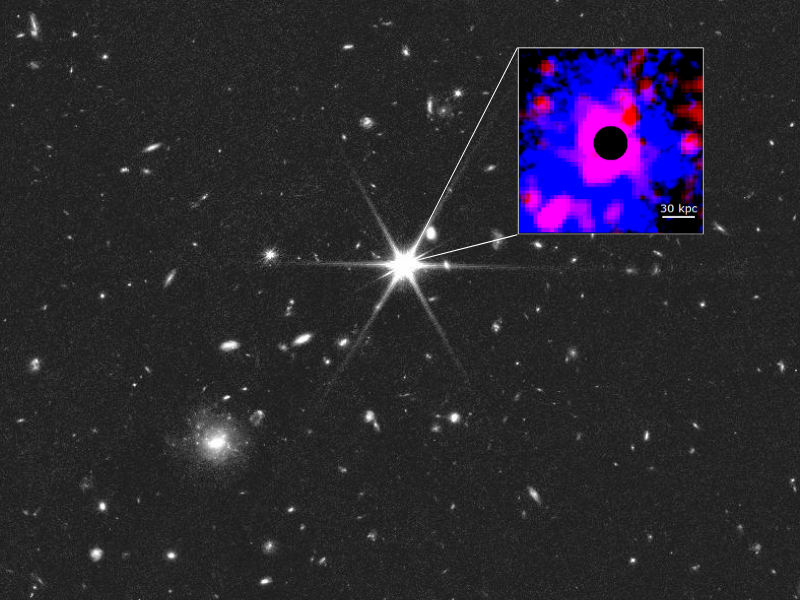
In one paper, researchers report that the ICM is being heated up around a quasar that is not emitting jets, but instead through gravitational shocks. They can tell this because jets would produce a strong radio emission, but this object is radio-quiet. They think that cold gas is falling back towards the center of the clusters, and in the process is being heated to 20 million kelvins.
But this early gas is not just cooler - it's also between 10 and 100 times denser than the ICM in the local universe.
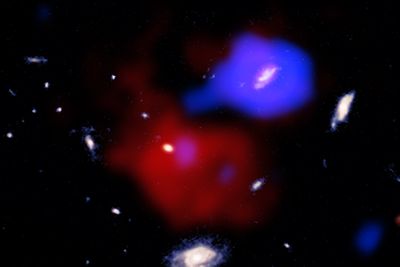
In a second paper, researchers observed cold gas around another galaxy in the cluster that is, cruriously, not falling inward. And the reason for this is a black hole jet just down the road.
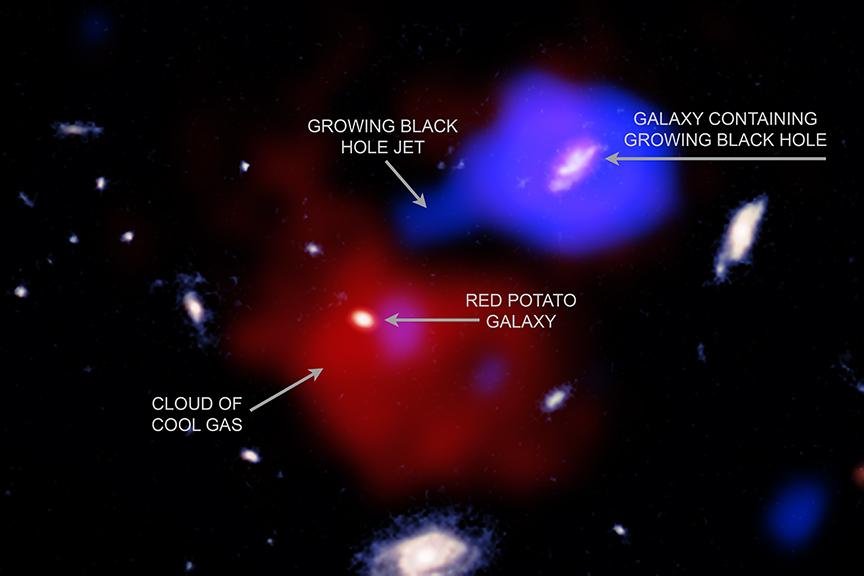
The cold gas is seen around an object nicknamed the red potato. Astronomers would expect that, given the abundance of gas around the potato, it should be something of a star nursery. But it is not forming as many stars as expected.
The solution to this mystery has come from Chandra.
It has shown that a growing black hole in the galaxy next door is blasting a jet of particles at the red potato galaxy. It is suggested that this is causing the cold gas around the red potato to be unusually turbulent, which is, in turn, stopping the gas from falling inwards where it would form new stars.
The observations of this cluster are not only revealing new insights into how the ICM evolves over the age of the universe, but also how galaxies and stars form, and how black holes affect their galaxies and neighbors.
The papers were published in the journal Astronomy & Astrophysics (here and here).


