Space and Physics
 PUBLISHED
 106
106


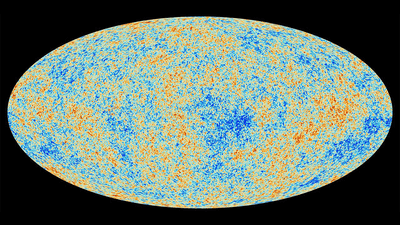


Astronomers looking at the cosmic microwave background (CMB) have found further evidence of "cosmic birefringence", and it may require new physics to explain the phenomenon.
The CMB, according to our best understanding of the universe, is the faint and nearly uniform radiation leftover from the earliest light in the universe. The light was released around 380,000 years after the Big Bang, when the universe had finally cooled enough for protons and electrons to form atoms, allowing light to propagate and the universe to become transparent.
"The CMB is the farthest and oldest light any telescope can detect. It is impossible to see further beyond the time of its release because then the universe was completely 'opaque'," the European Space Agency explains. "The CMB takes astronomers as close as possible to the Big Bang, and is currently one of the most promising ways we have of understanding the birth and evolution of the universe in which we live."
On the plus side, this radiation is faintly detectable and permeates all of the known universe. It appears to fit with our models of the universe, from its beginnings to now, pretty darn well, if not perfectly. But there are a few anomalies which have long been known about within the CMB, to various degrees of confidence, which suggests there are still mysteries to unravel and explain. For example, there's the cosmic dipole anomaly, or the far more dramatically named "axis of evil".
In 2020, scientists reported a new phenomenon termed "cosmic birefringence". Polarization is the process by which the oscillations of a light wave are restricted to a single plane, perpendicular to the direction of propagation. Generally, this polarization remains in the same direction as the light travels across space. But looking at the CMB and comparing it to light scattered by dust much closer to home in the Milky Way, that team found evidence that the CMB has been rotated slightly since it was emitted near the beginnings of the universe.
The rotation is only very slight, with the initial paper placing it at around 0.3 degrees. A September 2025 preprint paper using polarization data from the Atacama Cosmology Telescope places it at 0.215 degrees, but even these slight rotations are unexpected by the standard model, and could hint at new physics.
"The polarized light of the cosmic microwave background is sensitive to new physics that violates parity symmetry," the team explains in that paper. "For example, the interaction of photons with the fields of elusive dark matter and dark energy could cause a uniform rotation of the plane of linear polarization across the sky."
In another new preprint paper, which has not yet been peer reviewed, scientists suggests that the dark matter candidate known as "axions", or axion-like particles, could be the solution.
"Axion-like particles (ALPs), as promising dark matter candidates, possess unique advantages in naturally explaining such phenomena," the team writes in their paper. "Our findings reveal that the superposition of two ALP fields with distinct masses can relax the constraints imposed by the washout effect and reconcile with observations."
Further study will be needed to strengthen the case for cosmic birefringence, and to narrow down how much the CMB has rotated since it was emitted. Then we can begin to figure out what it means for physics and the standard model.
The new study is posted to preprint server arXiv.