Space and Physics
 PUBLISHED
 3
3



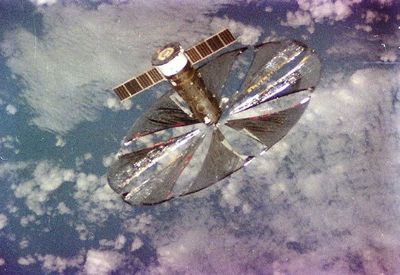


In the early 1990s, Russia hatched a madcap plan to turn night into day using a giant space mirror to beam light down onto planet Earth like a celestial nightlight. As ludicrous as it sounds, it actually worked. Just.
The mirror, called Znamya, meaning "victory banner" in Russian, was the brainchild of Vladimir Syromyatnikov, one of the country's top aeronautical engineers and fondly known as "Big Cheese." He earned his reputation designing the docking system that linked the Apollo-Soyuz test flight in 1975, a historic moment when the US and Soviet Union set aside their Cold War differences and literally shook hands in space.
The idea for a space mirror had been floating around for decades, but it gained serious traction in the 1980s when it was conceived as a solar sail that could harness the radiation pressure of sunlight to thrust a spacecraft through space.
However, the Soviet establishment, and later the burgeoning big businesses of the Russian Federation, were more interested in exploiting the technology to extend daylight hours and boost productivity.
By the early '90s, the USSR had collapsed, but Syromyatnikov's project managed to survive into the newly formed Russian Federation. The first prototype, Znamya 1, never left Earth's surface and stayed in Russia, where it was used for testing.
Znamya's time to shine
Then came Znamya 2, a 20-meter (66-foot) wide circular mirror made of aluminum-coated plastic. Despite its impressive span, the shiny sheath was paper-thin and weighed less than 4 kilograms (9 pounds). Once deployed in Earth's orbit, it could peer over the curvature of the planet and reflect sunbeams down to a place still in darkness.
It was attached to a Progress M-15, an uncrewed spacecraft used to resupply the Mir space station, which blasted off from the Baikonur Cosmodrome in Kazakhstan on 27 October 1992.
On the night of February 4, 1993, it was time to shine. The Progress spacecraft had finished its primary task, so Znamya 2 was released and let its mirror unfurl like a flower coming into bloom.
Remarkably, it worked.
Znamya 2 managed to reflect a 4-kilomtere (2.5-mile) beam of sunlight down to Europe for about 6 minutes before sunrise, Discover Magazine reported at the time. The cosmonauts reported watching a dim disc of light glide across the planet's surface, while a handful of observers on the ground caught a brief flash as the beam passed overhead despite heavy cloud dominating the sky.
Off the back of this small success, the Russians started to dream up bigger ideas, like using a constellation of even larger space mirrors to illuminate construction or forestry sites 24/7 in parts of Siberia that weren't hooked up to the power grid.
Znamya 2.5 was launched in 1999, but it ended in failure after the delicate mirror became snagged on an extending antenna. While there were discussions to launch Znamya 3, the project never got off the ground, and Russia’s dream of pioneering space mirrors slowly faded into obscurity.
New attempts to build a space mirror
Decades later, though, and this ambitious idea born out of a communist empire has now been taken up by capitalist cowboys riding the new wave of space privatization.
Earlier this month, the US Federal Communications Commission (FCC) approved Reflect Orbital's plan to place a reflecting satellite into orbit that will bring sunlight to places on Earth still in the dark. Ultimately, the company hopes to place as many as 50,000 mirror satellites into orbit.
Needless to say, astronomers are not happy with the plan, claiming an army of light-reflecting satellites will severely interfere with their stargazing operations.