


 Space and Physics
 PUBLISHED
 1
1


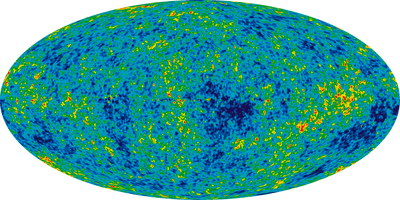


The Big Bang wasn't really a bang. It wasn't a crash, a rumble, or anything you might expect from the birth of everything as we know it. In fact, if you'd somehow surfed through the infant universe after it rapidly expanded into existence 13.8 billion years ago, what you would have heard might have resembled something closer to an avant-garde electronic music sample. You can check it out for yourself in the Soundcloud player below.
Back in 2001, John Cramer, a physicist at the University of Washington, wrote a magazine article attempting to describe the sound of the Big Bang, drawing on data from the cosmic microwave background (CMB) gathered from high-altitude balloon experiments and early satellites.
The CMB is essentially the afterglow of the Big Bang, a prevailing model that attempts to explain how the universe came to be from an extremely hot, dense state. Also known as relic radiation, the CMB is a constant hum of low-energy radiation that permeates the observable universe. It first emerged just 380,000 years after the Big Bang, when the cosmos had finally cooled enough for electrons to become trapped in orbits around nuclei, forming the first atoms.
A couple of years after Cramer’s article was published, he received an unexpected letter. A mother in Pennsylvania wrote to tell him that her 11-year-old son was working on a school project about the Big Bang, and the boy had asked whether the sound of the Big Bang had actually been recorded anywhere.
Cramer replied to the curious letter, explaining that it hadn't been. However, it got him thinking about whether there was a way to reproduce the noise. He went back through the CMB data and tried to find a way to turn it into audio information. Unfortunately, there were no microphones running 13.8 billion years ago, so the original audio information is lost to time. But Cramer found a way to approximate it by extrapolating CMB data on temperature fluctuations in the very early universe.
"The original sound waves were not temperature variations, though, but were real sound waves propagating around the universe," Cramer explained in a 2013 statement.
The audio (above) was originally based on data from NASA's Wilkinson Microwave Anisotropy Probe (WMAP), a spacecraft that operated from 2001 to 2010 and was tasked with mapping temperature differences across the CMB sky. However, it was later updated with data from the European Space Agency's Planck satellite mission.
Cramer produced several versions of the audio, ranging from 20 to 500 seconds. Each clip compresses a massive stretch of time, spanning from 380,000 years to about 760,000 years after the birth of the cosmos.
As the universe expanded and cooled, it stretched the wavelengths of these waves outward, shifting the sound into what Cramer described as "more of a bass instrument." To get the audio into a range that's perceivable to human ears, he had to boost the frequency by a staggering 100 septillion times (that’s 100 followed by 24 more zeros). The sound turns from an otherworldly whirring into a deep buzzing belch, before gradually fading into an incredibly low grumble.
There is — or at least, was — another way to experience the radioactive aftermath of the Big Bang. On old analog TVs, tuning between channels would produce a pattern of flickering "snow" on the screen. Most of that static comes from other forms of interference, but a small fraction is the faint afterglow of the CMB itself.


