


 Space and Physics
 PUBLISHED


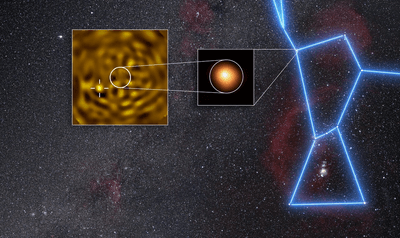


Astronomers have produced an image of Betelgeuse B, also known as Betel-buddy or Siwarha, the companion star suspected of hiding in close orbit around the most famous red supergiant star. The image is blurry enough to make a Bigfoot hunter proud, but the team that took it are confident they have the real thing.
Betelgeuse's brightness and color have always attracted attention. In recent years its notoriety has gone up as astronomers revealed it will become a supernova soon, debated how soon that is, and as the world got to watch it fade dramatically.
The possibility that some of Betelgeuse’s changing brightness, and even color, could be attributed to a companion orbiting too close to the main star to distinguish, was proposed in 1986, but has recently attracted renewed interest.
In 2024, two papers modeled the timing of a suspected orbit, and predicted that our best chance to see Betel-buddy comes around every three years, including the December of that year.
Indeed, one team used the Gemini North Telescope to take an image they claimed showed Betel-buddy, but they also admitted that its clarity did not reach the standard astronomers seek for matters like this.
It’s taken longer to publish, but Dr Miguel Montargès of Observatoire de Paris - PSL claims to have one-upped the Gemini North team using the European Southern Observatory’s Very Large Telescope (VLT) around the same time, helped by a slice of luck.
Montargès and co-authors used techniques designed to find exoplanets to process the images and distinguish the companion from the main star.
.png "Betelgeuse B in the cross-hairs, with a circle marking where Betelgeuse A would be had it not been scrubbed out")
“I jumped from my chair when I saw the processed images,” Montargès said in a statement. “Honestly, I thought we did not have the sensitivity to detect Betelgeuse B as it was predicted. Because it is more massive than predicted, we see it!”
Modeling of Betelgeuse’s cycle produced estimates that Siwarha, as the Gemini North team named the object, from the Arabic for bracelet, had a mass similar to the Sun’s. However, the VLT images are consistent with a star 2.6-3.1 solar masses in size, which has arrived on the main sequence just as Betelgeuse A is leaving it.
The location of Betelgeuse B in the images indicates its orbit is at least eight times as wide as Earth’s. It’s only the system’s epic scale that makes it so hard to see against Betelgeuse A’s glare
“The fact that we can still discover a nearby companion, more massive and brighter than the Sun, around such a well-studied star is remarkable,” said Montargès. “These are among the best moments in science: seeing something new, unexpected.”
“To be certain that the companion is really there, we still need to observe it in one year on the other side of the star, but there is very little space left for doubt,” Montargès added.
“This is the conclusion of a century-long quest.”
Physicists usually consider claims unproven until they reach a confidence level greater than 3σ, or 5σ when the consequences are sufficiently important. The Gemini North observations had a confidence of just 1.5σ, but Montargès and co-authors claim two processing techniques produced confidences of 5.1σ and 6.1σ, respectively.
After the November 2027 opportunity, chances to view the companion will come along a little less than every three years, but they won’t last forever.
Betelgeuse A has puffed up so much that its so-called buddy is suffering friction as it orbits, like a satellite encountering the outer atmosphere. As with such a satellite, that friction causes it to lose energy, and slowly spiral in towards the center of the giant star, becoming harder to see and eventually losing its distinct identity.
That demise will probably come before the estimated 100,000-year timeline for Betelgeuse A to become a supernova; in which case, future astronomers could have a chance to see if such interactions alter the much-anticipated event.
“The question is truly opened whether this companion is going to have an impact on the evolution of the red supergiant,” Montargès said.
Studying the interactions between Betelgeuse’s components could tell us about the most common fate for stars of this size. The authors note that all stars at least eight times as massive as the Sun are thought to be formed as part of multi-star systems, yet by the time they have reached the red supergiant phase 60-80 percent are alone.
Interactions with neighbors may sometimes break the bonds between stars, or an even larger companion will have already gone supernova. However, it is likely the majority of accompanying stars have been consumed by the bloating partner.
The study is published open access in Astronomy and Astrophysics.


