Space and Physics
 PUBLISHED



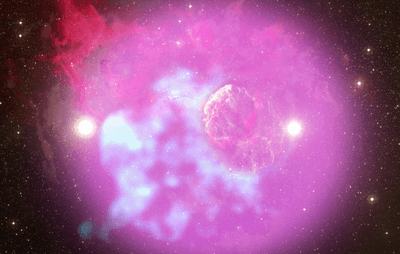


Astronomers have found evidence that two closely associated supernova remnants were probably formed by both stars in a binary system going supernova in quick succession (at least by astronomical standards).
Supernova remnants (SNRs) are among the most visually striking objects in the sky, taking the appearance of multicolored clouds of dust that expand under the force of a stellar explosion.
They are of particular interest to astronomers because they offer precious insights into the processes that seed the universe with heavier elements, which are formed inside stars and strewn across the universe when they explode.
Sadly, these remnants only last around 100,000 years before fading away. As long as that might seem to a human, it means we’ll never find the vast majority of them in a galaxy that is billions of years old.
O- and upper B-type stars, the kinds that are large enough to end their lives as core collapse supernovae, often form together, so we should expect to see plenty of double supernovae caused by multiple stars going boom at once.
Detecting one takes luck, however, since in most cases the first SNR will have faded beyond detectability before the second explosion occurs.
However, it now seems we have our first example. "[The interval between explosions] does seem surprisingly short when compared with the several-million-year lifetimes of massive stars,” Miltiadis Michailidis at Stanford University told IFLScience.
“If the two stars were born with very similar masses, they would naturally exhaust their nuclear fuel and reach the ends of their lives at nearly the same time."
It's possible, said Michelidis, that if the stars were close together before they blew up, they may have exchanged material by "mass transfer," increasing the likelihood of them exploding around the same time.
Indeed, Michailidis added, in some cases supernovae may have occurred so close together in time that “their expanding remnants quickly merge[d], making them appear as a single supernova remnant rather than two distinct objects.”
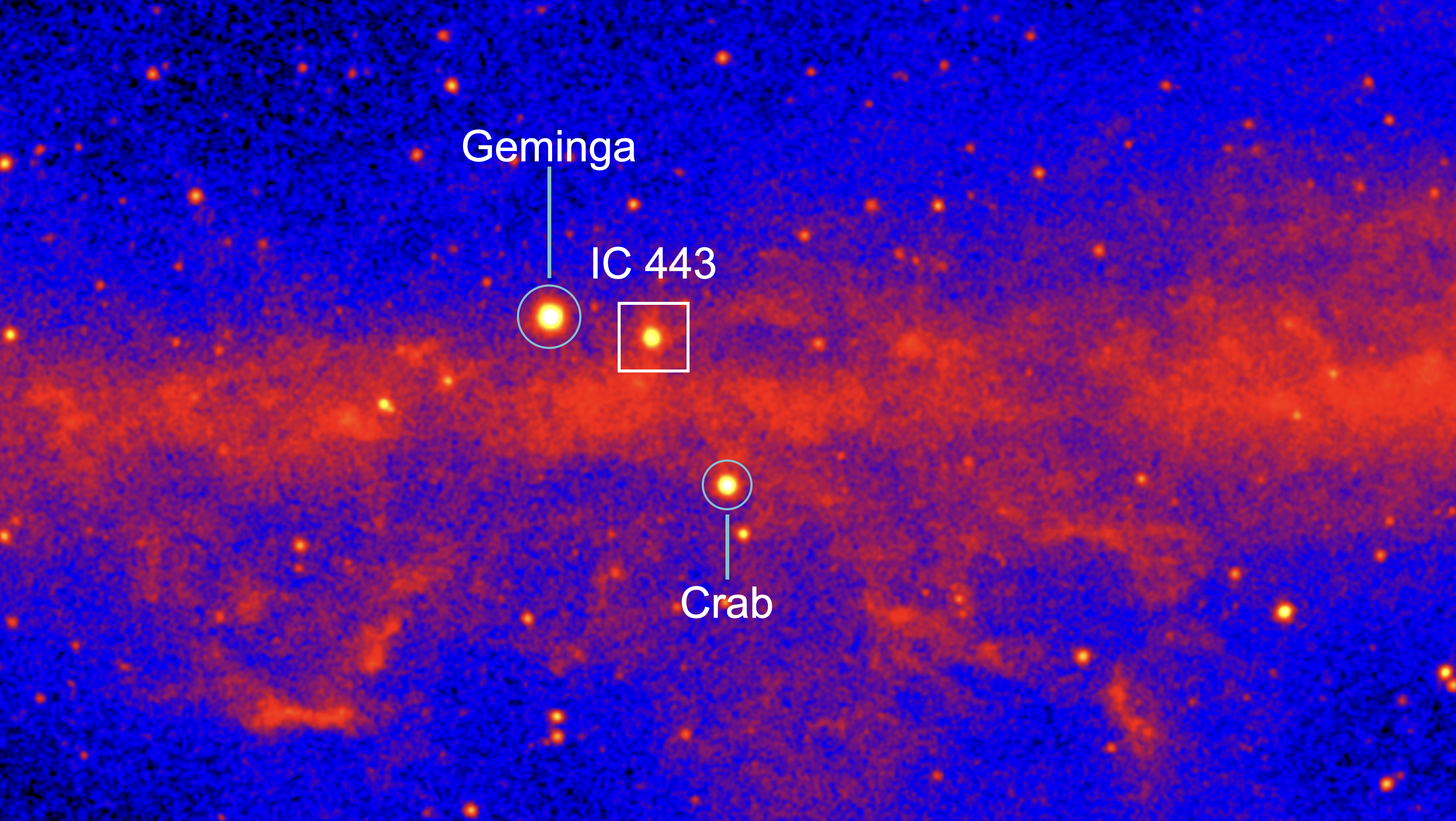
The Jellyfish nebula, officially known as IC 443, is a prime target for research. It is the result of a supernova that occurred perhaps 8,000-9,000 years ago. Thirty-two years ago, another remnant – known as G189.6+3.3 and possibly between 20,000 and 100,000 years older – was spotted right next door to it.
The close association of the two SNRs in the sky isn’t as odd as it would seem to non-astronomers. Most SNRs lie in the galactic plane, because that is where the vast majority of the Milky Way’s supernovae-producing stars form.
Moreover, when discovered, all we knew was that G189.6+3.3 looked near to IC 443 from our perspective. It could have been twice as distant, for all the discoverers knew.
Fortunately, being so close to the Jellyfish means a lot of observations had been made that included G189.6+3.3 before it had been recognized as a distinct SNR.
Michailidis and colleagues used 16 years of data from the Fermi Large Area Telescope and a variety of other instruments at other wavelengths, and these multiple avenues of evidence convinced them that these SNRs are equidistant from us at 5,900 light-years.
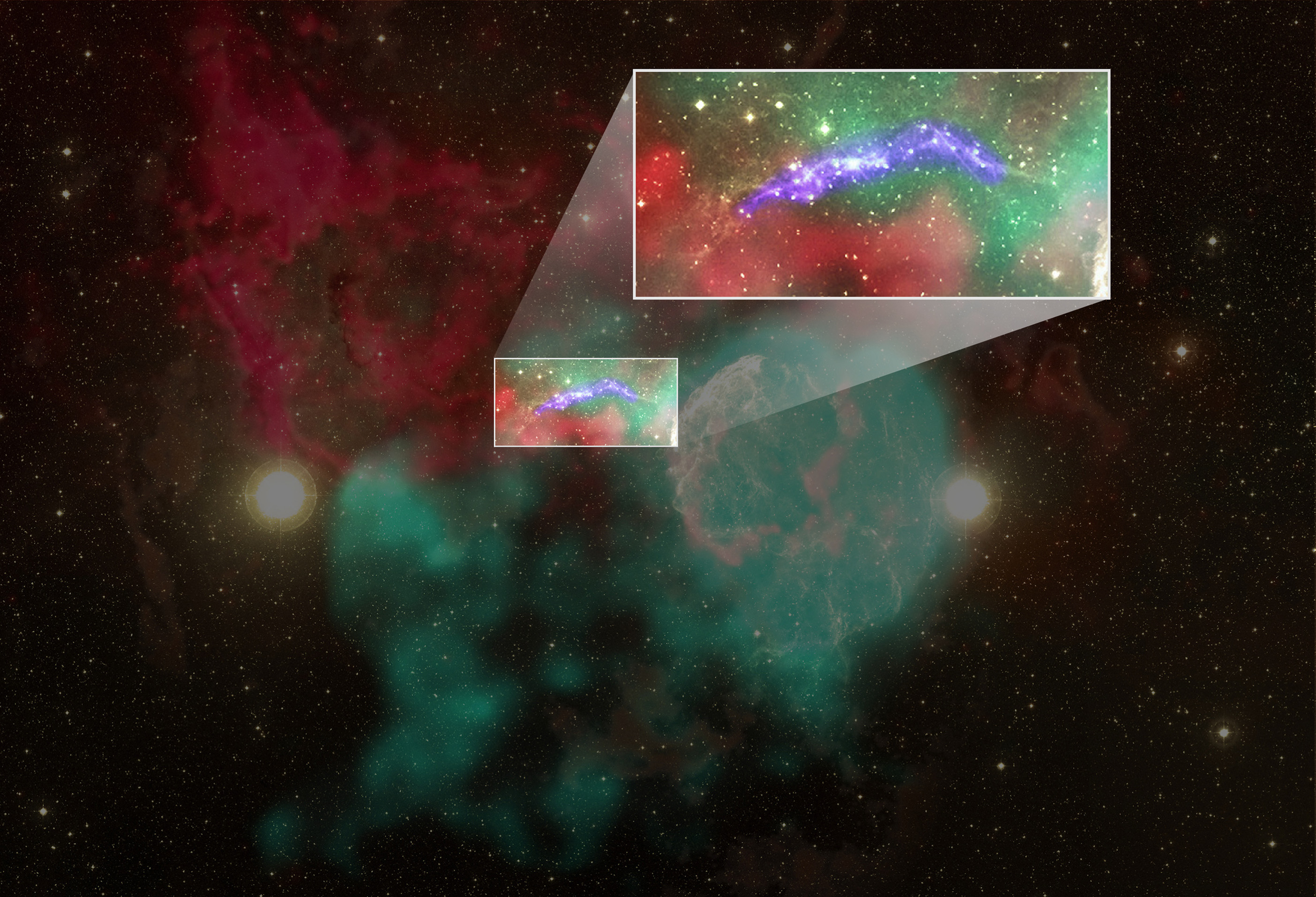
IC 443 contains a known neutron star, CXOU J061705.3+222127, often thought to be the legacy of its explosion.
“No compact object has yet been securely associated with the older supernova remnant,” Michailidis told IFLScience, "although a faint X-ray source has been suggested as a possible candidate without compelling supporting evidence.”
Moreover, said Michailidis, the neutron star isn't in IC 443’s center, creating debate as to whether it’s really the remains of the star.
“Newly formed neutron stars/pulsars receive natal kicks during the explosion and therefore… move through space with velocities that are often hundreds of kilometers per second,” Michailidis said.
Consequently, while recent neutron stars can be matched to more recent SNRs such as the nearby Crab Nebula, with SNRs as old as these, the object that made them might be long gone.
The estimated centers of the two explosions are currently 30-48 light years from each other, which is quite distant. However, we know that when one star in a binary system goes supernova, it gives a powerful shove to the other.
Products of such events become hypervelocity stars, even sometimes getting thrown out of the galaxy. A companion of similar mass to the first exploder wouldn't gain that much speed, but it isn't hard to imagine a push causing it to migrate such a distance in tens of thousands of years.
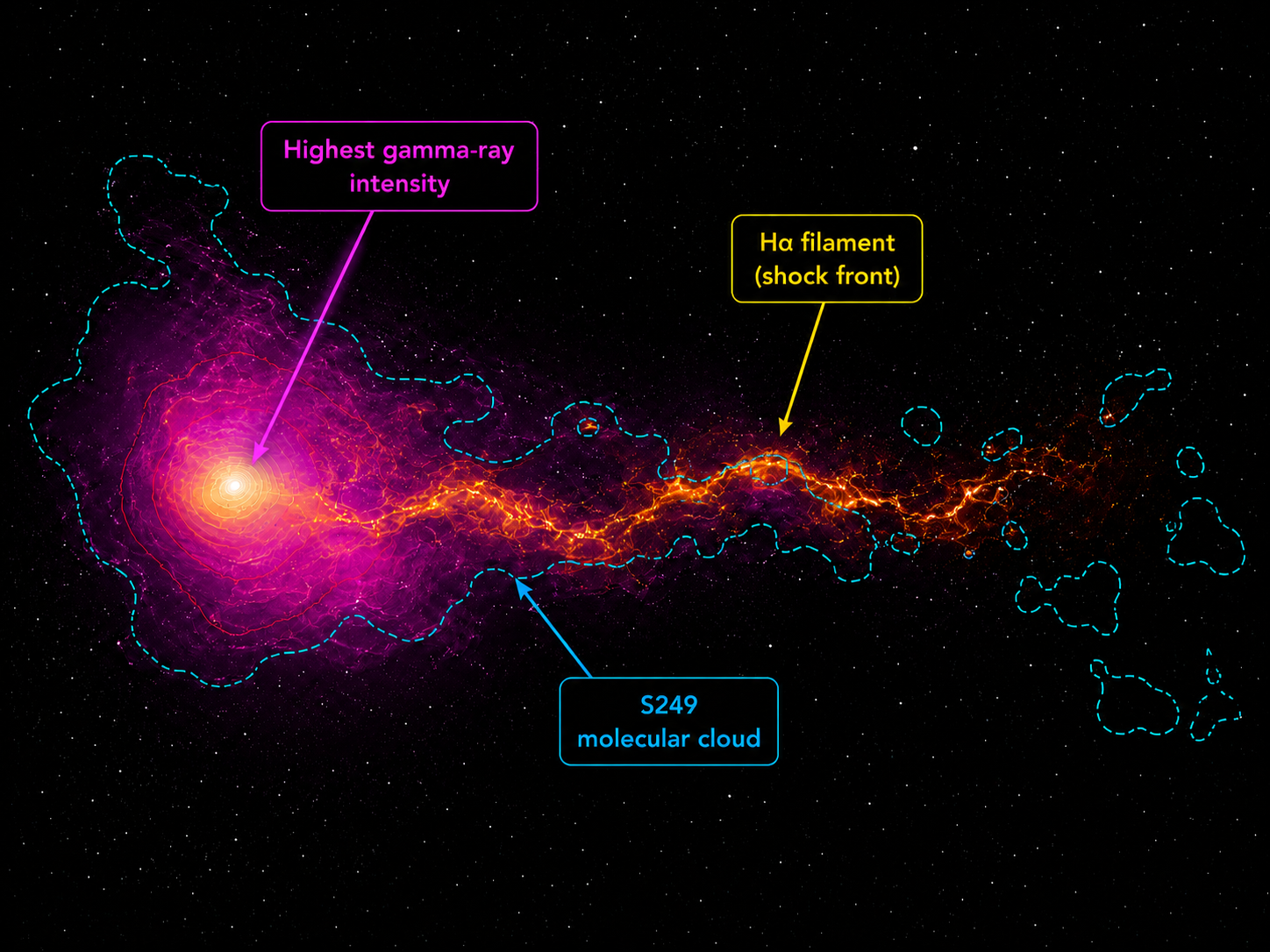
Michailidis said we don’t know how close the two stars were before the explosion, and therefore whether mass transfer contributed to their similar timing.
Nevertheless, he noted: “Massive stars are generally born in close binary systems, with typical separations ranging from a few astronomical units to at most a few thousand AU.”
Stars like this form in clusters with other giant stars nearby and, unless they’re close to start off with, usually get parted by their neighbor’s gravitational interference.
The team hasn't yet attempted to reconstruct the parameters of the pre-explosion system, Michailidis added, but intends to try, given what could be revealed about supernovae’s power.
“Ultimately, they offer a unique opportunity to connect the observable remnants we see today with the evolutionary history of the massive binary system that produced them,“ Michailidis told IFLScience.
“Until now, our understanding of these final evolutionary stages has relied almost entirely on theoretical models and numerical simulations.”
Considering the rate supernovae occur in similar galaxies, it is thought there should be at least 1,000 SNRs bright enough to detect, yet fewer than 400 have been found. “This is often referred to as the ‘missing supernova remnant problem,’ and it was one of the topics of my PhD research,” Michailidis noted.
Given their likely locations, some may have been confused with other types of gas clouds or hidden by interstellar dust. Michailidis hopes new wide-field instruments will identify some more, potentially including more that may have come from binary systems.
The study is open access in Nature Communications.