


 Space and Physics
 PUBLISHED
 1
1



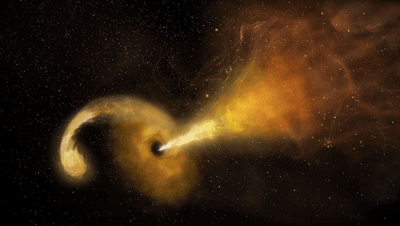


At the center of almost every galaxy, there is a supermassive black hole. These incredibly dense objects are millions - if not billions - of times the mass of our Sun. So does this mean that all the supermassive black holes are to be found at the center of galaxies?
The answer is no, and researchers have the observations to prove it.
Using NASA’s Neil Gehrels Swift Observatory, astronomers discovered a black hole ripping apart a star. This is a rare phenomenon known as a tidal disruption event (TDE). But what’s even more exciting is that this was not happening in the center of a galaxy, as would be expected.
Instead, it was occurring in the outskirts of a galaxy 750 million light-years away. The TDE in question was itself happening more than 30,000 light-years away from the galaxy’s core. That’s farther than the Sun is from our galaxy’s center.
“We were looking for these star-shredding events as a way to find otherwise invisible supermassive black holes wandering away from the galactic cores where they usually reside,” lead author Robert Stein, a research fellow at the University of Maryland, College Park and NASA’s Goddard Space Flight Center, said in a statement.
“With this discovery, which is one of just a couple that have been confirmed so far, we’ve validated a new technique and can use it to hunt for more.”
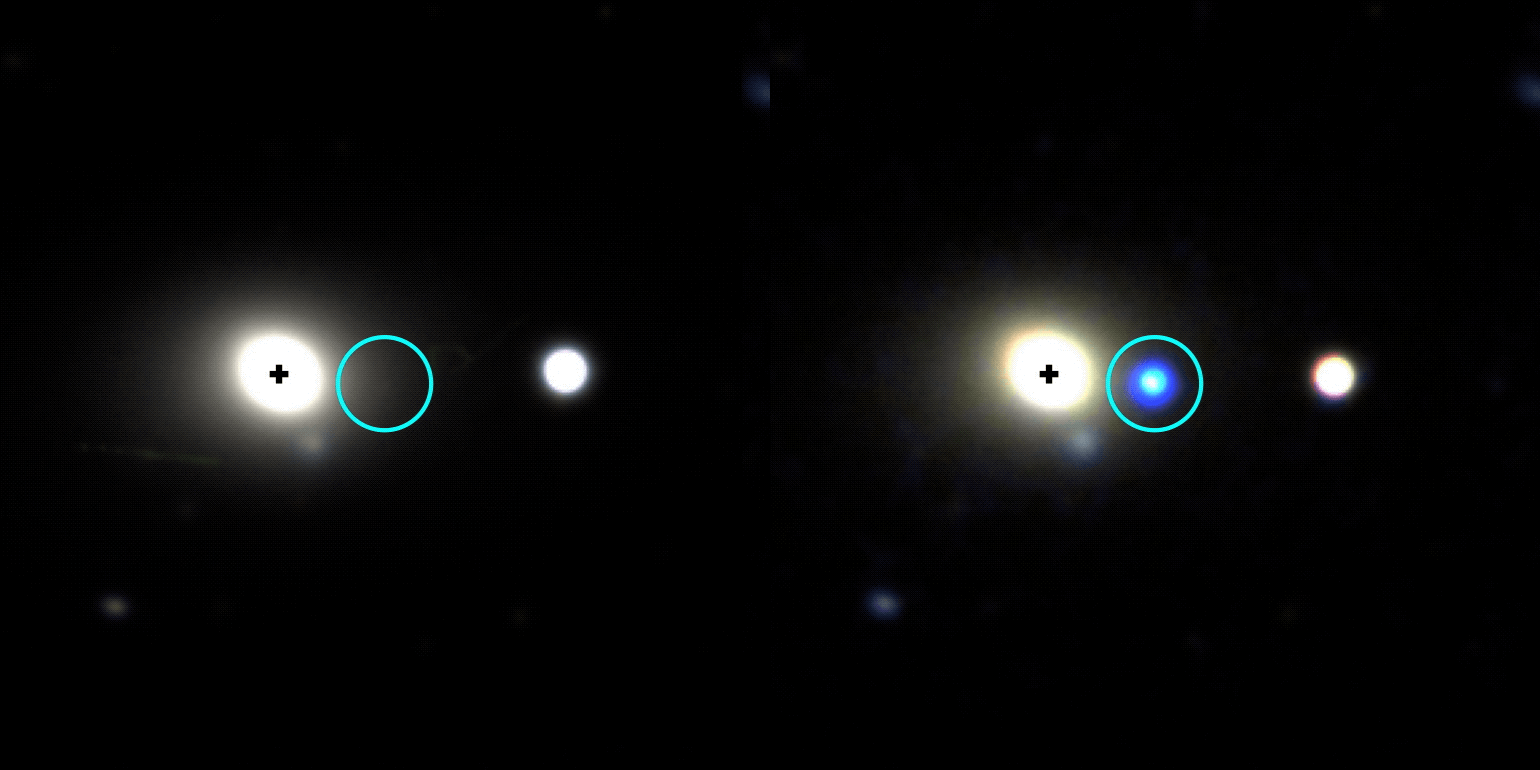
The galaxy in question also has a central supermassive black hole of roughly 660 million times the mass of the Sun. The second, wandering one observed on the outskirts of the galaxy, however, is much lighter, estimated to be "only" around 1.23 million Suns.
The wanderer is much smaller than the central black hole, but it is still pretty massive. Sagittarius A*, which sits at the center of our galaxy, is by comparison 4.6 million times the mass of the Sun.
The event was first noticed by the Zwicky Transient Facility, a survey conducted by the Palomar Observatory in Southern California designed to spot weird flashes of light from the universe. After spotting one such flash, it was followed up by the Southern Astrophysical Research in Chile and Swift in space.
The observations suggest that the TDE outshone its entire host galaxy in ultraviolet light. It was equivalent to 10 billion suns shining together.
A crucial question is where this second wandering black hole came from. One possibility is that there was a three-way galaxy merger, and the lightest supermassive black hole among the three was sent flying. The other possibility is that the merger (two-way is sufficient) is ongoing and the black hole had a snack on its way to the core where it'll meet the even bigger black hole already there.
“It must have originated in a galaxy’s center, but not the one it’s in the outskirts of now,” Stein said. “We think the host galaxy’s supermassive black hole is still at its core, but the one eating the star could have started off in a small galaxy that merged with the big one we see today.”
“Further discoveries could reveal the origin of this apparent ‘orphan’ black hole,” Stein said. “The key science question we want to answer is: How common are wandering black holes?”
The work validates how TDEs can be used to reveal the presence of wandering massive black holes, like what was seen by Hubble in 2025. Models suggest that these off-center supermassive black holes might actually be very common.
A paper describing these results was published in The Astrophysical Journal Letters.


