Space and Physics
 PUBLISHED


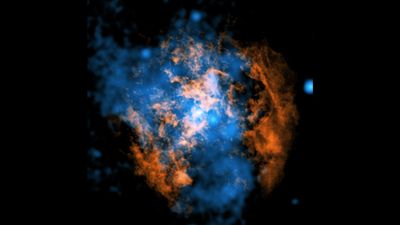


Supermassive black holes release winds. When they are active, those winds are powerful enough to shut down star formation and extend for millions of light-years. When they are quiet, more tenuous winds should be present. It seems that Sagittarius A*, the supermassive black hole at the center of our galaxy, was pretending to be the exception to this rule.
For more than 50 years, astronomers looked for this release of material without finding any evidence of it. Yet, they did not give up. Evidence of ancient releases can be seen above and below the plane of the Milky Way, the so-called Fermi Bubbles; the wind had to be there.
“Unless a black hole exists in a perfect vacuum, it must blow a wind somehow,” Northwestern University’s Mark Gorski, who co-led the study, said in a statement. “And there is no perfect vacuum in the universe. With new observations, this is the first time we’ve had a clean enough view to see the wind’s imprint. We looked at the data and said, ‘There it is. There is the thing that everybody’s been looking for 50 years.’”
Gorski and his co-lead author Elena Murchikova used five years' worth of observations from the Atacama Large Millimeter/Submillimeter Array (ALMA). The radio observations were then further improved by the duo thanks to a new calibration method. That served to remove the radio emission from the black hole itself.
The final map of the material is 100 times deeper and 80 times sharper than previous observations surrounding Sagittarius A*. They finally found a cone-shaped cavity about three light-years across that had been swept out of cold gas. The supermassive black hole’s wind did that, as the cold gas travels towards it.
“We were the first to show that molecular gas very, very close to the black hole is feeding it,” Murchikova explained. “The wind is not powerful, and its direction probably wanders with time. It shows that our black hole is not unique, and our place in the universe is not unique.”
The challenges in finding this signal come from our relative position with respect to the supermassive black hole. Between us and Sagittarius A* there is the whole plane of the Milky Way, with gas and dust in the way. That’s 26,000 light-years' worth of stuff, and this wind is being spotted in the few light-years that surround the black hole.
“To observe our own black hole, we have to look through the plane of our galaxy,” Murchikova said. “That means we have to peer through gas, dust and ionized structures, and you can’t really see through all of that easily.”
To confirm the observations, the team compared their work with the X-ray emission detected by NASA’s Chandra telescope. The two matched perfectly.
“Exceptional claims require exceptional evidence,” Gorski said. “We wanted to make sure that we weren’t just looking at some sort of imaging artifact. Then, the X-ray image from Chandra just slotted in perfectly. The molecular features lined up.”
“When you find something that no one has seen before, the first thought that runs through your mind is not ‘Oh my god, we made a discovery,’” Murchikova said. “It’s ‘Oh my god, what’s wrong with my analysis?’ But when we overlaid our image with the X-ray image, it started to make sense.”
The wind that caused the cone expanding from Sagittarius A* must have been active for at least 20,000 years. The team was also able to confirm something that was already believed: Sagittarius A* is quiet compared to other supermassive black holes.
The study is published in The Astrophysical Journal Letters.