Space and Physics
 PUBLISHED
 1
1




It’s a big universe out there, and scientists get to touch very little of it, so most of what we know comes from light and the rest of the electromagnetic spectrum. The wavelengths of what we can collect from distant objects tell us more than anyone imagined a century or more ago, but it’s very handy that the light we detect can also carry information in other ways, particularly through polarization.
For example, last year we reported “Interstellar comet 3I/ATLAS shows ‘extreme negative polarization’” and three years ago that polarization revealed the shape of a new type of exploding star. Sometimes polarization of light crops up in other research as well, for example such as how bats navigate, but astronomers use it the most.
So, what is polarization of light and other electromagnetic radiation, and why is it useful?
Linear polarization
Quantum theory tells us that light has properties of both a particle and a wave. The wave-like nature of light is much more like a transverse wave – like a vibrating string or a wave on the ocean, than a pressure wave (sound). That means that it rises and falls at right angles to the direction in which it is traveling.
For a water wave, oscillation can only occur up and down, but a wave moving along a string has far more options. If you get a friend to hole one end of a piece of rope and you hold the other, you can create wiggles in the rope by shaking your end up and down, side to side, or at some angle in between. In this context, light is much more like the string than water.
Any specific photon of light can be thought of as vibrating up and down as it approaches the instruments with which we will capture it, or side to side, or some other angle. A more scientific explanation is that each photon has an electric and magnetic field, which must always be at right angles to each other, as well as to the direction of travel. The electric field might be in a vertical direction and the magnetic horizontal, or vice versa.
Most of the light in the universe starts off with unpolarized or incoherent photons, meaning they have a random jumble of directions. If you pointed a measuring device at the Sun that collected just one photon at a time, and measured the direction of each one’s electric field, these would arrive every which way. You couldn’t tell from the orientation of one how the next one would look.
When light is fully polarized, however, all the photons vibrate the same way, that is the electric and magnetic fields of one photon will be in the same direction as the next.
Nature seldom deals in absolutes, so it’s rare for naturally polarized light to have 100 percent conformity among the photons. Weak polarization sees a detectable trend for more photons to line up one way, but only slightly more than a random distribution.
That’s common in light reflected by comets, for example, but 3I/ATLAS showed greater polarization than usual, with a higher proportion of photons aligned in the same direction, generating excitement among those who like jumping to conclusions.
Circular polarization
It’s easy, at least for those who aren’t aphantasic, to create a mental image of linearly polarized light. Circular polarization is more challenging.
Circular polarization occurs when the electrical and magnetic fields rotate in a circle rather than maintaining a stable orientation. Consequently, while photons arriving close together in time will be likely to have the same field direction, the will cycle.
The rotation can be either clockwise or anticlockwise, sometimes referred to as right and left-handed polarization.
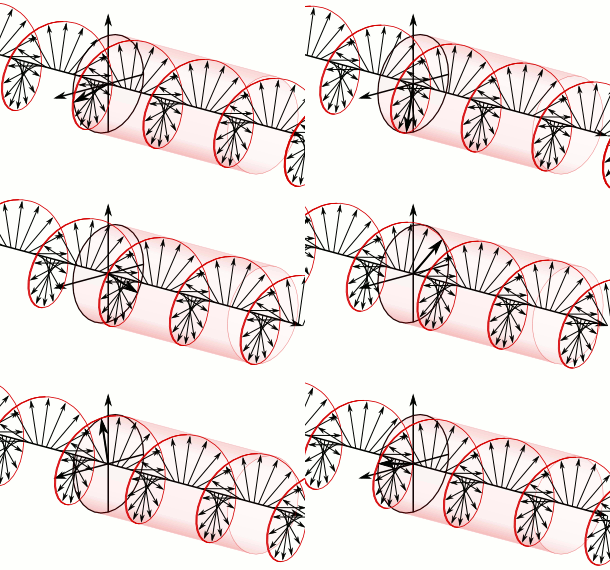
Putting all this together, light is said to be polarized six ways: four linear polarizations, defined by an electric field pointing up, down, left, or right; and clockwise and anticlockwise circular polarizations.
Some animals have the capacity to detect polarized light, and some species of mantis shrimps can distinguish circularly polarized light from linear polarization. Bloody show-offs.
How does polarization reveal the universe?
In the laboratory, polarized light is produced by shining incoherent light on a filter that only lets photons through when their magnetic field has a certain range of orientations. This can then be used for to identify minerals and measure the stress of engineering materials.
Some animals also use polarization to communicate. For example, light becomes at least weakly polarized when it is reflected off their scales, something only a limited pool of others – often potential mates or rivals of their own species – will notice.
Light from astronomical objects can be polarized, either by something to do with the source, or by a natural filter between that source and us. Consequently, detecting polarization, and measuring its strength, can alert astronomers to something they’d be unlikely to find in other ways.
For example, when light travels through an area rich in dust, some of it will be blocked (more at visible wavelengths than infrared, which is one of the great advantages of the JWST). If the dust lies in a magnetic field, it becomes orientated in that field’s direction, which will cause it to block some photons more than others, leaving the light that gets through polarized.
We know that the galaxy has a magnetic field, and can map it, by measuring how polarized light becomes depending on the parts of the galaxy it passes through to reach us. We can also measure the distance to some sources of light, which would otherwise be challenging, but quantifying how polarized the light has become. The farther the source, at least within the galaxy, the more magnetized dust it will have had to pass, and therefore the greater the polarization.
Some stars and particularly magnetars have powerful magnetic fields, which polarize radiation before it reaches interstellar space. If the field is rotating, the result radiation is circularly polarized.
Pulsars, for example, release highly polarized light. The strong polarization found in all long-period radio transients alerted astronomers to the fact that whatever the source of these mysterious signals, it must come with plenty of magnetism.
Without being there to wave a compass around, polarization of light, radio waves, or other parts of the spectrum can be the only way we know a magnetic field exists deep in space.
Sometimes, the polarization can offer even more detailed information. For example, although pulsar signals repeat frequently, the signal is never quite identical, contrary to the common analogy of them being like the sweeping beam of a lighthouse. We see variations not only in strength, but in polarization, between one peak and another.
The changes in this polarization could tell us a lot about what is going on with the source, although in some cases this still represents a mystery we have yet to decipher.