Space and Physics
 PUBLISHED


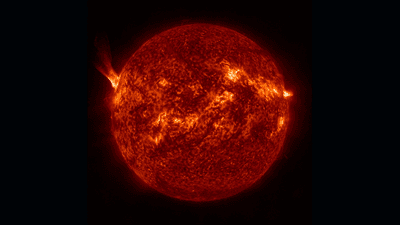


If it’s sunny, pop outside and get some sunshine on your skin (not for too long and use SPF). That light reaching you is old. Some might as be as old as the pyramids; some might have been produced while Neanderthals still shared the Earth with us. And some of it might be much older than our species. How is that possible?
Light moves as fast as anything can go in the universe, but only in vacuum. When inside the Sun, the path is a lot more tortuous, adding millennia to a distance that would take light seconds to cover normally. The radius of the Sun is 695,700 kilometers (432,450 miles), so a photon – a particle of light – could cover that distance in just over two seconds. But the Sun is definitely not empty space.
The Sun is made of hydrogen plasma, the so-called fourth state of matter, so the protons and electrons that make the hydrogen are not organized in the standard atom form. Plasma is a fluid of charged particles – think of it as protons in a sea of electrons or vice versa. Photons are constantly being absorbed and emitted by these particles in what looks like a pinball path, bouncing around before finally escaping the Sun’s surface.
This is known as a random walk, and how long it takes very much depends on how tightly packed things are. This provides a value known as the mean free path. That value is the average distance a photon will be able to move before getting absorbed and then re-emitted in a different direction.
For the Sun, the mean free path is usually given to be about 1 centimeter. That means that if a photon were doing those steps in an impossible straight line, it would take about 70 billion steps. The actual distance that the photon would cover is the square of that value, so 4.9 billion trillion centimeters – which is about 20 percent of the distance between the Earth and the center of our galaxy. To cover that, light would take over 5,000 years.
Now, more recent estimates suggest that the mean free path for a photon at the core of the galaxy might be less than one millimeter, over 10 times smaller than previous estimate. Since the actual distance is a square, this means 100 times more steps, which in this case pushes the time it takes to travel from the Sun’s core to the outside to over half a million years. Sophisticated simulations find a more middle-ground number of 170,000 years.
The actual age of each individual photon can’t be estimated, but it will be somewhere between these two values, tens to hundreds of years old. Once it is out of the solar surface, it is then just a quick trip of eight minutes and 20 seconds before it hit your skin. A long time coming for such a lovely warmth.