


 Space and Physics
 PUBLISHED


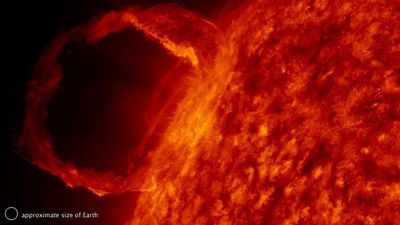


The Sun might be our closest and best-studied star, and yet it is still full of mysteries. One of them looks to have been finally solved. It has to do with the solar prominences, large plasma structures that are seen floating around the solar disk. Some of them remain stable for weeks, if not months, and how that was possible was a mystery.
The crucial unknown was how the prominences were resupplied of cool plasma from the solar surface. These structures, which can span thousands of kilometers, are located in the solar corona, the atmosphere of the Sun. The corona is millions of degrees, while the prominences are a mere 10,000 °C (about 18,000 °F). The prominences are also a lot denser, a hundred times more, than the surrounding corona.
Researchers have compared them to having a giant mountain floating in mid-air. We can see them as Magritte’s surrealist The Battle of the Argonne made of plasma. So what does the supply chain to maintain these floating plasma mountains look like? It needs strong magnetic fields!
“In the Sun’s atmosphere, the magnetic field is the driving force. It also plays a decisive role in all processes that contribute to the formation and maintenance of the prominences,” first author Lisa-Marie Zeßner-Ondratschek, from the Max Planck Institute for Solar System Research, said in a statement.
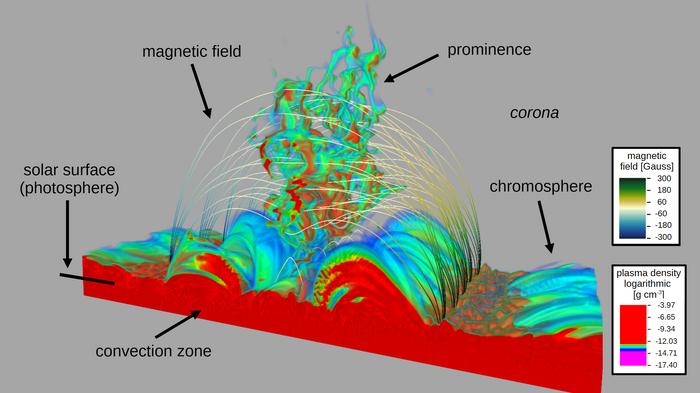
Calculations set to explain the formation of the smaller prominences show that the magnetic field forms two humps close to the surface of the Sun. Thousands of kilometers above the valley between these two humps, the prominence takes shape. Some of the prominence's plasma, being cooler than the surrounding, will rain down, but two processes compensate. Material is ejected by the chromosphere, the region above the solar surface, and some material from the corona can move along the magnetic field and cool down into a prominence.
“Our calculations show, more realistically than ever before, how both processes interact to supply the prominences with material and thus keep them alive,” explained Zeßner-Ondratschek.
The long-term survival of prominences is particularly important when we consider space weather, the way material ejected from the Sun affects our planet. The longer-lasting prominences might truly go out with a bang: sending plasma rushing out across the solar system.
“To protect Earth’s infrastructure in time, reliable forecasts of dangerous space weather are needed. A deeper understanding of prominences is a crucial piece of the puzzle,” added Sami K. Solanki, Director of the “Sun and Heliosphere” Department at MPS and co-author of the new publication.
A paper describing the findings was published in Nature Astronomy.


