


 Space and Physics
 PUBLISHED





What you'll discover in this article
- Astronomers using JWST took the first detailed chemical analysis of Neptune’s inner moons and rings.
- They found something odd, suggesting they are the remains of destroyed moons.
- Researchers were surprised by the lack of ice. Where did it go?
Triton is the largest moon of Neptune and the seventh largest in the solar system. It's also the only large moon that travels in retrograde, moving backwards compared with its planet’s rotation. New evidence suggests a possible explanation: Triton wasn't born there; it was captured – and havoc ensued.
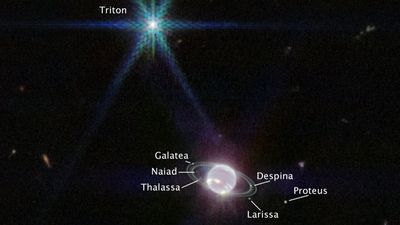
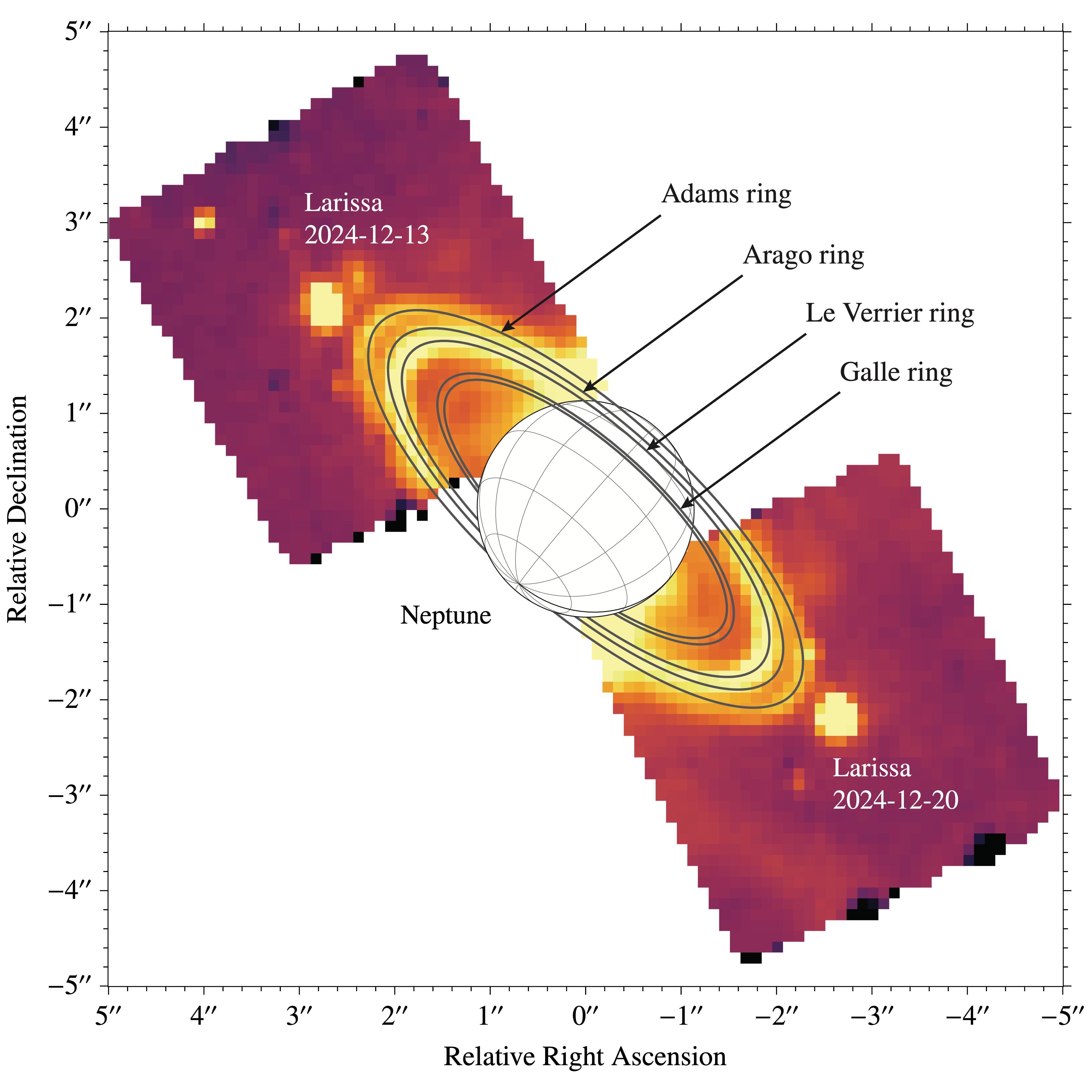
Astronomers have today released a paper reporting observations of Neptune and its moons using JWST. With the space telescope's spectroscopic capabilities, they were able to analyze the rainbow of infrared light from Neptune’s inner rings and three moons: Proteus, Larissa, and Galatea.
In those rainbows, which are called spectra, the scientists found the chemical signatures of interesting minerals, ones they didn't expect to find on the surface of the moons or in the rings.
“Using JWST, we obtained the first detailed spectra of Neptune's small inner moons and rings and found something we weren't expecting: clay minerals on their surfaces," Dr Ryleigh Davis at UC San Diego told IFLScience.
"Specifically, magnesium-rich phyllosilicates, which are the same minerals found in the most aqueously altered carbonaceous meteorites and on the dwarf planet Ceres.”
It wasn't necessarily Triton physically hitting them, but rather the gravitational chaos its presence introduced
Ryleigh Davis
Those clays are unusual in the outer solar system, and the moons are far too small and cold to have possessed that chemistry. One explanation is that the clays could have formed deep within a whole different moon or moons, which were then destroyed.
“Finding this material on Neptune's inner moons points to a catastrophic event in Neptune's past that destroyed those ancient worlds and exposed their deep interiors, with the small moons and rings we see today reaccreting from that wreckage,” Davis told IFLScience.
The potential culprit for this destruction was the capture of Triton, which, to borrow a phrase, came in like a wrecking ball.
“After capture, [Triton] would have been on a highly elliptical orbit, and the gravitational perturbations from that orbit would have destabilized whatever regular satellites existed at the time, either flinging them from the system or driving them into crossing trajectories and ultimately into collisions with each other,” Davis told IFLScience.
“It wasn't necessarily Triton physically hitting them, but rather the gravitational chaos its presence introduced.”
Little remains of the original system of moons, said Davis. If we assume the mass of all of Neptune’s original moons was similar to Uranus’ large moons today, only 1 percent of that material stayed in the system. The rest was lost.
The observations also provide fresh mysteries.
“Surprisingly, despite deriving from large icy worlds, we find essentially no evidence of water ice on any of the moons or rings. One of the biggest open questions our result raises is where all of that water ice went. We think most of it was lost during the catastrophic collisional processing that followed Triton's capture, but the details of how that happened are still not well understood,” Davis said.
A paper describing the findings was published in the journal Science Advances.


