Space and Physics
 PUBLISHED





When June 3rd, 1869, dawned in Tahiti, James Cook, Charles Green, and Daniel Solander breathed a sigh of relief. Having already survived a perilous voyage halfway round the world and found a small island in the world’s largest ocean that Europeans had only learned about two years before, the last obstacles on their quest – clouds – were absent. Surely now there was nothing to stop them from becoming part of one of the most important scientific observations of the era?
Alas, as you might expect, something did indeed stop them. When the trio attempted to carry out their task, which was to observe the times at which Venus began and completed its transit of the Sun, they were hindered by what Cook referred to as a “dusky shade." This led each of them to produce estimates that differed so much from the others that none could be relied upon.
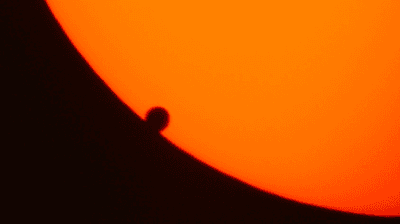
Although we cannot be absolutely sure of what hindered their measurements, it is considered likely that it was something now known as the black drop effect. Astronomers scattered around the world suffered the same problems, delaying efforts to use the transit of Venus to accurately establish the size of the solar system.
On the other hand, it’s plausible that this effect contributed to Cook’s subsequent detailed mapping of the Australian East Coast, which in turn led to the establishment of an English colony there 18 years later.
So what was the black drop effect that hindered their efforts? Why were these observations considered important enough to send a crew so far, at great expense by the standards of the day, and in the face of terrible danger? And why have some speculated it changed the course of history?
The importance of transits
By the early 18th century, everyone with a basic knowledge of science knew Earth was almost spherical and orbited the Sun, just like the other planets. What they didn't know, however, was the distance to those other planets, or the Sun.
This wasn't purely a matter of curiosity. The biggest challenge for sailors, particularly in unmapped territory, had become working out their position east to west, or their longitude.
While astronomers had come up with a method to calculate longitude, at least under clear skies, it required precise knowledge of the distances to the Sun and planets.
Isaac Newton thought he'd found a way to measure the distance to the Sun, but he got it wrong, leading to a mocking segment in Jonathan Swift's Gulliver’s Travels, a cruel humiliation for such a scientific giant.
In 1716, Edmund Halley realized the question could theoretically be answered when the inner planets transited across the face of the Sun. The timing of when the planets started and finished crossing the Sun’s disk would be different depending on where the observer was.
If the times were measured precisely and compared, factoring in the distance between the measuring sites, you could calculate the distance to the planet in question.
Although Halley’s method could be used on either inner planet, the precision required for measuring Mercury's transit was beyond the capabilities of the day, as Halley himself knew from his own visit to St. Helena in 1677.
Venus, being much closer as it crosses in front of the Sun, was an easier target, making the transits of Venus in 1761 and 1769 the opportunity of the century.
Cook’s mission
The 1761 measurements were inconclusive, partly because of bad weather at many astronomers’ locations, combined with some misadventures of those who made the effort.
Almost half the planet faced away from the Sun during the 1769 event, but hopes were high for combining measurements from places that would see it; the further apart the better.
Western Europe lay at one end of the area where the event could be measured, and Tahiti was the best-suited place on the other end, at least among the lands known to Europeans at the time.
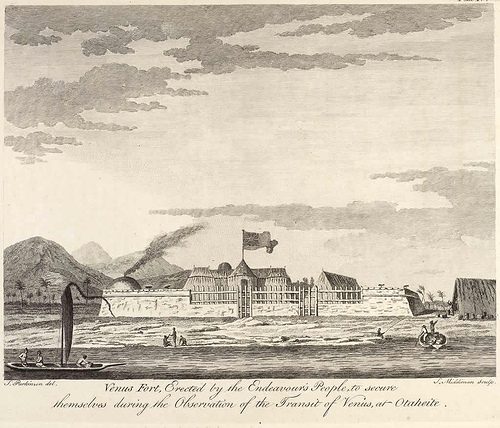
Cook was charged with leading the mission because, unlike most naval officers, he was trained in cartography and mathematics. Between himself, astronomer Green, and naturalist Solander, the observations were considered to be in skilled hands.
Each of the trio was to make four measurements: the time when Venus’s leading edge first appeared to block part of the Sun, the time when the whole of the planet could first be seen in silhouette, the moment when the planet’s edge reached the other side of the Sun, and when Venus was no longer visible at all.
Yet when the four compared their results, they differed by so much that none could be considered reliable, particularly for the second and third measurements.
The black drop effect
Instead of a perfect circle, Venus’s silhouette looks slightly blurry, making it difficult to be sure exactly where it ends, so getting the timing right was difficult.
Worse still, when Venus sits just inside the edge of the Sun, the shape of its silhouette appears to bend the wrong way at the border, as if a teardrop-shaped patch of darkness joins the two edges. The additional dark area makes it look like the planet is a bubble, blebbing off the darkness that surrounds the Sun, and it prevents observers from recording precisely when Venus ceases to be in contact with one limb of the Sun and comes into contact with the other.
Given how thick a layer of carbon dioxide we now know surrounds Venus, it’s easy to attribute the effect to Venus’s atmosphere, and indeed this was the favored explanation for a long time. Even before we knew anything about the Venusian climate, Cook referred to “An Atmosphere or dusky shade round the body of the Planet.”
However, Mercury has effectively no atmosphere, and yet something of a black drop effect is seen during its transits as well, leading some to suggest it might be Earth’s atmosphere that's responsible.
During Mercury’s transits in 1999 and 2003, though, even observations from space revealed a black drop effect, despite being unimpeded by Earth’s atmosphere.
Astronomers attributed this to distortions created by optical instruments and the fact that what we see as the edge of the Sun looks darker than the rest of its surface (known as limb darkening). This is still the leading explanation.
These effects would be equally in play with Venus, and the instruments available to Cook were naturally of lower standard than those used by professionals today, creating the uncertainty he and his team experienced. If Venus’s atmosphere matters at all, it’s a secondary effect.
Photography has allowed us to freeze the black drop effect, seeing it without the pressure of time. However, other improvements in optical technology have led to observers of the 2004 and 2012 transits seeing a less pronounced effect than their 18th- and 19th-century counterparts reported.
The rest of the voyage
Cook’s instructions were to sail south from Tahiti in search of Terra Australis. Aristotle had believed that there must be an approximate balance in landmasses in the northern and southern hemispheres.
Those who took Aristotle’s every pronouncement on trust added an entirely fanciful continent in the far south to maps. The idea took hold over centuries, leading to a widespread belief that much of what we now know is the South Pacific was a continent.
It was thought that New Zealand, visited by Abel Tasman 127 years before, was probably part of this mythical continent, and Australia, then known as New Holland, might also be connected to it.
Cook was able to prove that if such a continent existed, it did not reach north of 40 degrees latitude south, and that New Zealand was two islands, not attached to any larger landmass.
At this point, the mission could easily be considered a mixed success at best. Observers elsewhere in the world produced results at least as bad, but Cook couldn’t have known that yet. To a man famous for his perfectionism, the failure to match with his colleagues rendered them of little value. Proving the absence of a continent and mapping New Zealand were achievements, but ones that might not justify the cost of the voyage.
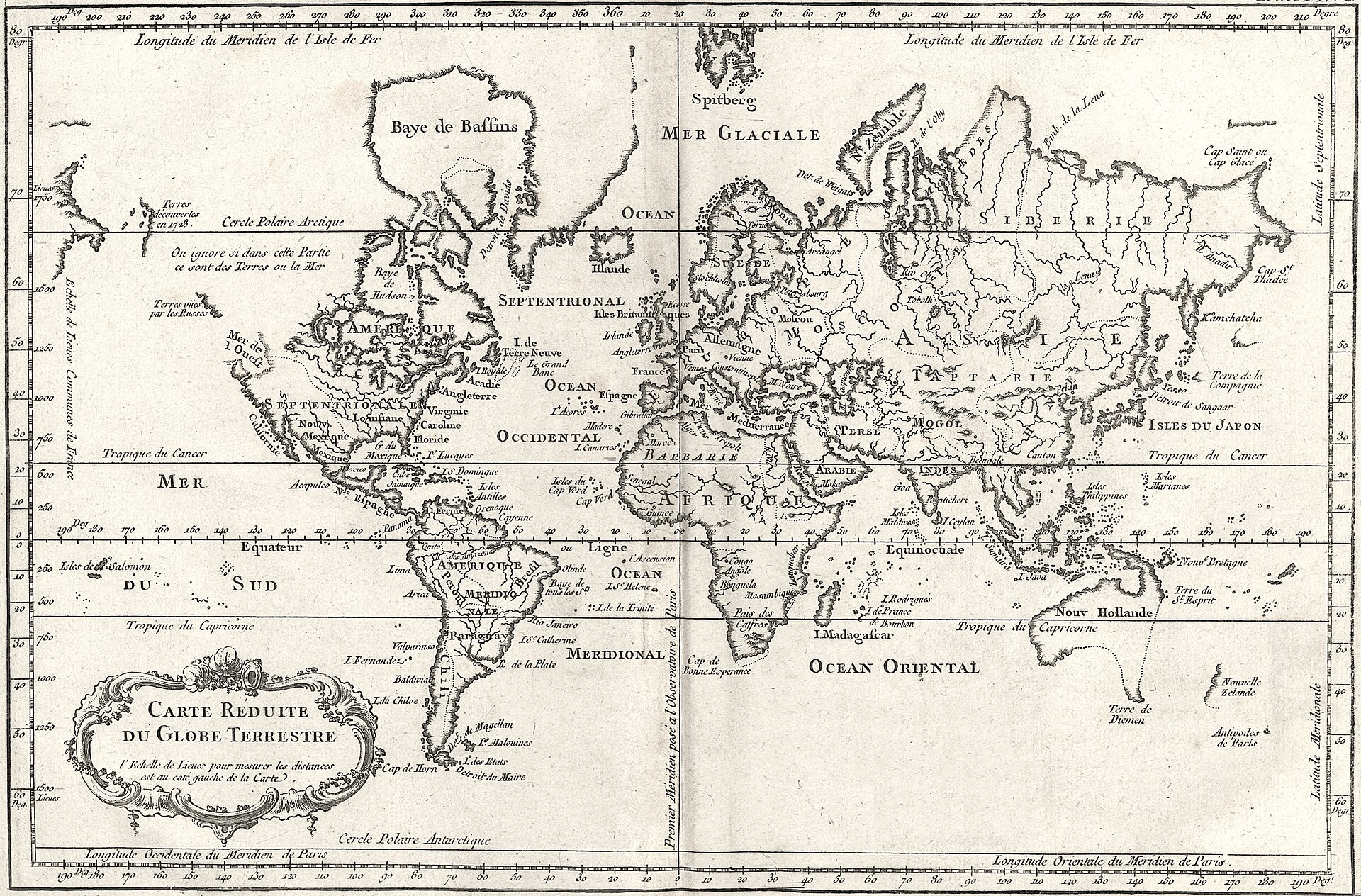
It is in that context that Cook decided to survey the east coast of New Holland, a land whose northern and western coasts had been mapped by Europeans long before.
This wasn't part of his instructions, although it wasn’t prohibited either. We’ll never know whether, had the black drop effect not interfered with his measurements, Cook would have opted for a swifter return in triumph, but it’s certainly plausible. Mapping land he knew existed may well have struck him as the only way to redeem his mission and perhaps himself.
Australia’s west coast had proven an uninviting place, and the northern edge also had little to tempt the Europeans of the day. However, Cook and naturalist Joseph Banks found parts of the east coast more hospitable, returning with reports that eventually inspired the decision to establish a colony there.
The forces driving European colonization were much greater than just one expedition. Australia was never going to last another century unconquered. However, had Cook not undertaken the mapping at the time, it’s plausible another country would have got in first, and history would have been quite different. Without the black drop effect, he might not have done it.