Space and Physics
 PUBLISHED


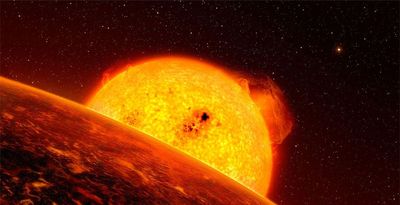


Just because the Solar System has kept its current configuration for billions of years, it doesn’t mean that it will continue forever. We already know that the ticking time bomb is the evolution of the Sun from a yellow star to a red giant, but new research suggests that there are more destabilizing moments in the Solar System's future.
It has been known that Mercury’s orbit is susceptible to becoming untenable. It has about a 1 percent chance of leaving the Solar System within the next 5 billion years and a fraction of the models show this could lead to a collision between the smallest planet and Venus, Earth, or Mars.
Even if this does not happen, when the Sun runs out of nuclear fuel and swells up, turning into a red giant, it will expand well beyond the orbit of Venus, maybe all the way to Earth.
The outer Solar System and its major planets – Jupiter, Saturn, Uranus, and Neptune – had been estimated to be a lot more sturdy when it comes to perturbation; some estimates suggested an incredible 1 million trillion years. The Sun will have gone from red giant to white dwarf and from white dwarf to black dwarf in that time.
The transformation from red giant to white dwarf is not catastrophic. The core of the Sun will contract into an object the size of our planet but 100,000 times heavier, shining from the heat produced in this contraction.
The outer layers will be pushed out into the galaxy, forming a planetary nebula.
The outer planets had been expected to survive this process of mass loss and even the close passage of the occasional star for 100 billion years. The new work says that this might not be the case.
The assumption is that the mass loss from the Sun will be smooth. Observations from other white dwarfs suggest that this might not be the case. Earth will be dust by then, but the outer planets of the Solar System will not be having a good time.
Even in a smooth release, you could have Uranus and Neptune switching places; but under the episodic mass loss regime, long before the Sun becomes a white dwarf, you have major instability. In some cases, Uranus is kicked out; in others, Neptune; in others still, Saturn says bye-bye as the ice giants get locked into resonant orbits.
According to the study, within a billion years of the Sun turning into a white dwarf, the outer Solar System as we know it will no longer exist.
“Newton, contemplating the drifting orbits of Jupiter and Saturn, suspected that the planetary order was mortal, and three centuries of celestial mechanics – from the classical invariability theorems to billion-year numerical integrations – have progressively deferred that verdict, most recently to timescales far beyond the age of the Universe,” the author wrote in their conclusion.
“Our results return the Solar System’s dissolution to astrophysically familiar territory, and relocate its cause: not the slow seep of chaos, nor the chance encounter with a passing star, but the Sun itself, which in dying does not merely enlarge the planetary system it built – it shakes it, and more often than not, spills it.”
“Newton’s envisioned instability is real after all. He was mistaken only about the perpetrator.”
Other new research has shown that planets can emerge from the chaos and aftermath of white dwarf formation. The first of these Phoenix planets, around white dwarf HS 0209+0832, was announced recently.
“We discovered the first second-generation planet around a white dwarf,” the discoverer of that planet Jamie Williams, from the University of Warwick, told IFLScience. “It's possible that in the far, far future a second-generation planet could form around the white dwarf that our own Sun will become.”
The study is published in The Astrophysical Journal Letters.


 1
1