Space and Physics
 PUBLISHED





What you'll discover in this article
- The peculiar chemical signature discovered in the atmosphere of a white dwarf indicates a planet being destroyed.
- But this dying planet has elements that could only have come from a second bout of planetary formation.
- "It's a completely new kind of type of planet. It doesn't look like anything in the Solar System, and it doesn't really look like anything that we've seen in the universe before,” Jamie Williams, from the University of Warwick, told IFLScience.
Death is not the end, or at least stellar death might not be the end of planets.
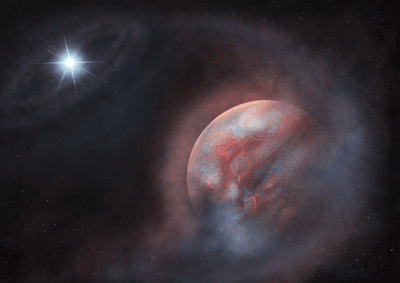
Second-generation planets are worlds that form long after a star has lived beyond its standard life have been suspected to exist for a while. Now researchers have discovered one orbiting a white dwarf.
If we find one second-generation planet around a white dwarf, then I think it's very possible that we could find many, many more.
Jamie Williams
The lifecycle of a star
Stars are born in large clouds of gas, and in the early years of their lives, a disk of material form from which planets are born. Stars roughly the mass of our Sun will live most of their lives in the main sequence, fusing hydrogen into helium.
For those stars bigger than the mass of our Sun, once the hydrogen at their core is spent they will then contract. This increases the temperature and pressure in their core, causing the remaining helium to fuse. In response to that change, the star swells up into a red giant.
These massive stars then fuse more elements and eventually explode in a supernova.
Stars more like the size of our own will instead end their life as a white dwarf. The core of the star will contract into something new: an extremely hot object, not much bigger than Earth but packing between 0.5 and 1.4 times the mass of the Sun.
White dwarfs push away the outer layers that used to belong to the red giant. It now appears that they can make planets too. At least this is the case for HS 0209+0832.
“We discovered the first second-generation planet around a white dwarf,” lead author Jamie Williams, from the University of Warwick, told IFLScience.
Second-generation planet
The telltale signs of this later progeny rest in the chemical composition surrounding the white dwarf. The atmosphere is rich in heavy chemical elements that are not normally found in white dwarfs.
If we find one second-generation planet around a white dwarf, then I think it's very possible that we could find many, many more.
Jamie Williams
These can form through a mechanism known as the s-process. This can happen during the red giant phase and it is responsible for the formation of elements such as zinc and copper. Those elements should have been pushed away as the white dwarf formed.
Finding them still in the atmosphere means that they are returning from somewhere. The researchers think that a planet rose like a phoenix from the ashes of its star system, but it is now being destroyed by the white dwarf that created it.
“This planet is very unusual because it's really rich in these elements, which are formed in the giant phase,” Williams told IFLScience. “The main one is niobium, which is the first time we see it detected in a planet or a white dwarf.”
Niobium around this white dwarf have been detected at levels 1,000 times higher than that in our Sun. As a first-generation planet couldn't have that much niobium, this provides supporting evidence that the planet formed during this second-generation scenario.
This is not entirely clear-cut. A first-generation planet might have been polluted by these heavy elements and then moved inwards. Currently, it orbits around this white dwarf in less than five days. But that said, the team believes it is more likely it formed from a debris disk that settled around the white dwarf following the red giant phase.
One-of-a-kind... but more to come?
Whatever the exact formation mechanism, the object is one of a kind. Second-generation planets have been considered around pulsars and stellar objects produced in supernovae, but not in white dwarfs. This is exciting as white dwarfs are a lot more abundant.
“It's a completely new kind of type of planet. It doesn't look like anything in the Solar System and it doesn't really look like anything that we've seen in the universe before,” Williams says.
Williams has got some observation time on Hubble to find more candidates of second-generation planets.
“If we find one second-generation planet around a white dwarf, then I think it's very possible that we could find many, many more,” he explains.
This might be a window into the future of our corner of the universe. Maybe the death of the Sun won't be the end of planets afterall.
“It's possible that in the far, far future a second-generation planet could form around the white dwarf that our own Sun will become,” Williams explained.
A paper describing this exciting discovery was published in Nature Astronomy.