Space and Physics
 PUBLISHED




The Milky Way, our galaxy, has not always looked the way it does today. We see it as a band of stars across the sky, but from an external point of view, it would be a spiral galaxy with four arms and an elongated core. It used to be different, and we now have a way to turn back time.
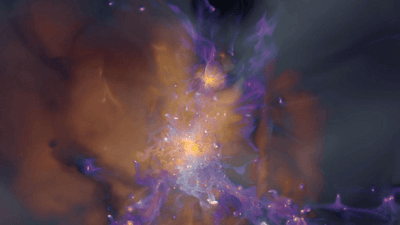
Researchers have developed a new simulation to recreate the initial year of our galaxy. The work takes us back to cosmic dawn, the moment a hundred or so million years after the Big Bang when the first stars started shining.
The team used data from the first three years of JWST together with cutting-edge knowledge of the various physical mechanisms at work in a galaxy. There's gravity, of course, but also the motion of the gas, the effect of bright young stars, and how their lives and deaths change the chemistry of the interstellar medium.
“Essentially, we put in all of the physics we think is relevant – gravity, hydrodynamics, radiation, chemistry, etc. – and then let it evolve and see if it reproduces what we actually see when we look around us today,” project leader Harley Katz, assistant professor of astronomy and astrophysics at the University of Chicago, said in a statement.
Stuff in the universe is spread out in a structure we call the cosmic web. Galaxies big and small sit at the nodes of the web. Back at cosmic dawn, a series of these early galaxies encountered each other, merged, and eventually formed the Milky Way.
“We follow thousands of subsystems in the model and directly compute what they all would have looked like with our most powerful space telescopes, which is many orders of magnitude more than what had been simulated before,” said Katz.
“Within those you see an incredible diversity. Some of them are bursting out in star formation, others are dead, others are in the process of dying.”
Interestingly, some of the galaxies are like the now famous Cloud-9, a large collection of gas and dark matter that has no stars at all. Other building blocks of the Milky Way started with stars and ended up being just a black hole.
The simulation also suggests a solution to the "iron problem" for very small galaxies. Iron is produced in the most massive stars, and the bigger the galaxy, the more they tend to be rich in iron. But in very small systems, the relationship between iron and mass breaks down.
Previous simulations failed to reproduce these observations, but the new work was able to point the finger at the possibility that the yet-to-be-directly-seen first population of stars might have been more efficient at making iron.
This would mean that they made a lot more iron when they went supernova, contributing to the relationship. In smaller systems, the explosion is enough to push the iron away because there’s not enough gravity to keep the material in.
The new simulations have not got all the answers, though, and the team sees this as an opportunity.
“Looking at these results, it’s very clear that the physics happening right after the Big Bang has direct impact on what we see today in the local universe,” said Katz.
“But there are also things we’re not getting right, which is interesting too – what are the parts we’re still missing? That can lead you into new directions and new questions.”
The project, called MEGATRON, is discussed in six papers covering the different aspects of galaxy formation and early evolution.
The papers are published in The Open Journal of Astrophysics.