Space and Physics
 PUBLISHED



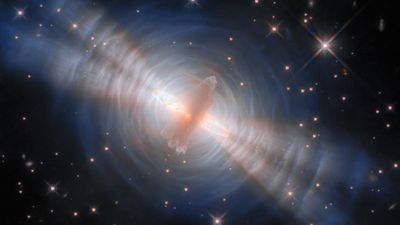


We have never seen the Egg Nebula like this. In a new image taken by Hubble, we can see that the death throes of a dying star have crafted concentric rings, dust lanes, and polar lobes. The telescope has stunningly captured how the light from the star is partially blocked, appearing to cast four beams, glowing deep from the shrouded center. It is truly a picture of dynamism, of how a star, ageing, loses its outer layers.
The Egg Nebula, also known as CRL 2688, is the youngest and closest pre-planetary nebula ever discovered. It is located about 1,000 light-years away, which is relatively close in galactic terms. The term pre-planetary nebula might be confusing, given the similarity with protoplanetary disk, but the two are the opposite ends of a stellar life-cycle.
Baby stars form from nebulae, and they end up with a protoplanetary disk, a donut of material from which planets can form. Some of the material falls onto the star, and some is ejected in spectacular jets, like in the exclusive JWST image we published a few weeks ago of the "Dragon Jet". Once a star has finished growing, it enters the main sequence, where it shines thanks to the fusion of hydrogen at its core.
Stars like our Sun or larger eventually run out of hydrogen to fuse at their core. Without energy pushing the outer layer out, they begin collapsing towards the core. This process increases pressure and temperature near the core. In some stars, this leads to the fusion of a dense layer of hydrogen; in more massive ones, the helium core will ignite immediately. The result of this process is a lot of energy being released, causing the outer layers of the star to be pushed out. When this happens to the Sun, our star might extend all the way to the orbit of Earth.
These outer layers are weakly held together by gravity, and the internal stellar processes send them flying. Eventually, in low-to-intermediate mass stars, they will form a large spherical shell shining thanks to what remains of the star: a white dwarf. This looked a bit like a planet to astronomers, and they called it a planetary nebula, even though it has nothing to do with planets.
But before a star gets to that point, it will have a more chaotic shedding phase, and this is the pre-planetary nebula. As you can see in the Egg Nebula, the shells of material are being released, but closer to the central star and its possible companion, there is still a lot of clumpy dust. This creates the dark structures across. Material released from the polar regions of the star appears from this vantage point to be less dense, reflecting the starlight in the inner region and then casting a shadow, splitting the star beam into four.
The pre-planetary nebula phase is short, lasting at most a few thousand years. These observations are precious. They provide a unique view of this short-lived phase of stellar evolution. And they are also a work of art.