Space and Physics
 PUBLISHED





What you'll discover in this article
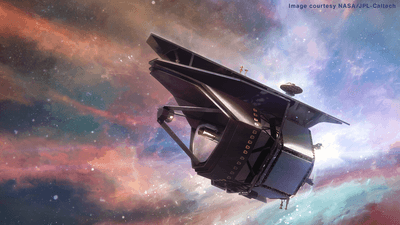
- NASA has announced the development of a new far-infrared (FIR) telescope called PRIMA (PRobe far-Infrared Mission for Astrophysics).
- This will be the first far-infrared telescope mission launched in two decades, allowing us to observe aspects in the universe that we simply can't see from Earth.
- “PRIMA will contribute to every aspect of astrophysics,” Professor George Helou told IFLScience
NASA is spoiling us with infrared telescopes, and with good reason.
After several years of revolutionary discoveries from JWST, and as the Nancy Grace Roman Space Telescope flies towards its orbital viewpoint, infrared is where it is at to solve some of the biggest mysteries of the universe.
Our understanding of the cosmos is highly biased without that IR half of the light, like reading a book with every other page missing.
Professor George Helou
The space agency knows it can go deeper, and it looks like it will.
A few weeks ago, NASA announced that PRIMA (PRobe far-Infrared Mission for Astrophysics) will move to its next phase of development. This is the first of the agency’s Probe Explores, a new class of medium-sized missions. Medium in terms of budget and delivery time, not goals.
“PRIMA has three defining scientific objectives: understanding the origins of planetary atmospheres; describing the co-evolution of galaxies and the black holes at their centers; and tracing the buildup of dust and metals over cosmic time,” Professor George Helou, from Caltech, told IFLScience.
A Lagrangian dream-team
The mission science center will be hosted by Caltech's Infrared Processing & Analysis Center, and the mission will be operated by the Jet Propulsion Laboratory. Excluding its launch, the mission has an estimated cost a capped at $1.2 billion.
Once in space, PRIMA will then travel to the second Lagrangian point (L2), where JWST and Roman are already scanning the skies.
“NASA announced a launch date of 2033 at the time of selection,” Helou told IFLScience. “PRIMA has followed the Explorer line process from the outset, which emphasizes controlling schedule and cost, and the team is ready to go.”
“So the expectation is launch to L2 in 2033, then commissioning and testing, then 5 years of prime mission, after which NASA and the science community will consider mission extensions following established processes.”
I am most excited about PRIMA measuring how fast galaxies are growing their stars and supermassive black holes [...] and using dust itself to track the buildup of elements in our universe over time.
Professor Alexandra Pope
Thanks to very accurate flying, Roman's mission has now more than doubled its lifespan and is expected to last until the late 2040s. This means that PRIMA and Roman will be able to work in tandem in the sky, not just at the same time but on the same areas.
“PRIMA will be extremely sensitive to light at far-infrared wavelengths which Roman and other telescopes cannot access,” Professor Alexandra Pope, from the University of Massachusetts Amherst and the Science Team Lead for PRIMA, told IFLScience.
“PRIMA will survey some of the same areas of the sky as Roman in order to get a complete picture of how planets, galaxies, and supermassive black holes form and evolve.”
A first for two decades
Helou stressed that the capabilities of PRIMA are unlike anything we have had before. The last far-infrared mission in space was ESA’s Herschel, which ended once the telescope ran out of coolant in 2013, about 13 months beyond its planned 3-year mission.
By the time PRIMA flies, assuming the mission is confirmed at its final review, it will be the first far-infrared telescope in space in two decades.
We can’t do far-infrared astronomy from the ground as our atmosphere blocks that light, but it is incredibly important to study the universe at those wavelengths.
“About half the light energy filling the universe is infrared light. This is because a lot of cosmic events, from planet formation to black hole growth, happen inside dusty regions, which absorb the visible and ultraviolet light and re-emit it in the IR,” explains Professor Helou.
“Our understanding of the cosmos is highly biased without that IR half of the light, like reading a book with every other page missing. PRIMA will reopen that FIR window and enable the next round of discoveries.”
The mission is very exciting, and if its predecessor is any to go by it has exceptional potential.
“I am most excited about PRIMA measuring how fast galaxies are growing their stars and supermassive black holes together 10 billion years ago, and using dust itself to track the buildup of elements in our universe over time,” Professor Pope explains.
“PRIMA will contribute to every aspect of astrophysics,” says Professor Helou.