Space and Physics
 PUBLISHED


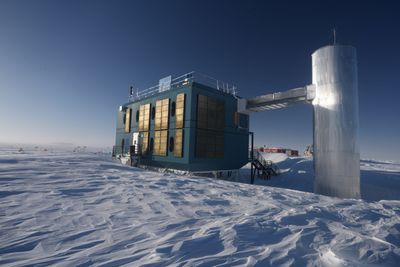


The winner of the 2026 Nobel Prize in Physics was awarded to Francis Halzen for his work on astrophysical neutrinos and his role in the development of the IceCube experiment in Antarctica. The prize is worth 12 million Swedish kronor (around $1.2 million at the time of publication).
Neutrinos are also known as ghostly particles: they have a mass so small that for decades we didn’t even know if they had mass, and they have no electric charge. Every second, 100 trillion neutrinos from the Sun pass through our bodies. That happens even at night when they have first gone through the Earth. And we are none the wiser.
There are other sources of neutrinos in the universe: other stars, supernovae, and the environments around black holes. The challenge was to find them.
In 1987, Halzen considered using water ice as a detector for these elusive particles.
Ultrapure water (which is safe to drink!) has been used to study neutrinos, such as in the Super-Kamiokande experiment in Japan – which has also produced Nobel-winning research. Neutrinos occasionally slam into a water molecule, producing a flash of light.
The project Halzen first proposed was called AMANDA (Antarctic Muon And Neutrino Detector Array), and the later IceCube uses the same principle in ice. Within a cubic kilometer of Antarctic ice, the collaboration placed a camera that can detect high-energy neutrinos.
The experiment has so far found neutrinos from other galaxies, from the plane of the Milky Way, from the most powerful supermassive black holes in the universe, and even from intense star-formation episodes.
Reached on the phone while traveling through Italy, Halzen stressed the importance of the wide collaboration of people and institutions that made IceCube happen. The Nobel Prizes are awarded to a maximum of three people, while science is done by large groups.
“Francis Halzen has led an international team of researchers and engineers who have provided us with a fantastic instrument. His tenacity and scientific vision has paved the way for a new kind of astronomy,” Mark Pearce, Chair of the Nobel Committee for Physics, said in a statement.
Asked about what he was going to do for the rest of his day, Halzen said, "I'm working on a proposal; I hope this prize will help get it approved.”
IceCube has inspired other detectors that have moved from the ice of Antarctica to the deep sea. The KM3NeT (Cubic Kilometre Neutrino Telescope), a giant underwater "ghost particle" observatory, is currently being built at the bottom of the Mediterranean Sea.
Its first phase has already detected the most energetic neutrinos ever seen, something that continues to puzzle scientists. Similar detectors have been proposed by China as well.
There is so much we are yet to understand about neutrino physics and the astrophysical sources of these peculiar particles.