


 Space and Physics




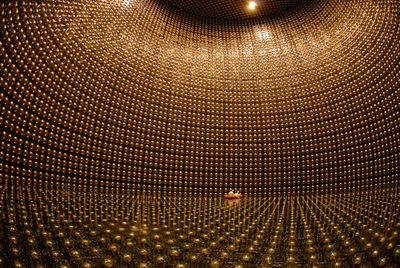


The Super-Kamiokande experiment is an observatory at the forefront of neutrino physics and also one of the most visually stunning: an apartment building-sized cavity covered in gold bulbs and filled with water.
The water is ultrapure, a crucial requirement to perform the sophisticated work that goes on there. We have come across several posts online claiming that this ultrapure water is extremely dangerous to human beings, so let us reassure you: it won’t harm you or kill you.
What is Ultrapure Water?
The water you drink, whether from the tap or a bottle, is not just H2O. In regular water, there are a variety of dissolved salts and minerals, plus the regular amount of viruses and bacteria you find in the environment. Water in different parts of the world tastes different because of the different composition of everything else dissolved it.
There are several ways to remove other stuff from water. There’s simple filtration, for one, and also distillation, when water is boiled and the vapor is condensed back into liquid. A more sophisticated way is using the principle of reverse osmosis, where a semi-permeable membrane is used to separate water molecules from other substances.
To obtain ultrapure water, a combination of the above (usually microfiltration and reverse osmosis) is conducted. Then the water can be treated with vacuum degassing and ultraviolet light to sterilize it. Ultrapure water has a lot of industrial applications.
What effects does it have?
There's an old prank highlighting the danger of the chemical dihydrogen monoxide for its ability to accelerate corrosion, cause erosion, and, if inhaled, cause suffocation. Dihydrogen monoxide is water, of course, and we all know that it rusts metal, changes the landscape, and you can drown if you breathe it in.
Regular water is a solution. If you take a glass of water and keep pouring table salt in it, there will be a point when some of it stops dissolving. This means that the solution is saturated. Ultrapure water has (ideally) no stuff dissolved in it, so it is more effective at leeching metals from surfaces or corroding materials.
This doesn’t mean that it’s like some super-acid you can't touch. You can touch it and even swim in it (although dissolved salts make it easier to float, so you might have to work a little harder to not sink).
What about the human body? You can certainly drink without any immediate ill effect. It probably tastes extremely bland. The issue is only long-term. Ultrapure water wouldn’t pull minerals from your body, but we do acquire some minerals through drinking water, so if you were to drink only ultrapure water, you might develop some deficiency. If you were committed to the ultrapure water life, we are sure you could buy those minerals as supplements.
Why is it used in Super-Kamiokande?
Super-Kamiokande, which is located near the city of Hida in Japan, studies neutrinos. These subatomic particles, also known as ghost particles, are tiny, have no charge, and are produced in nuclear reactions. They can travel through solid matter, even through the whole Earth, without being affected. Every second, a constant stream of trillions of neutrinos coming from the Sun passes through your body.
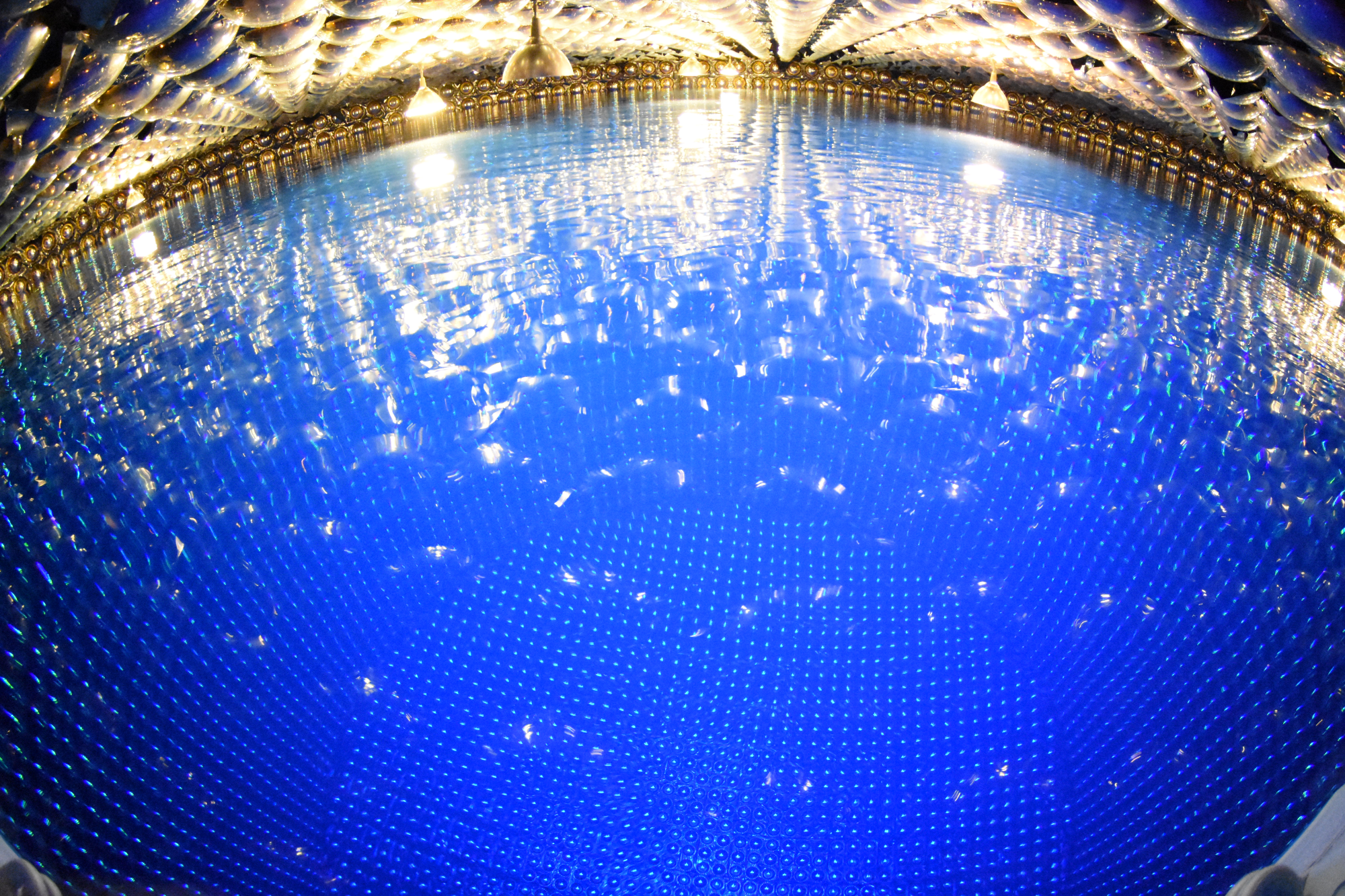
Occasionally, a neutrino will slam into an atom and produce an electrically charged particle. When this happens in the massive Super-Kamiokande tank, the particle will move faster than light is able to (at least in water, nothing is breaking the fundamental speed limit of the universe here). This creates Cherenkov radiation, which will be captured by the photomultipliers located all around the tank.
Ultrapure water makes the measurements more accurate. Regular water would be less transparent and could even have its own sources of radiation. There are 50,000 tons of water in the facility when in use, and they are continuously reprocessed at a rate of 30 tons per hour within a closed system.

 1
1