Space and Physics
 PUBLISHED





Observatories like IceCube in Antarctica and Cubic Kilometre Neutrino Telescope (KM3NeT) have been capturing powerful neutrinos coming from well beyond the Solar System, even from other galaxies. Tracing them to their origins remains difficult, but researchers might have struck gold in an event from 2021.
High-energy neutrino IC 210922A was spotted by the IceCube Neutrino Observatory back then. Immediately, astronomers around the world looked towards the sky in the direction of Eridanus. Neutrinos have very little mass, no charge, and can move through anything – hence the nickname "ghost particles." So, they roughly move in a straight line.
Astronomers were looking for a transient event. Maybe it was a supernova or a star being ripped apart by a black hole. Something of extreme energy located on the trajectory that the neutrino had traveled.
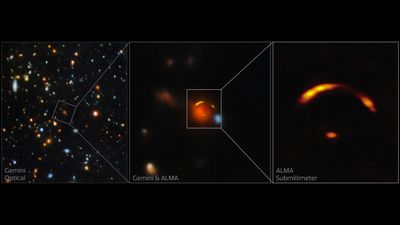
Yuji Urata of MITOS Science Co., Ltd. in Taiwan and his team saw instead that there was a different kind of possible neutrino source. An extremely bright galaxy, located 11 billion light-years away, was being gravitationally lensed by a closer object. The distant galaxy, called JCMT0402−0424 and nicknamed “Shadow Blaster,” is a star-forming powerhouse, trillions of times brighter in infrared than our Sun.
The team studied the object in detail using multiple telescopes across a variety of wavelengths. They discovered that the distant galaxy is experiencing a major star-formation episode without having an active supermassive black hole.
They also studied the property of the lensing object, a foreground galaxy, and how it would affect the neutrino signal. All this information, combined with the lack of any other promising candidate, suggests that Shadow Blaster could be the source of this cosmic neutrino.
“Shadow Blaster possesses the kind of dense, gas-rich environment that theoretical models have long suggested could efficiently produce high-energy neutrinos,” Urata said in a statement. “If confirmed, Shadow Blaster would be the first-ever individual dusty star-forming galaxy directly linked to a high-energy neutrino event.”
Shadow Blaster isn't a unique object. The team estimates that compact, star-forming galaxies like it might provide a good chunk of the high-energy neutrinos we have so far detected.
“Our analysis suggests that this population could contribute up to roughly 20% of the observed diffuse neutrino background measured by IceCube,” explained Urata.
This work is an example of the unfolding revolution that is multimessenger astronomy. This is the combination of regular light astronomy with neutrino and gravitational wave detectors. The combination is like adding a second sense we were lacking. Hearing, for example, where we were only seeing.
It is still early days, though, but it is an exciting possibility that we might have found another source of high-energy neutrinos.
A paper describing the research was published in the journal Nature Astronomy.