Space and Physics
 PUBLISHED



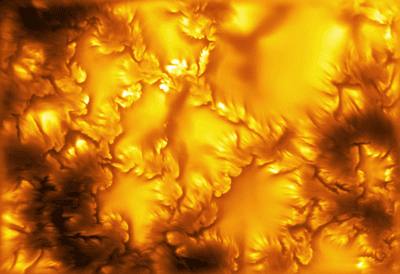


Swirling patterns on the Sun's surface may explain why our star's magnetic field lines have a tendency to tangle and reconnect, producing powerful solar storms that cause auroras and other atmospheric phenomena here on Earth.
Although we understood that these tangles are the immediate cause of solar flares and coronal mass ejections, astronomers have been less successful in figuring out what produces the tangling itself.
The Daniel K. Inouye Solar Telescope, a four-meter (13-foot) solar land-based scope on the island of Maui, Hawai'i, and the most powerful telescope built specifically to study the Sun, was the perfect tool for the job, and it may also have helped us get to the bottom of another solar mystery.
You see, temperatures at the center of the Sun are around 15,000,000°C (27,000,000°F), and at what we call the surface, where our star becomes too optically dense to see inside, it’s a comparatively cool 5,500°C (9,930°F).
That makes sense, since the heat is generated in the core, where pressures are great enough to fuse hydrogen. However, you would expect the Sun’s outer atmosphere, beyond the surface, to be cooler still. In reality, it is actually millions of degrees.
Explanations for why have been offered before, but none so far has been terribly satisfactory, so it was hoped that the extraordinary detail Inouye can provide would offer clues. It seems to have done just that.
Spotting the instability
Solar eruptions are driven by the release of enormous amounts of magnetic energy, and this is thought to be the result of magnetic field lines suddenly reconnecting after becoming twisted around each other.
The reason for the twisting, known as flux braiding, is poorly understood, but a phenomenon called Kelvin-Helmholtz instability – which produces a kind of churning effect at the boundary between two fluids – might provide the answer.
Although Lord Kelvin and Hermann von Helmholtz first described the phenomenon based on the bahaviour liquids in lakes and oceans, we now also see it in gases and even in the behavior of the solar wind when it encounters planetary magnetospheres.
It so happens that the images produced by Inouye show patterns on the sun's surface that also resemble the kind of churning produced by Kelvin-Helmholtz instability. The effect looks like breaking ocean waves or sand dunes.
.png "A close-up view of a selected region from the Inouye Solar Telescope image reveals the extraordinary spatial resolution of the Inouye's observations. Although the images appear yellow, they were actually taken with at a blue light wavelength and colored to look familiar")
What the human eye cannot see is that these swirls of plasma are highly magnetized. The fact that Inouye’s images show the swirls everywhere with a strong magnetic field indicates they could be what causes the magnetic twisting.
Indeed, by comparing Inouye's images with computer simulations, a team led by Dr David Kuridze at the US National Solar Observatory found that these vortex like-structures were typically found 50-65 kilometers apart at the edges of the magnetic areas.
The authors conclude that bubbling at the surface of the Sun in the form of granules 500-2,000 kilometers (300-1,200 miles) wide interacts with magnetic structures to cause layers of plasma to slide past each other, and the instability results.
“Time sequence images reveal a far more complex and dynamic solar scene than previously observed,” they write in a paper describing the observations.
Puzzling Heat Explained
In addition to its possible role in solar activity, Dr Thomas Rimmele at the National Solar Observatory said in a statement that "Kelvin-Helmholtz instability is likely a mechanism that contributes to the heating of the outer atmosphere and is part of the solution of the longstanding enigma of why stars have a million degrees Kelvin hot corona.ˮ
The phenomenon is known to be an efficient method for spreading mass and energy, and it is thought that the instability causes magnetized and non-magnetized plasma to mix. This would promote the spreading of magnetic fields through the solar atmosphere, potentially explaining why it is hotter than the surface.
"The Sunʼs magnetic field is generated by dynamo processes that act like giant cosmic engines that turn the star's rotational energy into magnetic fields," said Kuridze. "However, because the solar magnetic cycle is only 11 years, a remarkably rapid timescale in cosmic terms, the generated magnetic flux must dissipate efficiently."
"Current models struggle to explain this rapid diffusion. The Kelvin-Helmholtz instability we discovered in the solar photosphere can act as a key source of this missing magnetic diffusion,” he said.
Dr. Friedrich Wöger, who also worked on the study, added: “We are only at the beginning of recognizing the wide-reaching impact the discovery of Kelvin-Helmholtz instability has on our understanding of the connection between the magnetized plasma motion and the energy transport and release into the upper solar atmosphere."
The study is published in Nature.