Space and Physics
 PUBLISHED



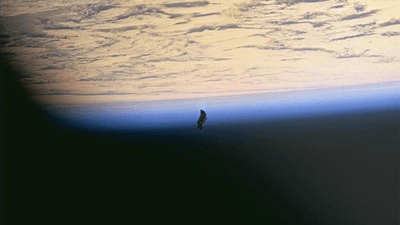


With all the pressing problems going on in the world right now, Kessler syndrome may have escaped your attention. But unless we take it seriously, a space disaster is on its way.
It all basically comes down to the fact that humans create a lot of trash.
Unfortunately that trash doesn't stop at the Kármán line, which is the internationally accepted definition for the edge of space. Since the first satellite launched into orbit in 1957, we have committed hard to having satellites circling the Earth, doing everything from espionage to keeping your GPS working.
But in 1978, Donald Kessler and Burton Cour-Palais realized that this situation couldn't go on indefinitely. Instead, it might lead to an absolute nightmare scenario in which low-Earth orbit becomes completely unusable to us, or even impassible, perhaps for decades or centuries.
But isn't space famously massive?
In the pair's first paper on the subject, Kessler and Cour-Palais outlined the problem in that as space fills up with functional and dead satellites, collisions become more likely.
While no collision is good collision, the problem is that colliding at high velocities results in a lot more debris. This in turn would lead to further impacts, possibly setting off a chain that would escalate the situation dramatically.
"The average impact velocity of 10 km/s ensures that almost all the earth-orbiting objects will exhibit hypervelocity impact characteristics when they collide," the team explained, adding that the impact site would likely be subject to melting or vaporization.
"A crater, or hole, will be formed, the molten ejected mass coalescing into more or less spherical particles. In addition, the shock waves, particle fragments hitting other surfaces, and vapor pressure may cause fragmentation outside the cratered region, possibly resulting in the catastrophic disruption of both objects."
The team explained that the process would be similar to that seen in the asteroid belt, though on far quicker timescales and with a "debris belt" perhaps forming within the next century.
They recommended placing constraints on satellite launches in order to delay the formation of the belt.
So we did that, right? Right??
Since then, we have only accelerated putting satellites into orbit.
As of July 31 2026, there are around 18,850 satellites in orbit around Earth (though not all of these are in low orbit), collectively weighing around 17,000 tonnes. Already, over 660 incidents have been documented which have resulted in break-ups, explosions, and collisions.
Kessler returned to the topic in 1991, as satellite launches continued and space began to fill up.
"There are a number of uncertainties in these models, and additional analysis and data are required to fully characterize the future environment," he wrote in that paper.
"However, the nature of these uncertainties are such that while the future environment is uncertain, the fact that collisions will control the future environment is less uncertain. The data that already exist is sufficient to show that cascading collisions will control the future debris environment with no, or very minor increases in the current low Earth orbit population."
In the coming years, plans from the likes of Elon Musk and others want to see even more satellites added to the sky.
But satellites aren't really colliding, are they?
Kessler's work suggested that the worrying situation of colliding satellites could take decades or even centuries to occur. But in 2009 we got our first look at an accidental satellite-on-satellite collision.
This was followed by a deliberate anti-satellite test by China, which saw their Fengyun-1C satellite destroyed by a medium-range missile.
"On February 10, 2009, a fully maneuverable and 'well-behaved' operational satellite ran into a 16-year-old derelict satellite at 11.6 km/s," a paper on the accidental collision explains, closely matching Kessler's predicted velocity.
"In less than a millisecond, the two satellites disintegrated, producing nearly 2000 tracked debris objects and on the order of 100,000 untracked fragments in the centimeter range."
Meanwhile, the deliberate destruction of Fengyun-1C resulted in 3,300 trackable objects.
"This was by far the worst break-up event in space history − some 3.5 times worse than the worst previous event," the European Space Agency (ESA) explains.
"Satellites in Sun-synchronous orbits at around 800 km altitude still today experience an increased number of close conjunctions with debris objects," they added. "Roughly 30% of such events are caused by Fengyun-1C fragments."
Cosmic clean-up
Efforts are being made to try and deal with dead satellites and fragments of debris which are floating around up there.
Some missions are aimed at grabbing and retrieving the debris, while others are looking at pushing it into our atmosphere to burn up. But given the scale of the problem this will be quite the task, even when we have a method that has been trialed and tested.
One big issue is international co-operation. If we are to avoid a runaway chain of collisions predicted by the Kessler syndrome, we need to be careful about what we are putting up there.
A recent paper looking at the economics of satellites, and the potential for a runaway effect, found that Kessler syndrome could begin in the pretty near future, depending on how much more we put into orbit, and how these satellites fragment upon impact.
They warn strongly against low-Earth orbit being open access, with individual organizations not internalizing the risk they pose to other satellites in low-Earth orbit. Worse, the team believes that the situation which causes it may still be highly incentivized.
"Kessler syndrome has similarities to extinction of a biological population," write the authors. "When the discounted future benefits of conservation are below the immediate benefits of exploitation (e.g., the intrinsic growth rate is below the discount rate), profits can be maximized if the species is driven to extinction."
According to this team, Kessler syndrome could occur anytime between 2040 and 2184.
In the meantime as Kessler imagined and modeled, collisions are continuing to take place. The most recent example occured on 13 September 2026, as a Cold War-era satellite shattered into pieces.
It is time to take Kessler syndrome seriously, before it is too late.