Space and Physics
 PUBLISHED



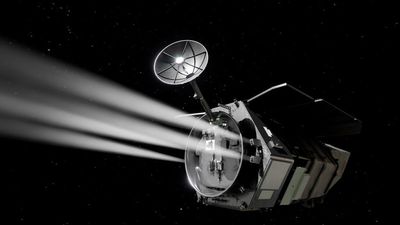


The Nancy Grace Roman Telescope launched three weeks ago on a mission to discover new planets, study galaxy evolution, and help us make sense of some of the biggest questions of the universe. Its original mission was intended to last 10 years, but recent fuel-saving developments, including a maneuver NASA has described as "exquisite," mean it is now expected to operate for over double that time.
Since launching from Kennedy Space Center on August 30, Roman has been on its way to the second Lagrangian point (L2), a location of gravitational equilibrium beyond the orbit of the Moon that moves with our planet around the Sun. It won’t end up exactly at L2, however. That’s prime space real estate, and there are a lot of telescopes already there, including JWST.
Instead, Roman will have to maintain an orbit around L2, so it needs fuel to adjust its position over time, putting a cap on the total duration for which it can stay operational. The extended mission for the telescope was initially expected to last 10 years. However, due to weight-saving updates in the craft's design since 2015, the team at NASA was able to load it up with extra fuel at launch, which added four more years.
Since then, the telescope has made one of two necessary maneuvers on its journey to reach L2, and it was designed and performed so perfectly that the saved fuel has added another four years to Roman's operational lifespan.
In fact, this maneuver was so flawless the team expects it will save enough fuel for four additional years because the second maneuver will now be much easier to pull off. With all those savings added up, the telescope will potentially have enough fuel to operate for more than twice its original planned length.
“As a result of exquisite planning by our orbital dynamics team, brilliant execution by the operations team, and a precise launch from SpaceX, Roman has fuel for at least 22 years of potential science operations,” said Jamie Dunn, center director at NASA’s Goddard Space Flight Center, in a NASA blog post.
In addition, the team has begun turning on and testing the telescope's instruments. NASA has announced it has successfully activated the Wide Field Instrument (WFI), a 300-megapixel infrared camera that is Roman's imaging superpower.
The telescope possesses a mirror 2.4 meters (7.9 feet) across. That's the same size as the one in the Hubble Space Telescope, but because of its larger, 300-megapixel infrared camera, Roman's effective field of view will be 100 times larger, covering a patch of sky equivalent to what is covered by the moon when viewing from Earth.
“Roman's superpower is that it can scan large areas of the sky much more efficiently,” Neil Zimmerman, who works on the Roman mission at NASA, told IFLScience previously. “It's a very agile observatory. That means that we can point, stop, and take an exposure and then repoint again and do that over and over again.”
Before they could switch WFI on, however, the team had to wait 10 days after launch for it to dry out at a relatively toasty -65°C (-85°F). Believe it or not, this is the temperature when the instrument heater is turned on, which is necessary so residues from manufacture and launch can dissipate into space rather than being frozen in place, where they would interfere with the telescope's function.
With contaminants jettisoned, the heater turned off, and the instrument turned on, Roman has now cooled to its operating temperature of -143°C (-225.4°F).
The team also tested the telescope's coronagraph, a system of optics and mirrors that will block the light of distant stars, potentially revealing the presence of exoplanets orbiting them.
“Imaging planets is a very hard problem. You can imagine that you're trying to see a point of light next to another point of light right next to it that's about 1 billion times brighter,” Zimmerman told IFLScience.
“In order to image planets like this, we need a special kind of instrument that's called the coronagraph. The Roman telescope will use several advanced technological features that will make it by far the most sensitive of all the coronagraphs that have been used in space before.”
Roman is expected to reach L2 in early December, about 100 days after its launch. NASA expects the first scientific images in early 2027.