Space and Physics
 PUBLISHED
 1
1





In the 1700s, humanity, through a lot of hard work, astronomy, and a little help from a stick, had figured out the size of Earth and the relative distances to several major objects in the Solar System. We'd even cracked the genuinely difficult problem of determining that the Sun is at the center of the Solar System and that Earth moves around it.
But while we understood the relative distances to our fellow planets from the mid-1600s and the dawn of telescopes (i.e knowing, for example, how many times further away from us Saturn's orbit is than Mars's), we had no idea of the actual distances involved.
The relative distances were figured out using Kepler’s third law of planetary motion. "The orbital period of a planet, squared, is directly proportional to the semi-major axes of its orbit, cubed. This is written in equation form as p2=a3," NASA explains. "Kepler's third law implies that the period for a planet to orbit the Sun increases rapidly with the radius of its orbit. Mercury, the innermost planet, takes only 88 days to orbit the Sun. Earth takes 365 days, while distant Saturn requires 10,759 days to do the same."
In short, by knowing how the orbital period, or the time it takes to complete an orbit, is tied to the average distance from the Sun, you can figure out each planet's relative distance from the Sun. For ease, the Earth-to-Sun distance is defined as one astronomical unit (AU). With Kepler's laws, we could figure out that Mars is ~1.8 AU from the Sun, for example, and the same calculation works on the other planets, but we didn't know how far that would be in miles or kilometers, just how many times nearer or further one planet is compared with another.
In 1716 CE, English astronomer Edmond Halley, most famous for calculating the orbit of the comet that now bears his name, had an idea for an arguably more impressive feat: figuring out how large the Solar System really is.
The idea was beautiful in its simplicity but would require many a daring voyage to see it through, as well as some international cooperation. It also needed a lot of patience, requiring astronomers to wait for the next two times Venus would transit the Sun, predicted to take place in 1761 and 1769.
"Venus's transit over the sun's disk, whose parallax, being almost 4 times greater than that of the sun, will cause very sensible differences between the times in which Venus shall seem to pass over the sun's disk in different parts of our earth," Halley explained in his 1716 essay.
"From these differences, duly observed, the sun's parallax may be determined, even to a small part of a second of time; and that without any other instruments than telescopes and good common clocks, and without any other qualifications in the observer than fidelity and diligence, with a little skill in astronomy."
In short, by observing exactly when Venus entered and exited the Sun's face from our perspectives on Earth, many miles apart, it would be possible to figure out the exact distance to the planet.
"Once the precise contact times were determined, a complex mathematical calculation was performed to determine the observed path of Venus across the Sun from each location," the European Space Agency explains. "The angular difference between these paths resulted from a parallax shift. Corrections had to be made for the slight differences in contact times caused by east-west differences in longitude."
Once you had this distance, and knowing Kepler's laws, you could then use it to figure out the absolute distances to the other planets of the Solar System.
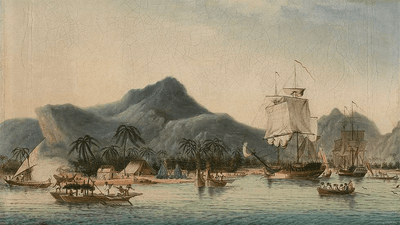
Halley died before these transits took place, but several voyages set off in order to precisely track the Venus transit and finally measure the Solar System. The most famous of these was probably Captain James Cook’s expedition to Tahiti.
"This day prov'd as favourable to our purpose as we could wish, not a Clowd was to be seen… and the Air was perfectly clear, so that we had every advantage we could desire in Observing the whole of the passage of the Planet Venus over the Suns disk," Cook wrote of the transit, which he had spent eight months sailing in order to witness. "We very distinctly saw an Atmosphere or dusky shade round the body of the Planet which very much disturbed the times of the contacts particularly the two internal ones."
Cook's measurements alone weren't enough to figure out the exact distance to Venus, but with the combined observations of over 100 observers around the world, we were able to determine the true distances of the various planets of the Solar System.
Perhaps the funniest of these voyages was the one led by Guillaume le Gentil, who attempted to observe the 1761 transit from Mauritius but was unable to make satisfactory measurements. Knowing that the next transit would be in 1769, and then there would not be another opportunity for around a century, he decided to simply hang around on the island and wait it out.
When he finally returned to Paris in 1771, he found that he had been declared legally dead and his wife had moved on and remarried. That might not have been so bad if he had at least played a part in measuring the Solar System, but that too had been ruined; after waiting eight years without contact with his family, his view had been blocked by clouds.