Space and Physics
 PUBLISHED




The Galileo Affair is often portrayed as the story of one man, with facts on his side, being persecuted by the Catholic Church for clearly stating the truth. While these are certainly themes within the story, it's actually a little more complicated than that, and even more interesting.
By Galileo's time, humanity had figured out a fair bit about our circumstances. We had figured out that the world we were standing on was a sphere, and even measured it pretty accurately using a shadow in a well and a stick. That's no small thing, and humanity had to grapple with the idea that some people on the other side of the Earth were upside down (and from their perspective, you were upside down). But our models of the Solar System – hey, this is all actually quite difficult to figure out – were really messed up.
The Aristotelian view of the Solar System was the favored model at the time, and it became embedded in the teachings of the Catholic Church. This model had the Earth, the heaviest of the elements (earth, water, air, and fire) at the center of the universe, with the stars, Sun, planets, and Moon being fixed on a sphere, held in place by an element named aether that wasn't found on Earth. This sphere rotated, explaining the apparent movement of the celestial bodies. The appeal to the Catholic Church was that it cast the heavens above as perfect bodies, moving in perfect circles around Earth, the most important place there is.
But there was a problem, in that the celestial bodies are not perfect, as Galileo would discover thousands of years after Chinese astronomers, and the bodies don't move in perfect circles around Earth.
Around 150 CE, Ptolemy came up with a version of the sphere concept using concentric shells, as well as the concepts of eccentricity and an epicyclic model, that preserved the central ideas but was able to explain the movements of celestial bodies better.
It looks pretty strange from a modern perspective, when centuries of work has let us know that the Sun is at the center of the Solar System. But this model, which was seen as a mathematical tool representing the true Aristotelian universe, was able to make better predictions than anything that came before it. But it couldn't explain a lot of things, such as how the planets appeared to slow down or even reverse direction from our perspective (termed retrograde motion).
In 1515, Polish priest Nicolaus Copernicus proposed a more familiar alternative, that Earth was just like the five other planets we knew about at the time (the others being too small/distant to be seen without a telescope).
"Afraid of criticism (some scholars think Copernicus was more concerned about scientific shortcomings of his theories than he was about the Church's disapproval), he did not publish his theory until 1543, shortly before his death," NASA explains. "The theory gathered few followers, and for a time, some of those who did give credence to the idea faced charges of heresy. Italian scientist Giordano Bruno was burned at the stake for teaching, among other heretical ideas, Copernicus' heliocentric view of the Universe."
Copernicus's model was an improvement, placing Earth, the planets, and the Sun in roughly the correct order and relative locations. It could also explain retrograde motion as an illusion caused by Earth passing the slower-moving outer planets, or being passed by faster-moving inner planets as we all go about our orbits. However, as we didn't yet know of Kepler's laws of planetary motion, and that the planets' orbits aren't perfect circles but ellipses, Copernicus too had to make use of epicycles in his work, and his predictions were no better than Ptolemy's model.
Now we are all caught up, we can start talking Galileo. When telescopes were invented, and Galileo created his own, we began to get a much better view of the objects filling our skies, and we started to notice they weren't so perfect after all. On the Moon, Galileo found mountains, and though he was well over a thousand years behind Chinese astronomers, he also saw sunspots moving across the Sun's surface.
On 7 January 1610, Galileo Galilei turned his new and improved telescope to observe the gas giant Jupiter. Here, he spotted several points of light near the planet, which he initially thought to be stars. But observing them over the next week or so, and watching as a fourth point of light joined them, he realized they were moving with Jupiter and against the motion of background stars, and he correctly identified that he had seen moons (now known as the Galilean moons) orbiting the planet. This showed for the first time that not everything in the Solar System revolves around us, and Galileo (correctly) saw that as a big argument in favor of the Copernican/heliocentric model.
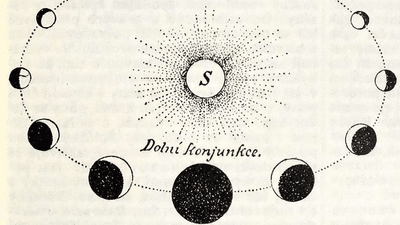
The real kick in the Ptolemaic model of the Solar System, though, came with observing Venus. Galileo watched Venus as it made its orbit around the Sun, and spotted that it went through a full range of phases, just as the Moon does. This wouldn't work if every body in the Solar System orbited Earth, as in this model Venus would always occupy the space between Earth and the Sun. If that were the case, we would only ever see a limited range of phases in Venus, and it would remain a thin crescent from our vantage point. Galileo saw a full Venus, a crescent Venus, and everything in between, ruling out this model.
So, that's everything sorted, and the Catholic church will accept that the Earth is not the center of the Solar System, no? No. The Catholic Church, as you are probably well aware, banned the promotion of heliocentrism and declared it “foolish and absurd in philosophy” and “formally heretical,” meaning big trouble for anyone who correctly surmised that the Sun is the center of the Solar System.
Tycho Brahe, a somewhat eccentric but brilliant astronomer, proposed his own half-way model, which saw the Earth stationary at the center of the Solar System, while the other planets were allowed to orbit the Sun.
This idea may appear somewhere in the range of "odd" to "really stupid". But it would have also been a bit of a leap to abandon the geocentric model of the universe because of Galileo's observations. While he certainly showed that the Aristotelian view was incorrect, there were quite a few problems to work through, which Galileo had not satisfactorily addressed (not that I'm blaming old Galilei for this).
A major problem, which Galileo took some steps towards addressing, is that we hadn't figured out inertia yet. On Earth, we don't feel like we are hurtling through the Solar System, and for the most part it all feels like we are stationary. That's a weird thing to wrap your head around. If the world were rotating, people thought, surely when you dropped an object it would end up flying off at an angle, rather than straight down.
Galileo attempted to solve this with an experiment on a ship, dropping a rock and seeing where it lands. Of course, if you have ever dropped anything in a closed car driving forwards, you know it does not hurtle backwards when you let it go, but falls directly downwards. The experiment demonstrates that the laws of physics are the same in any inertial frame of reference (in this case, a ship moving at a constant speed, or someone standing on the shore and moving with Earth).
But we still had a lot to figure out, first by Newton, before we could abandon the view that we were stationary. And Galileo was incorrect on this topic too, suggesting that the tides were the result of Earth's rotation, rather than the real culprit: the Moon.
As well as this, we couldn't see our movement in the sky. Humans were aware that if we are moving, we should see a subtle shift in nearer stars compared with background stars as we move through the Solar System, known as stellar parallax. We didn't see any sign of this until 1838, the result of improved telescopes and the observations of German astronomer Friedrich Bessel.
All in all, though Galileo was correct, he didn't quite have enough evidence to be throwing his weight around quite as much as he did. Galileo, it's reasonable to say, had a bit of an attitude problem when it came to people not accepting his ideas. Having been warned directly not to teach heliocentrism, he wrote his 1632 book Dialogue Concerning the Two Chief World Systems, very much doing that, although it was presented as a discussion between a heliocentrist, a geocentrist, and an impartial observer.
In the book, he names the geocentrist Simplicio, supposedly a reference to an Aristotelian philosopher, but also meaning "idiot" in Italian. The character, which represented the views of a pope who could have Galileo executed if he wanted to, was depicted as quite stupid, which is quite a dangerous move for someone who hasn't quite nailed his arguments down.
Galileo, following a trial, was held under house arrest until his death, and he was forced to renounce heliocentrism, even though it was correct.