


 Space and Physics
 PUBLISHED




What you'll discover in this article
- The first thorium-229 nuclear clock has been achieved.
- It is not as precise as regular atomic clocks, but it could be a revolutionary tool in probing fundamental physics.
- “We can expect really exciting measurements in the near future,” Professor Thorsten Schumm from the research team told IFLScience.
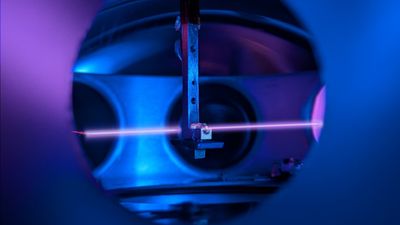
The world of precision timekeeping has a new kid on the block. Researchers have presented the first functioning thorium-229 nuclear clock. The breakthrough has so many exciting possibilities, from higher-precision timekeeping to a new way to probe what we know and don’t know about the universe.
For decades, atomic clocks have been the gold standard of timekeeping. We use cesium-133 atoms in these instruments. The outer electron of such atoms is made to jump to a higher energy level; the electron will then drop back to its ground state, emitting a specific microwave frequency.
A resonator keeps the atoms in an excited state, locking in the natural frequency and using that as a perfect ticking clock.
A single second corresponds to 9,192,631,770 cycles of this transition. They are precise to a part in 10-16; in other words, they lose one second every few hundred million years.
Yes, it is an incredible level of precision, though physicists knew that they could achieve even higher precision. Recent breakthroughs have seen scientists switching from microwaves to visible and even ultraviolet light. These are the optical atomic clocks, currently 100 times more precise.
Still, there might be ways to push even further if instead of looking at the electrons around the atomic nucleus, you look at the nucleus itself. Atomic nuclei are made of protons and neutrons; these too can be excited, and that’s how a nuclear clock works.
“In contrast to processes in the outer electron shell used in all previous atomic clocks, the nuclear clock uses a quantum transition of a neutron to define a resonance frequency and therefore time,” the corresponding author on one of the papers, Professor Thorsten Schumm from TU Wien, told IFLScience.
A whole new level of sensitivity
In classic atomic clocks, you are dealing with interactions governed by electromagnetism. In the nucleus, things are more complicated.
There is still electromagnetism, trying to push the protons apart as they are all positively charged; however, there is also the strong nuclear force keeping all the quarks that make protons and neutrons together. Last but not least, the weak nuclear force makes an appearance too, which can produce certain nuclear decays.
The thorium-229 nuclear clock shows that the nucleus can be studied in a similar manner to how we study atoms as a whole.
“For the first time, we can study nuclear processes with the precision known from atomic spectroscopy,” Professor Schumm told IFLScience.
The nuclear forces are a lot stronger when you are at the level of neutrons. This can make a nuclear clock up to 1 million times more sensitive to variation in the properties of those forces.
Probing the known and unknown
Such a device is clearly extremely exciting. Beyond timekeeping, it allows us to study fundamental interactions right into the nucleus. Given our ongoing quest to understand the fundamental forces, nuclear clocks are a new tool with excellent potential.
The team immediately tested this potential. They used the clock to look for dark matter. We do not know what dark matter is – it’s a hypothetical substance that should outweigh the matter that makes us five to one.
One theory suggests that dark matter is made of ultralight particles called axions, and these axions could create a periodic modulation in one or more of the fundamental forces. This would result in a change in the ticking of this clock.
Even though the clock is not at the precision required yet, the team still looked for this.
“We didn’t see any obvious signal yet, but honestly, that’s no surprise, as we still can and will improve the clock quite a bit before we actually think we should see a signal,” Professor Schumm told IFLScience.
Whether we will ultimately beat the world’s best optical atomic clocks is an open question.
Professor Thorsten Schumm
The team, which included researchers from Physikalisch-Technische Bundesanstalt (PTB) – the national metrology institute of Germany – did great even in this first experiment. While they were looking for a slightly different model, they did reach a precision similar to that of optical atomic clocks.
“We can expect really exciting measurements in the near future.”
Limits and potential
The current precision of this clock is short of what you can get with cesium atomic clocks by about four orders of magnitude. So, it would lose a second every 30,000 years.
The main limitation is the ultraviolet lasers being used. Those that are available tend to be quite weak and have noise. Still, the researchers report that new and improved lasers are becoming available, making improvements just a matter of time.
The laser limitation might be gone in just three years and the team is confident that they can get to the level of cesium atomic clocks. Optical atomic clocks, however, might be another challenge.
“Whether we will ultimately beat the world’s best optical atomic clocks is an open question.But even if not, it will still be a very good clock with a dramatically reduced form factor, which will find many practical applications,” Professor Schumm told IFLScience.
Optical atomic clocks, too, have been seen as incredible timekeepers and exciting new instruments for fundamental physics – one is currently being tested to see how time moves faster up a mountain.
Nuclear clocks might not become the best next thing to measure time, but their potential also spans far and wide.
“In the media, there is a strong focus on using the nuclear quantum transition as a clock transition for metrology,” Professor Schumm told IFLScience.
“It is, however, also a totally new quantum system that can be used for other things, such as storing information (due to the strong robustness mentioned above) or for sensing applications.”
As they say, this is just the beginning.
“I am curious which ideas will emerge around the nuclear transition and how it can be extended to other nuclei,” Professor Schumm told IFLScience.
The breakthrough is published across two papers in the journal Nature. The second paper was led by Shiqian Ding from Tsinghua University.




 2
2