Space and Physics
 PUBLISHED




What you'll discover in this article
- Near-Earth object 1998 SH2 had to be reclassified as a dark comet and not an asteroid.
- It failed to show up in observations, suggesting something must have changed its orbit around the Sun.
- Lead researcher Davide Farnocchia spoke to IFLScience, and finds it pretty interesting how the confirmation of its cometary nature came to be.
Thanks to celestial mechanics, over the last several centuries we have become pretty good at predicting the position of planets, moons, comets, and asteroids. The more observations we have of a body, the better we know where it will be. So imagine the surprise when a near-Earth object fails to be where it should!
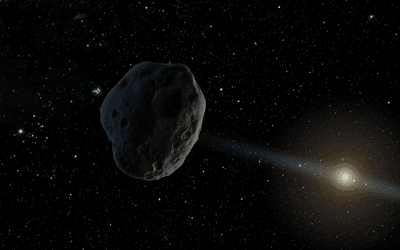
The body in question is 1998 SH2, and until very recently, it was believed to be an asteroid. New research now reports that this is a dark comet, a comet whose nature is not immediately obvious, lacking the traditional large and bright tail.
When we saw the magnitude of that acceleration, the speculation is that maybe this object was not an asteroid but a comet.
Davide Farnocchia
The last observations of this object were in 2016, but predictions placed its return near Earth at the end of August 2025.
On August 30 of last year, it would be at its closest, 3.1 million kilometers (just less than 2 million miles) from our planet.
Researchers set up to do some radar observations of 1998 SH2. Radar is a powerful instrument in studying near-Earth objects due to its high precision, reducing our uncertainty around an object’s orbit and improving our knowledge of its physical properties.
The problem was that 1998 SH2 was not where it should have been.
The team verified that it was not an instrument issue. Observations using visible light instead of radio waves found the object once again, but not in the right position. This suggested that something had perturbed the object. Close passage to planets can cause shifts, but nothing could explain the change with external forces.
“It turned out that you needed some pretty strong perturbations to the orbit to get there,” lead author Davide Farnocchia, a navigation engineer with NASA’s Center for Near-Earth Object Studies at JPL, told IFLScience.
“When we saw the magnitude of that acceleration, the speculation is that maybe this object was not an asteroid but a comet.”
The team believed that 1998 SH2 was generating some thrust by ejecting gas into space, as a rocket might do. This pushed it on a different path. The dark comet hypothesis was compelling, but it needed evidence.
The team used the Canada-France-Hawaii Telescope near the summit of Mauna Kea, as well as the European Southern Observatory’s Danish Telescope and Very Large Telescope in Chile.
I think that's pretty interesting because the idea that this was a comet didn't come from detecting the tails in the images. This came from the motion of the object.
Davide Farnocchia
Those images revealed incontrovertible proof that 1998 SH2 has a weak but clear tail. This is no asteroid. This object is a comet.
“Those are very large aperture telescopes, and so they could give us the resolution we needed to confirm the hypothesis that this object could in fact be a comet. We secured the time, we executed the observations, and sure enough, we found a tail. And so we were able to show that this object is a comet,” Farnocchia told IFLScience.
The findings are really exciting. Comets are usually found visually, due to their hallmark features. This 383-meter (1,257-foot) object was instead keeping its true nature hidden from us.
“I think that's pretty interesting because the idea that this was a comet didn't come from detecting the tails in the images. This came from the motion of the object,” Farnocchia told IFLScience.
This reclassification is very important with planetary defense in mind. If potentially hazardous objects are no longer where we think they are, it puts our planet at risk.
“It's important to keep tracking these objects over and over again. It's not like once you've discovered it, you're done. Because these perturbations can affect the motion of these objects and so can lead to a different assessment of what the impact risk is,” Farnocchia told IFLScience.
The study is published in the journal Nature Astronomy.