Space and Physics
 PUBLISHED


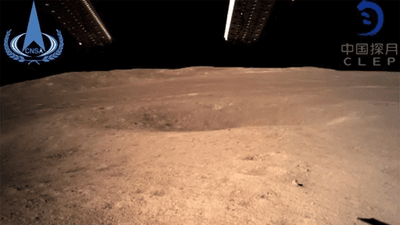


On January 2, 2019 at 9:26pm EST, China's Chang’E-4 probe did what no human or machine has ever done before, and landed on the far side of the Moon. According to a new study, the mission was a busy one.
As well as sending back the first views shot from the far side, and studying the lunar geology, the probe had time to conduct the first search for alien technology from our natural satellite.
There are a few ways in which scientists search for alien life. One is to search for exoplanets in habitable zones, using a number of methods (such as the wobble caused on a parent star by a planet) in order to do so.
Another is to search for signs of aliens trying to contact us directly, or otherwise communicating amongst themselves or with others, known as technosignatures.
So far, of course, we have found very little in the way of compelling evidence for technosignatures being sent by anyone other than one species of evolved ape right here on Earth.
There are several obvious scientific benefits of going to the Moon, including but not limited to the fact that you can study the lunar regolith up close. But there are a few less obvious benefits too. One of them is that our companion satellite serves as a really good shield against an increasingly noisy Earth.
"Chang’E-4 (CE4), the first mission to soft-land on the lunar farside, provides a unique opportunity for astronomical observations from an environment shielded from terrestrial radio interference [RFI] and thus serves as pathfinder for lunar farside radio search for extraterrestrial intelligence (SETI) studies," the team explained in their paper, which has not yet been peer reviewed.
"Operating on the lunar farside, it benefits from a much quieter electromagnetic environment, where the Moon strongly suppresses direct RFI contamination originating from Earth," they added, explaining that separating out interference from a possible real source is one of the major challenges for SETI.
It is largely assumed (perhaps due to our current level of technology) that aliens may use narrowband signals, like we do, for their efficiency in long-distance communication, as well as how easy they are to distinguish from the noisy, messy cosmos. And it was this which the team searched for.
As you are probably fully aware, given that the title of this article was not simply an excited "ALIENS FOUND BY ROVER ON THE MOON?!?", the search did not yield any technosignatures to speak of. In fact, after analyzing all of the data collected, the team did not manage to identify any particularly interesting candidate signatures, with "dominant structured features" found within it put down to most-likely being radio interference.
Nevertheless, the team was able to demonstrate proof of concept of using the Moon as a base for searching for technological aliens.
"The lunar farside provides one of the most favorable environments for radio observations, and upcoming lunar exploration programs are likely to make such observations increasingly systematic," the team concluded in their study, adding that a number of missions are planning to do just this.
"Future Chinese lunar mission plans, including Chang’E-811 and the broader international lunar research station roadmap, already point to planned radio astronomy payloads. NASA has started deploying low-frequency lunar radio spectrometers such as the Lunar Surface of the photoElectron Sheath (ROLSES) through the CLPS framework," the team adds.
"These developments are consistent with the view that lunar-based radio observations can provide a particularly favorable environment for SETI, and also suggest that the Moon, and especially the lunar farside, may become an increasingly important platform for future SETI studies."
The study is posted to preprint server arXiv.