Space and Physics
 PUBLISHED




The reason we haven’t heard from aliens could be remarkably simple: interstellar communication is hard, and turbulent plasma emitted by stars makes it harder. A new study proposes that when listening for signals from extraterrestrial civilizations, we’ve failed to allow for the distortion stars can cause.
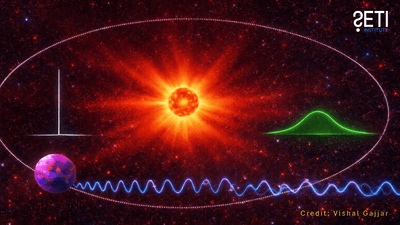
When radio astronomers detect a signal unlike anything they’ve seen before, non-astronomers rush to pronounce it aliens, but the finders often know that’s unlikely without needing any sophisticated testing. Although there are many ways to distinguish between signals that are probably natural or might be from aliens, the easiest is the bandwidth of the spectrum. Natural sources usually emit at a wide range of wavelengths. Artificial ones are expected to be narrow, particularly if they want to reach us, because broad signals waste vast amounts of energy.
Consequently, the Search for Extra Terrestrial Intelligence (SETI) concentrates on finding narrow signals, particularly searching at wavelengths we think aliens might choose. However, the new paper raises a problem with this, besides the one everyone can see: that without knowing aliens’ psychology, we can’t be sure of their favorite frequencies.
According to SETI’s Dr Vishal Gajjar and Grayce C. Brown, radio signals that pass through turbulent plasma broaden out, with their energy dispersed over a wider range of wavelengths. The plasma emitted by the Sun in its solar wind fluctuates even outside of major events like coronal mass ejections (CMEs) and could cause signal "smearing".
Astronomers already allow for some smearing induced by travel through interstellar space, but they haven’t previously considered what might happen within the signal’s home system.
"SETI searches are often optimized for extremely narrow signals. If a signal gets broadened by its own star’s environment, it can slip below our detection thresholds, even if it’s there, potentially helping explain some of the radio silence we’ve seen in technosignature searches," Gajjar said in a statement.
Gajjar and Brown decided to work out how large this local smearing was likely to be, using the effect of the solar wind on signals from spacecraft, and adjusting for differences between stars.
For some stars, the effect is small enough that ignoring the issue might be a reasonable approach, but for others, the smearing is a big factor. The team concluded that any aliens living on planets orbiting red dwarfs will have the greatest difficulty making their voices heard, unless they were willing to set up a repeater broadcaster in their star system’s outer reaches.
"Stars are very active. They have winds, they have coronal mass ejections. So what we were able to conclude is that some of these effects can completely wipe out any possible technosignature we can detect," Gajjar told IFLScience.
Red dwarfs are so faint that their only potentially habitable planets are quite close to the star, where the plasma turbulence is strong.
The authors conclude that for about 70 percent of star systems, a 1 GHz signal would be smeared by more than 1Hz, and for more than 30 percent of stars, the smearing would be greater than 10 Hz. The smearing gets even worse for longer wavelengths, and these calculations are during normal solar wind activity. CMEs would smear the signal, to steal a Hobbit’s phrase, “like butter scraped over too much bread,” over more than a kilohertz.
CMEs aside, this interference still leaves signals that would be far narrower than most natural sources, but many would also be missed by existing search techniques.
"One of the outcomes of the study was that that could perhaps explain the possible 'radio silence' [that] has been a question for [the] radio SETI community," Gajjar told IFLScience. "We've been trying to get a signal from extraterrestrial technology, but we haven't been successful. Maybe this could be one of the reasons."
Whether red dwarfs’ planets are candidates for hosting advanced life is one of the most contentious issues in astrobiology today. Some argue that their frequent flares, including those that contribute to turbulent stellar winds, would sterilize any planets close enough to host water. Others say there might be ways around this. However, with 70-75 percent of the stars in the galaxy being M-type red dwarfs, if there is any possibility they could host civilizations, it’s clearly very important we detect signals from them.
"By quantifying how stellar activity can reshape narrowband signals, we can design searches that are better matched to what actually arrives at Earth, not just what might be transmitted," Brown said in the statement.
There are far worse solutions to the Fermi paradox, but it feels like aliens trying to talk to us, and the signal being lost, might be one of the most frustrating ones.
The study is published in The Astrophysical Journal.