Space and Physics
 PUBLISHED
 1
1


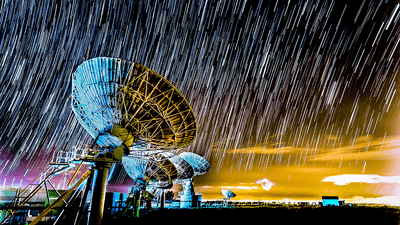


The “post-detection protocols” for announcing the discovery and existence of alien life have just had their first major update in 16 years, though the all-important "no reply" rule remains in place.
The universe is a pretty big place, and humans have only recently begun scouring it for signs of other intelligent lifeforms. While so far all we have heard is a great and eerie silence, there remains the chance that as our telescopes and understanding of the universe improve, we may one day find what we are looking for; signs of an alien intelligence, out there in the cosmos.
What should we do about it if we were to detect such a sign, be it a directed signal from a technological species, or telltale biosignatures on a distant exoplanet? What steps should scientists take next?
"We do not shout 'alien' the moment we see a strange blip"
These are questions that the International Academy of Astronautics (IAA) and the broader search for extraterrestrial intelligence (SETI) institute have put their minds to, first creating the “Declaration of Principles Concerning the Conduct of the Search for Extraterrestrial Intelligence" in 1989. These guidelines lay out what scientists should do at each stage of a detection, including how these findings should be communicated to the public. That latter task has gotten more difficult in recent years, and it was this area that had the greatest overhaul in the new 2026 update.
"The information environment we operate in today is vastly more complex than it was in 2010," Professor Michael Garrett, Chair of the IAA SETI Committee and professor of astrophysics at the University of Manchester, explained in a statement.
"In an era of deepfakes, automated misinformation, and instant global connectivity, unverified claims could trigger confusion or panic. These new protocols guide SETI scientists in maintaining the highest standards of evidence before making announcements to the world."
The guidance states that safeguards should be established for scientists involved in potential detections, who may face harassment or doxxing due to their involvement. Meanwhile, they establish the need to manage "viral" rumors about detections and potential detections, and the complex task of distinguishing the truth from potential hoaxes.
Overall the guidelines remain roughly the same, adhering to Carl Sagan's principle that "extraordinary claims require extraordinary evidence." The first step, as with previous guidance, is to verify any candidate detection of alien life and to seek independent examination of evidence by other organizations, preferably using other methods and instruments.
"We do not shout 'alien' the moment we see a strange blip," Garrett added. "The scientific method demands we check, check again, and then ask others to check. Only when we have reached a consensus that a signal is credible do we bring it to the world."
Nevertheless, these updated guidelines are not as prohibitory as the previous iteration, released before the rise of social media, in 2010. In the update, it is explained that scientists have no obligation to disclose verification efforts until a discovery is made, including through the media, and on social media. However, scientists should make use of these channels and respond to reasonable requests, the guidance states, though they should clearly identify speculative or unconfirmed conclusions as such.
"If a candidate technosignature is discovered, communication about ongoing observations and analyses may be necessary to dispel rumours and provide accurate and reliable information," the declaration states. "Similarly, if analysis determines that a previously reported candidate technosignature is not extraterrestrial in origin, this should be promptly disclosed and clearly communicated."
When a verification is made, the scientists involved are then obliged to report their discovery promptly "in a full, complete and open manner to the public, the scientific community, and the Secretary General of the United Nations."
Scientists should also take steps to protect the evidence of a detection, according to the updated guidelines. This could be in the form of protecting certain frequencies, for example, if the evidence came in the form of an electromagnetic signal.
No reply should be sent
The "no reply" rule remains in place in the updated guidelines. Essentially, we have no idea what an alien civilization may be like, nor what a confirmed detection will look like, either. There are those that think (usually after reading The Dark Forest) that we should never respond to an alien signal or detection, for fear of what we could be letting Earth in for if we did announce our own existence. But the guidelines are much more flexible, suggesting that there should be appropriate international consultations on whether to reply to an alien signal, and what that reply should contain.
"Pending the outcome of such consultations, no reply should be sent," the declaration says. "These consultations should be conducted through the United Nations and other broadly representative international bodies." The IAA SETI will also set up a Post-Detection-Sub-Comittee bringing together experts from fields including law, social sciences, and ethics to advise on how best to tell the public about a verified detection.
In short, the rough guidelines are; verify, then announce, and for god's sake don't reply until everyone has had their say. Please send your own ideas about how the government is keeping the aliens secret to unmonitored@iflscience.com.