Space and Physics
 PUBLISHED




Mars would be a terrible place to host Glastonbury for two reasons: Glastonbury is held in Glastonbury, and the way sound works on Mars is all kinds of messed up.
The speed of light in a vacuum is one of the most dependable things there is, compelled as it is to zip along at 299,792,458 meters (9.8 million feet) per second. It may slow a tiny fraction as it travels through a medium such as our atmosphere and interacts with molecules in the air, but whether you are on Earth or Mars you are going measure pretty much the same speed of light.
Sound, not so much. Sound is a vibration propagating as an acoustic wave through a medium, be it liquid, solid, or gas, and is very much dependent on the medium it is passing through.
On Earth, sound moves at 1,500 meters (5,000 feet) per second in water, and in air around 340 meters (1,115 feet) per second. In solids, sound can move much faster, though how fast very much depends on the solid in question.
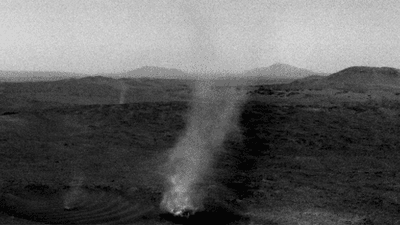
We do not have to simply infer how sound sounds on Mars, thanks to the many rovers that we have sent there. We even have sound recordings of dust devils whirling their way across the Martian regolith.
In 2022, an international team went about listening to the Red Planet more systematically used NASA's Perseverance rover to analyze how sound travels on the Red Planet. As well as this being the first time the speed of sound was measured on a planet other than Earth, the team found Mars to be a real freak of nature, and a terrible place to host any sort of gig.
The team measured the speed of sound in quite a simple way, firing lasers at rocks of a known distance and waiting to hear the resulting shockwave using the rover's microphones. Like on Earth, the speed of sound on Mars will vary quite a bit, but in the Jezero crater where the experiment was conducted it averaged out to 240 meters per second (540 miles per hour).
Another oddity, though by no means the oddest finding, was that the speed of sound varied by around 10 percent from day to night. This is to be expected due to the temperature change (see this story on how on one cold day in Canada, people could hear others talking from kilometers away, for example) but would be a real pain were there lifeforms on the planet. Martians should schedule their gigs for the daytime, for example, so that sound doesn't take ages to arrive.
The real oddity though (for those of us that are used to Earth sounds, which is every lifeform that we know of) is that there is a change in the speed of sound at a range that you can hear.
"Due to the unique properties of the carbon dioxide molecules at low pressure, Mars is the only terrestrial-planet atmosphere in the Solar System experiencing a change in speed of sound right in the middle of the audible bandwidth (20 Hz–20 kHz)," the study, presented at the 53rd Lunar and Planetary Science Conference, explains.
"For an acoustic wave with a frequency higher than ~240 Hz [just below middle C on a piano], CO2 vibrational modes activated through collisions do not have time to relax their energy," they added.
"It turns out that, on Mars, frequencies above 240 Hz travel more than 10 [meters per second] faster than low frequencies. It may induce a unique listening experience on Mars with an early arrival of high-pitched sounds compared to bass."
While lower sounds traveled at 240 meters per second (537 mph), higher-pitched sounds moved at 250 meters per second (559 mph). To make gigs more hassle than they are worth (let's not factor in that anybody listening outside of a space suit would die anyway) sound does not carry far, and higher-pitched sounds make it even less far than that.
"On Earth, sound might drop off after about 213 feet (65 meters); on Mars, it falters at just 26 feet (8 meters), with high-pitched sounds being lost completely at that distance," a NASA press release at the time explained.
In short, Mars ain't the kind of place to host your gigs. In fact it's cold (and sparse) as hell.