Space and Physics
 PUBLISHED
 3
3


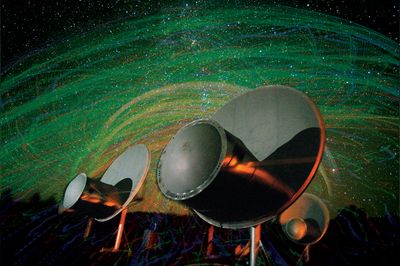


The claim that interstellar comet 3I/ATLAS was an alien probe was always ridiculous. It was an exceptional comet for sure, but if it looks like a comet and moves like a comet, you should first and foremost assume it’s a comet. Still, the SETI Institute wanted to be very thorough and conducted a deep search for possible radio emissions from it.
Scientists used the Allen Telescope Array and looked at the comet for seven hours across a variety of radio wavelengths. They found that there is no radio transmitter stronger than 10-110 watts on or near this interstellar object. So unless the aliens are actually communicating via toy walkie-talkies, we can assume the comet is not transmitting anything to anyone.
There are actually two interstellar objects that produce artificial radio transmissions right in that range. Unfortunately for alien hunters, those two objects are human-made. They are the Voyager probes. Their radio transmitters' strength is about 23 watts, but they are very far away, so we get an extremely weak signal here on Earth.
The power supply of either Voyager will be long dead before they pass near any other star system, and they wouldn’t even get as close as 3I/ATLAS got to the inner Solar System. Still, it was a good exercise to check if there was a similar radio emission from an object such as this.
"The results from 3I/ATLAS show how realistic it is to detect a signal with the technology we have today,” Valeria Garcia Lopez, co-author of the study, said in a statement. “That is why it is important to keep searching for technosignatures, even from objects we might not expect to have signals."
Also this week, observations from JWST conducted in December have revealed that 3I/ATLAS was truly a special object. In particular, the space telescope reported its first observation of methane from the comet.
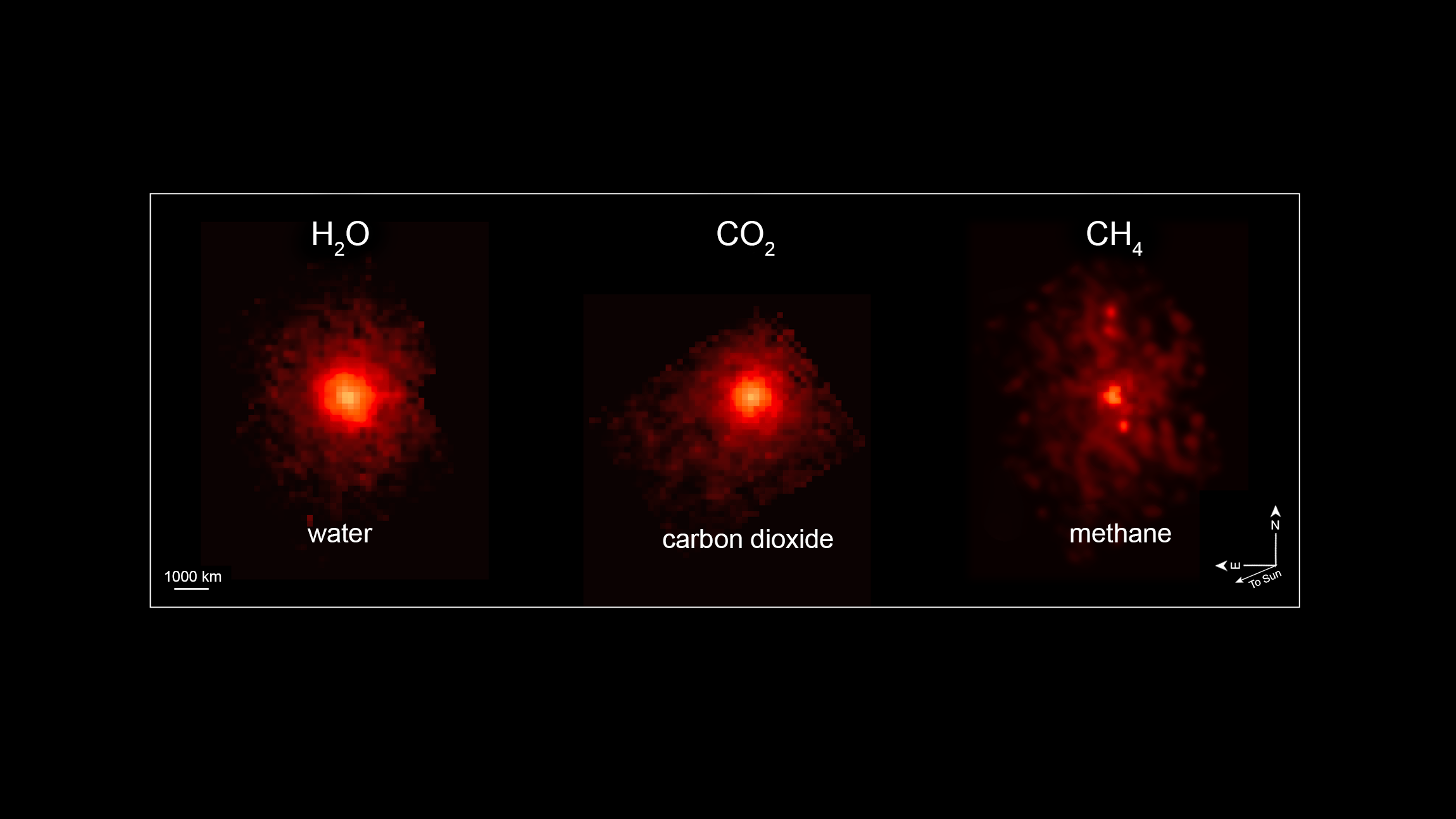
The new views show that water vapor spread a lot further from the cometary nucleus than both methane and carbon dioxide. This would suggest that those gases are buried deeper into the surface, and it is much easier for the ice grains to escape.
What JWST’s observations revealed is that the amount of methane and carbon dioxide relative to water is surprisingly high compared to Solar System comets. This once again suggests that this comet formed in very different conditions to the comets in the early Solar System!
The paper from the SETI Institute is published in The Astronomical Journal. The results from JWST are published in The Astrophysical Journal Letters.