Space and Physics
 PUBLISHED



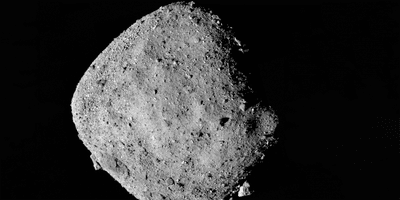


Scientists believe they have worked out where asteroid Bennu formed in the solar system. It is hoped that the answer will provide new insights into the formation of the inner planets, including Earth.
Asteroid Bennu is a fascinating puzzle. It formed from material that must once have been rich in water, as scientists saw water had affected the asteroid's composition in samples collected by NASA’s OSIRIS-REx mission and returned to Earth in 2023.
This would suggest it formed in the outer solar system beyond the “snow” or water-ice line, and it only moved closer to us much later. If it had formed closer to the sun initially, that water would have been in vapor form and wouldn't so easily have become tangled up in the formation of the asteroid.
Bennu is now relatively close to Earth and orbits the Sun once every 1.2 years. Every six years or so it gets within around 300,000 kilometers, making it the most dangerous asteroid we know of, with a small chance of hitting us in 2182.
The latest chemical analysis of the OSIRIS-REx sample, however, revealed commonalities not only with material from the outer solar system but also with the dust of the inner solar system. The researchers – who had just half a gram of the precious material to work with – say this means Bennu formed in a transition zone right at the solar system's snow line.
“Bennu is a hybrid: the material does not clearly match either the inner or the outer solar system,” lead author Professor Maria Schönbächler at ETH Zurich said in a statement.
And it isn't just Bennu that potentially came from this region. One of the other two sampled asteroids, Ryugu, visited by the Japanese mission Hayabusa2 in 2018, is believed to have come from the same reservoir of cosmic dust. A class of meteorites called CI meteorites are also thought to belong to the same family.
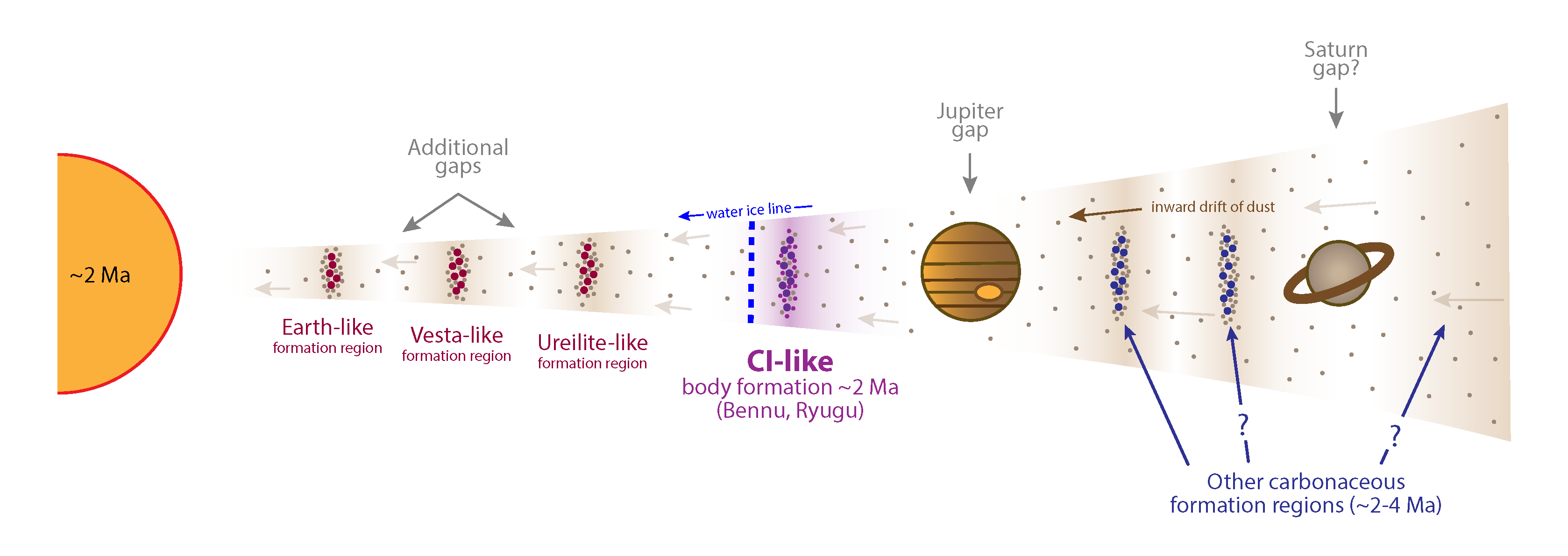
It's curious that the asteroid would have such an odd composition and also have formed at this specific point in the solar system, and the team proposes Jupiter might have something to do with why.
The largest gas giant was also the first planet, forming just 1 million years after the Sun, and its gravitational influence might have caused fine dust from the inner and outer solar system to mix together right at the water-ice line while blocking larger dust particles.
This scenario would explain why Bennu and Ryugu both seem to be composed primarily of tiny particles, the researchers argue, which incidentally makes these asteroids chemically extremely similar to the material that made up the sun itself, as well as the rocky planets of the inner solar system.
Due to the fact the asteroid is rich in water and organic material, it also provides important pieces of the puzzle regarding how the young Earth acquired the building blocks of life.
“Bennu may offer our best glimpse of the original mix of chemical elements from which the terrestrial planets were ultimately built,” said Schönbächler. “We are now wondering whether other asteroids have the same isotopic signature as Bennu and Ryugu,” she added.
A paper discussing the work was published in the journal Science Advances.