Space and Physics
 PUBLISHED
 3
3


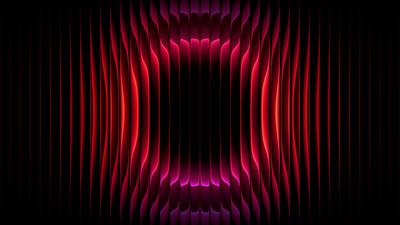


The world of particle physics is filled with very weird things, but this latest one might take the cake. Meet the glueball, a particle that is made of nothing we would consider matter – and yet, according to a Chinese team, it is very much there.
The name "glueball" is pretty self-explanatory as long as you know that there are particles known as gluons. These are the mediators of the strong nuclear force, just like photons – the particles of light – mediate electromagnetism. And just like photons, these gluons have no mass.
We do not experience the strong nuclear force, like we do with magnetism or gravity, but we wouldn’t be here without it. The strong nuclear force keeps the quarks, the fundamental particle usually at the center of atoms, together.
In our current theory of fundamental forces, AKA quantum chromodynamics (QCD), particles can have a specific color charge. This has nothing to do with real color that we perceive, it's just a naming convention. The idea is that particles ought to be colorless, so you need to have combinations that achieve that.
Think of color theory and how you can make white light using red, blue, and green. A proton at the center of a nucleus is made of three quarks, so to get a colorless result they should have red, blue, and green charges.
Now, let’s forget color theory because there are also particles called mesons that have only two quarks, and so their color charge is going to be red and anti-red, blue and anti-blue, or green and anti-green.
We said it was weird!
To add to the weirdness, gluons – which remember, have no mass – also come with a color charge. Thanks to that property it is possible, according to the theory, for gluons to interact in such a way that they form a particle – no matter what is necessary for the job.
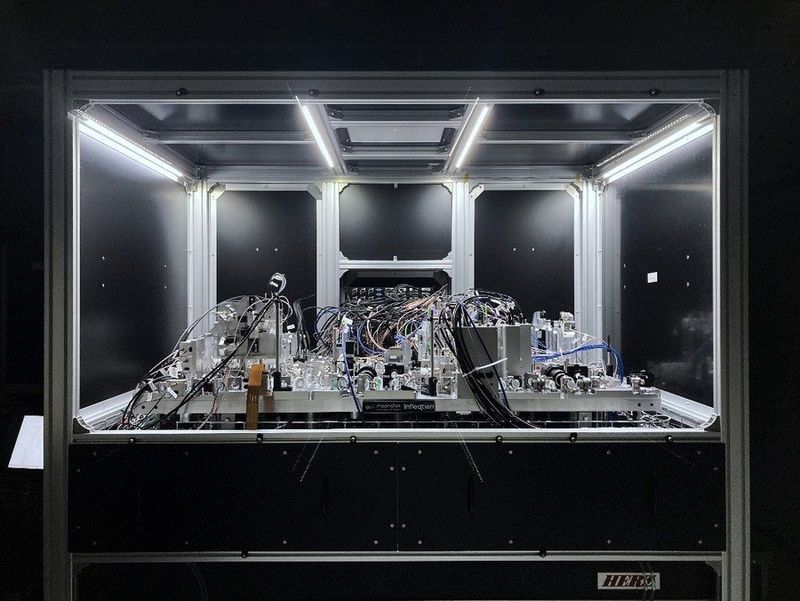
For that, we come to the Beijing Spectrometer III (BES III), a particle collider located in China that is great at producing a very special particle: the J/ψ meson (pronounced jay-psi).
As we said, mesons are made of two quarks; in this case, it is a charm quark and a charm antiquark. Like other mesons, J/ψ is very unstable, and it decays into other particles in just a fraction of a second.
Back in 2024, researchers reported the existence of a possible particle known as X(2370). Already, the particle appeared to have the right characteristics to be the lightest possible gluon in QCD.
In a preprint paper posted last month and in a follow-up presentation at the International Conference on High Energy Physics (ICHEP) last week, the team presented new observations. These strengthen the idea that they are indeed looking at a glueball.
The properties match expectations for a glueball, and the team believe that the particle is made of 90 percent gluons.
To confirm if this glueball is actually there, it will need independent verification. This might take a while – BES III is ideally designed to look for glueballs, like no other machine on Earth!
The study is available via preprint server arXiv.
[H/T: Science]
Correction (August 17, 2026): There was a typo in the last sentence of paragraph two which has now been corrected. The corrected sentence reads: "And just like photons, these gluons have no mass."