Space and Physics
 PUBLISHED


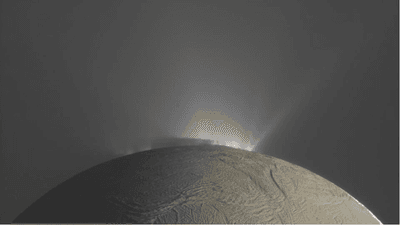


Two papers published together raise the chances that life might exist in the ocean inside Saturn’s moon Enceladus, and that we might be able to detect its presence in the spray from its geysers.
Hopes for the prospects of life in the outer Solar System have been on a rollercoaster ride in recent years, with some papers seeming to raise the chances, while others appear to dash them.
It will be a long time until we get a final word, but Professor Frank Postberg of the Freie Universität Berlin has contributed to two studies, published together, to show why Enceladus retains great potential.
The case for Enceladus rests on two observations: its wobble proved it has a liquid ocean inside, as tidal heating melts some of internal ice, and the geysers near its south pole provide opportunities to analyze that ocean’s composition. We now know that internal oceans are a common feature of the Solar System’s larger moons, but Enceladus may be unique in spraying the evidence into space probes’ paths.
Lab bench Enceladus
Scientists at Ludwig-Maximilians-Universität München attempted to recreate Enceladus-like conditions in a lab, with Postberg and other planetary scientists contributing their best advice on what those conditions are likely to be like.
They found that Methanothermococcus okinawensis, an archaeon that thrives around hydrothermal vents in the Pacific Ocean, could survive in these conditions, despite Enceladus probably being much more alkaline than M. okinawensis’s usual home.
“On Enceladus the specific geochemical conditions might allow one of the oldest known metabolic systems on Earth to work, even in very alkaline environments,” Postberg said in a statement.
If an earthly life form can survive under such conditions, something that evolved for them should thrive.
The road to this discovery was not entirely smooth, however. When the authors tried putting their organisms into a medium where pH levels of 10 or 11 appeared to be the only obstacle, M. okinawensis failed to grow.
However, once other Enceladus-like features, which had been expected to reduce the prospects for an earthly organism, were added to the alkalinity, the archaeon made itself at home.
“This was really a surprise to us,” Dr Nozair Khawaja said. “This was an experiment for which we did not expect such a successful outcome.”
One of the suspected features of Enceladus’s ocean is a shortage of carbon dioxide, relative to Earth. M. okinawensis can do without oxygen, but it still needs carbon dioxide. However, it proved astonishingly efficient at gobbling up the little that was available.
M. okinawensis’ success in the model Enceladus is thanks to the presence of hydrogen, thought to be produced by interactions between the ocean and the outer surface of the rocky core. The free hydrogen gives the microbe its energy source.
Although our knowledge of the chemistry of oceans inside Europa, Titan, and some of the moons of Uranus is even more doubtful than for Enceladus, it’s possible that the conditions Khawaja and co-authors created apply to these as well.
However, we are many decades, probably centuries, off being able to sample the oceans deep inside other moons to test if life has found a way. That’s where Postberg’s other study reinforces Enceladus’s difference.
Preprocessed ice grains
The Cassini spacecraft flew though the spray from Enceladus’s geysers on the way to becoming Saturn’s E-ring. Although not designed with this opportunity in mind, and therefore lacking the instruments NASA wish were sent, the Cosmic Dust Analyzer confirmed the presence of salts and organic compounds in the ice particles.
Postberg and co-authors argue that the ice grains Cassini sampled froze more slowly than previously thought, probably as a result of gas bubbles bursting low in the vents that run from ocean to surface. Freezing speeds approaching 20°C per minute (36°F per minute) might seem very fast to us, but they’re slow enough to allow chemical components to separate within a grain as salts precipitate at different temperatures.
If a separated grain’s journey into space includes bouncing against the sides of the vent it passes through, it can break apart into samples of ice mixed with one or two relatively concentrated impurities.
“Enceladus actually does a lot of the work for us in preparing samples for analysis that usually take a lot of effort in chemical labs on Earth,” Postberg said. “The oceanic constituents are separated from each other and simultaneously concentrated into individual ice particles.”
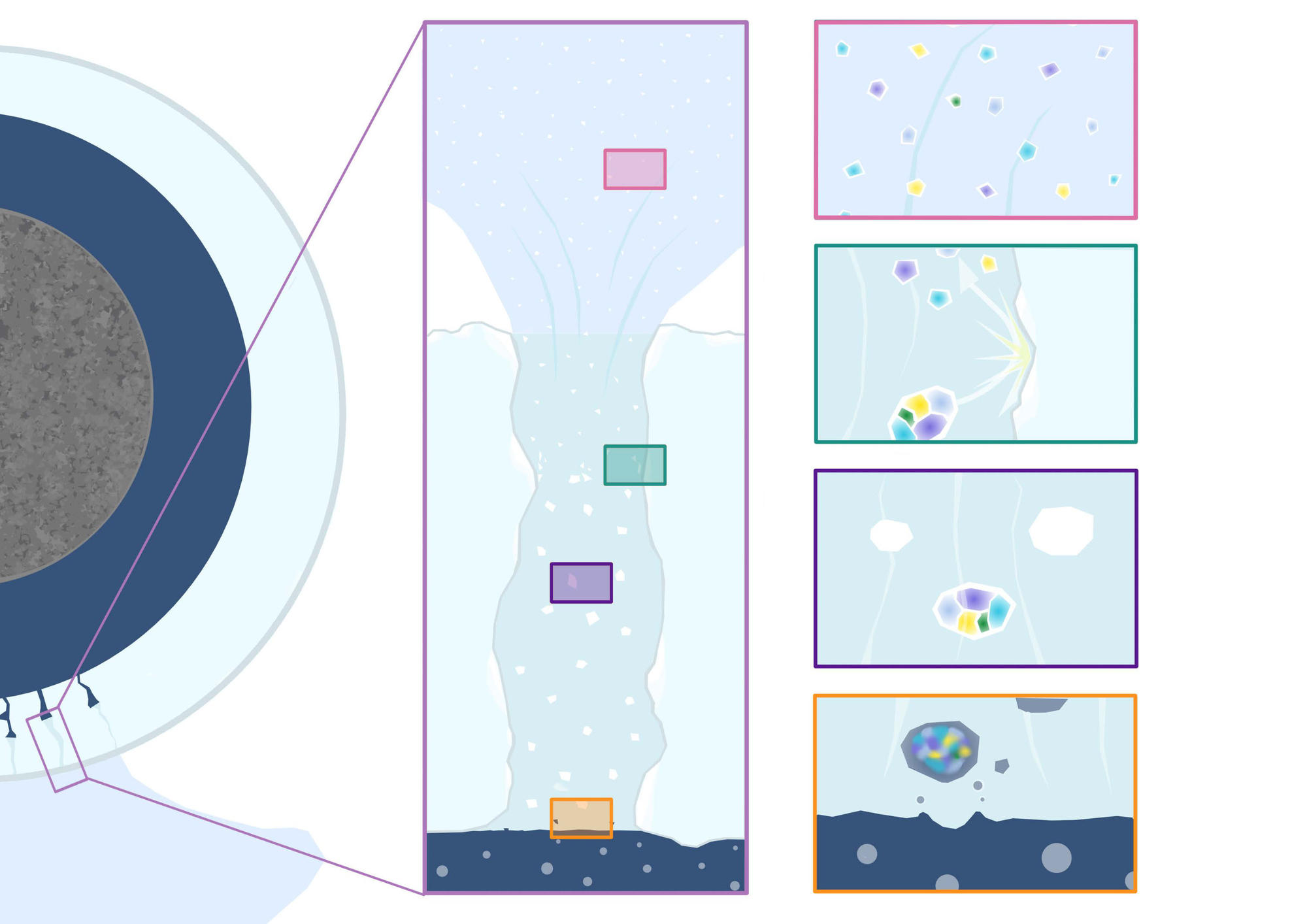
As a result, the grains Cassini collected are quite varied. Most are almost pure frozen water, but among those with significant impurities, some are dominated by sodium chloride, others a mix of sodium bicarbonate/sodium carbonate. Three other grain types are less likely to feature in the average pantry.
This means that if there is life inside Enceladus, instead of every ice particle carrying a faint sign of it, only a few would carry the signal, but for those it would be quite concentrated.
“That is great news in the search for life,” Postberg claimed. “Future spacecrafts will have to analyze many individual ice particles in the plume. But if they come across one with microbial material in it, they could identify biosignatures in the particle relatively [easily] with already available technology.”
So far, NASA has chosen not to prioritize Enceladus as a target for future missions, while the other three top prospects for extraterrestrial life – Mars, Europa, and Titan – are all about to get individual attention. That’s despite the fact that an Enceladus mission could also tell us much more about Saturn’s other moons than the one planned for Titan.
The European Space Agency is currently planning the L4 mission to fill that gap, although with an intended launch date of 2042 and 10 years’ travel time, there’s plenty of opportunity for the rollercoaster to turn downwards again first.
The two papers are published in Science Advances, here and here.