Space and Physics
 PUBLISHED


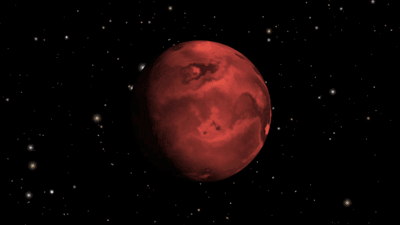


Astronomers have been surprised to discover a class of very hot planets with thick atmospheres.
How these atmospheres survive is major mystery, and solving it may offer insight into the prospects for worlds cool enough to support life, so the discovery of the coldest member of this class yet to be found is significant.
Planets that orbit close enough to their stars to become extremely hot are thought to tidally lock quickly, meaning one side always faces the star. That makes the day side becomes even hotter, taking many of them past the point above about 800°C (1,500°F) where silicate rocks melt to lava. Meanwhile the night side could be very cold.
However, observations indicate that for some of these “lava worlds” have day sides with temperatures cooler than their proximity to their star would suggest. That indicates heat is either being reflected by clouds, or redistributed by an atmosphere to the night side, or both. HD 3167 b is the coolest example yet.
The existence of lava planets with atmospheres is a puzzle in itself. A hot planet means a hot atmosphere, giving gas molecules more energy to escape.
Moreover, Dr Edwin Kite of the University of Chicago noted in a statement; “The closer a rocky planet orbits its star, the harder it should be to have an atmosphere, because it’s bombarded by stellar wind and gets more high-energy photons from the star. But it seems that many of these lava worlds do.”
Kite has had PhD students looking at known ultra-hot rocky planets to see which ones show signs of an atmosphere. Against all expectations, rather than the cooler lava planets being the ones to retain an atmosphere, so far it’s been some of the hottest.
That makes HD 3167 b particularly intriguing, as the coolest example yet found. Either there is a temperature threshold where atmosphere survives, and HD 3167 b is just above it, or something has allowed it to hold onto an atmosphere when planets at similar temperatures have not. Both would have very interesting implications.
HD 3167 b has a radius 60 percent larger than Earth’s and orbits its star in 23 Earth hours. Using the brightness of HD 3167, Kite’s team calculate with thick atmospheres the planet’s day side should have a temperature of exceeding 2,200°C (4,000°F). Yet the light reflected is more consistent with 1,500°C (2,700°F): still staggeringly hot, but indicating either much of HD 3167’s light is being reflected or distributed. It’s possible it has a very white surface, but the team considers an atmosphere much more plausible.
Team member Brandon Coy noted that we don’t know the composition of HD 3167 b’s – or any lava world’s - atmosphere. “Before this study, we expected that any atmosphere on these ultra-hot planets would be composed of vaporized rock, but we’re starting to see evidence that some might have heavier gases like carbon dioxide, carbon monoxide, or water in their atmospheres,” Coy said.
These ultra-hot planets get most of their heat from their stars. Earth, at a vastly greater distance, never received anything like that much Sunlight. Nevertheless, it is thought our home went through a similar stage, when the energy from being bombarded by giant asteroids created a magma ocean. Anything we learn about planets like HD 3167 b could prove relevant for reconstructing the early Earth.
The study is open access in The Astrophysical Journal Letters.