Space and Physics
 PUBLISHED



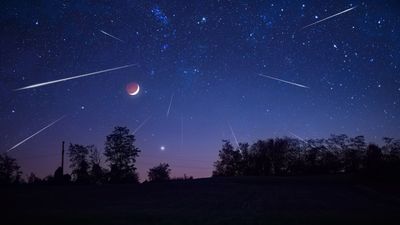


We had a summer of eclipses in the northern hemisphere, and we are going into a fall of bright planets and meteor showers. Though our friends in the south didn't get the solar eclipse, they will be seeing many of these upcoming astronomical sights, with the benefit of warmer nights as they hunt for the fireballs of the southern taurids.
First and foremost, it’s a full moon tomorrow. It’s the so-called Harvest Moon, which will be a stunning sight if you are looking at the sky with your naked eye. Not as stunning as the remaining three full moons of 2026, however, which will all be supermoons.
What's a supermoon, you ask? Well, the Moon gets closer and farther from Earth in its orbit, so when the full moon happens while it's at a closer point in that cycle, the Moon looks larger and brighter. The dates for the three full supermoons are October 26, November 24, and December 23.
If you have a telescope, you might be a bit annoyed that there is a full Moon tomorrow, because tomorrow also sees Neptune at opposition. Opposition is when Earth, the Sun, and that planet lie on a single straight line, so the planet, in this case the distant Neptune, is at its brightest and closest.
Neptune will continue to be bright for a while, however, so you still have time to see it at a later date. And if you are pointing your telescope at the sky, you might as well look for galaxy NGC 7331 and the supernova currently near its center as well.
When it comes to opposition, you have a better chance with Saturn. It will be at opposition next Saturday, October 4. It is already plenty visible, but it will get brighter, and the moon will be in its waning quarter so it won't compete as much as the full moon tomorrow. Also, there's no need for a telescope to see the "Lord of the Rings," you can see it with your naked eyes.
The trick to spotting a planet is simple. Unlike stars, planets don't twinkle. A star might as well be a point of light, so turbulence in the atmosphere makes this point move about. Planets are little disks, so turbulence doesn't have the same effect.
Saturn will be visible to the east in the early hours of the night, so look that way to spot it.
Last but certainly not least, the Southern Taurids meteor shower. This is one of the longest meteor showers we get, with fragments of comet Encke streaking across the sky from this week all the way to December.
The peak is expected to be the night of November 4 and November 5, which will be a fair night for meteor watching as the Moon will be in its waning crescent.
The Southern Taurids are known as the Halloween fireballs because they peak around the holiday. These meteors tend to have chonkier pieces than the average, and when it comes to meteors, size does matter, as larger ones are a lot brighter.
Same advice as with other meteor showers. Put your phone down and let your eyes adjust to the darkness. The Taurids radiate from the constellation of Taurus, so look for it (or the more iconic and nearby Orion).