Space and Physics
 PUBLISHED



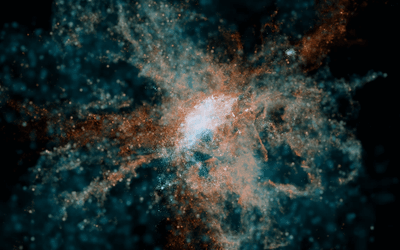


Our understanding of the early universe has just significantly changed.
We assumed that it took may hundreds of millions of years for the universe to become enriched in oxygen, carbon, and the other heavier elements. New observations challenge this picture.
In the seconds and minutes after the Big Bang, only hydrogen and helium (and a sprinkling of lithium) formed. All the other elements were eventually created by stars.
We have never seen the very first generation of stars. But it looks like they must have been quite the powerhouses in both producing and spreading the elements, as new JWST observations show that these heavier elements were being spread out from these galaxies as early as 500 million years after the Big Bang.
Observations of the early universe had already challenged how quickly a galaxy can become polluted by elements other than hydrogen and helium. Now, it looks like they were able to spread them out into intergalactic space.
“We observed that heavy elements escaped from galaxies very, very early in cosmic time,” lead author Dr. Yongda Zhu, from the University of Arizona, said in a statement.
“Not only were the galaxies producing these elements, but they were also dispersing them, possibly seeding other galaxies.”
Cosmic backlighting
That period of the universe is known as the Epoch of Reionization. Most of the hydrogen in the universe at that point was neutral (so made of a proton and an electron).
The light of young stars ended up ripping those electrons away, a process called ionization. Because this was the second time hydrogen was ionized - as that is also how it first formed - it’s called reionization.
The team used the light of even more distant objects to backlight the gas that surrounded the galaxies that existed roughly 12 billion years ago, or just about 500 million years after the Big Bang. The more distant sources illuminate this gas, and the team was then able to work out the elements present.
“We used the galaxies themselves as background light sources,” said Zhu. “As light from the galaxies traveled toward Earth, it passed through surrounding gas, and we were able to look at the light's absorption patterns to detect specific elements.”
Based on these observations, the work suggests that even at that early time in the history of the universe, when the cosmos was just 3 percent of its current age, the galaxies had a chemical composition already similar to galaxies that existed billions of years later. This suggests that the enrichment was really fast.
“If you start out with pure vanilla ice cream but start mixing in sprinkles soon after, it won't be long until you can no longer find any pristine, plain, vanilla ice cream,” Zhu said.
A paper describing the observations was published in the journal Nature Astronomy.