Space and Physics
 PUBLISHED


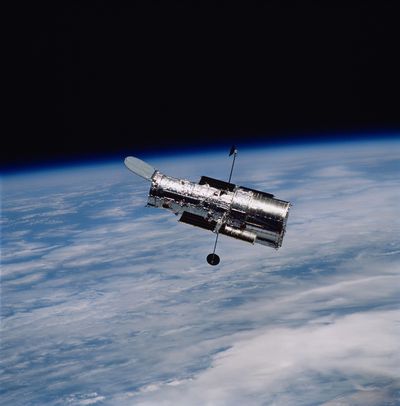


The Hubble Space Telescope continues to break records. Last Friday, September 19, it completed an incredible 200,000 orbits around the Earth, probably among the few working orbital systems that have ever crossed that threshold.
At 36 years old, with over 1.7 million observations in its illustrious and continuing career, the telescope has been going round and round our little planet. Hubble is an almost circular orbit between 470 and 475 kilometers (292 and 295.2 miles). It completes one orbit every 94 minutes, enough to get over 200,000 in its lifetime so far.
Old satellites still out there…
There is older stuff in orbit that continues going around our planet and will do so not just for decades to come, but maybe for centuries. The reason for that is that they are on higher orbits.
Eventually, almost 500 kilometers (300 miles) up in the sky and much higher, there is a little drag from the extremely tenuous outer layer of our atmosphere. Over time this creates drags, which slow down the satellite. Slower satellites go around at lower altitudes, where they experience more drag, and eventually they burn in the atmosphere.
The satellites that are lower down go around the Earth the fastest but have on average a shorter lifespan, so clocking these many orbits is rare. There are few exceptions, so here is a bunch of non-functioning satellites that are still going around.
The oldest satellite in space is Vanguard 1, launched at the very beginning of the Space Race in March 1958. It has clocked over 274,550 orbits by the time you read this article, and since it won’t come up until 2198, at least, it might be the one that get the crown in the end.
Two scientific satellites have got Vanguard 1 beaten. The first is Explorer 7, launched in October 1959, and the second is the weather satellite TIROS-1 from March 1960. Respectively, they clocked over 347,440 orbits and over 352,640.
TIROS-2 decayed in 2014, while TIROS-3 is still there and is following suit in number of orbits. These satellites were placed in elliptical orbits that are quite far from the Earth while being still pretty fast. That’s what allowed them to get so many orbits in them.
Unfortunately, their missions were very short. And the fact that they still clogged low-Earth orbit is far from a ideal. Space junk is a major problem.
How many orbits has the ISS experienced?
The International Space Station too has gone around the Earth a lot. It goes around every 93 minutes or so, over 15 times a day. Its first module was sent up in 1998, so the ISS experienced a whopping 152,800 orbits and counting.
Humans have been in the ISS for almost 26 years, so we have not crossed the 150,000 orbits yet.
That will be crossed on April 2, 2028! Whoever is in the ISS that week, better have cake!