Space and Physics
 PUBLISHED


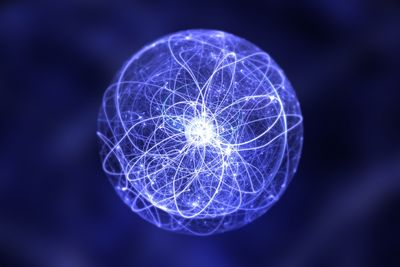


Quarks are truly funny particles. They are the fundamental building blocks of the protons and neutrons, but we have never seen them directly. It is also impossible to have a single quark: they do not exist individually.
They are either in pairs, triplets, or more.
If two quarks are pulled apart, the energy to separate them is so high that it creates two extra quarks in the process. Thanks to a quantum computer, this can now be simulated in the lab.
The phenomenon is called string-breaking. The strong nuclear force, one of the four fundamental forces, holds them together a bit like a taut string.
It is possible for particles to pop into existence if there is enough energy in a concentrated space. The breaking of the strong nuclear bond, once the distance and the energy are beyond a certain threshold, is enough to create two new quarks.
Studying this is easier said than done. Quarks are studied indirectly thanks to the most powerful accelerators. We do not have ways to slowly pull apart quarks and see what happens.
Quantum computers might be the solution to this problem. A team from the Duke Quantum Center (DQC) used a quantum simulator made of trapped-ion quantum computing.
Ions are atoms that have an electric charge due to having extra electrons or lacking some. The simulator was made of 13 trapped ions that could be tuned with lasers. The setup of the simulator was encoded to act like a string-breaking model.
The simulation was then validated with a regular computer that confirmed the accuracy.
“Working at the intersection of quantum simulation and high-energy physics is incredibly exciting,” first author Arinjoy De, previously at DQC and now machine lead at QuEra Computing, said in a statement.
“By simulating quark confinement and string-breaking phenomena in a controlled lab environment, we're opening up new pathways for experimental investigations into the behavior of matter at its most fundamental level.”
The work is a first step in building quantum simulations that are complex enough to go beyond what is possible to recreate with supercomputers. The “going-beyond” is a crucial promise of quantum computers.
“Quantum computer simulations provide the best platform to investigate complex questions like matter formation, short of having witnessed the Big Bang itself,” added Professor Christopher Monroe.
“These findings signal a marked development in the quantum science field and open new avenues for us to understand string-breaking dynamics.”
A paper discussing the results was published in the journal Nature Physics.