Space and Physics
 PUBLISHED



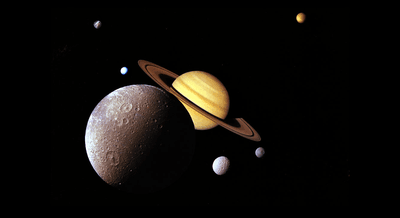


In less than two years’ time, all going well, NASA will launch its Dragonfly mission to Saturn's moon Titan. Many people would prefer it was going to Enceladus, but Saturn has at least 293 Moons, more than every other planet in the solar system combined.
Individually none of these may compete with those two for reasons to send a spacecraft more than a billion kilometers, but it’s often overlooked just how strange and different some of these others are.
Why planetary scientists are obsessed with Titan and Enceladus
As the only moon in the solar system with a thick atmosphere, Titan was always going to attract attention, especially given parallels between its atmosphere and that of early Earth. Still, we’ve been there before, landing the Huygens probe on the moon's surface in 2005. If Dragonfly is successful, it will mean Saturn’s largest moon will get two Earthly visitors before any of the other moons receives a single one.
Enceladus is clearly the second favorite. It is only Saturn’s sixth largest moon, but it’s been the focus of hundreds of IFLScience stories since it was discovered that it has an internal ocean that may supply enormous geysers that spray from near its south pole.
If NASA had chosen to, the forthcoming voyage could have involved a spacecraft snatching ice particles out of these geyser plumes on the way to Saturn's E-ring. These samples might then have revealed more about the internal chemistry of Enceladus, potentially including if there are prospects for life in that ocean.
But Titan and Enceladus are far from the only moons on offer. Of the remaining 290, Saturn has five more moons considered “major satellites" because they are large enough to be almost spherical. Four of these are quite similar in size and at first sight look rather similar, too, yet each has their own distinctive features, and we think they're worth talking about.
Possible rings and a two-tone moon
Perhaps surprisingly, the largest of these may be the least interesting. Nevertheless, Rhea has a couple of interesting quirks, including that it has been found to deplete the plasma in Saturn’s magnetosphere of electrons.
The original explanation for this was that Rhea might take after its parental planet with a set of faint dust particle rings. Sadly, such a ring system – which would get the beautifully alliterative name "the rings of Rhea" – is unconfirmed, but if it turns out to be real, it would be the only case we know in which a moon has its own rings.
While that point of interest is just a possibility, there is no question about Iapetus, the next moon in size. Its contrasting sides, one dark, one light, have been inferred for three centuries and were obvious to the Voyager missions. The dark leading hemisphere is slightly reddish-brown in color, very different not only from its other side but also from all the comparable moons.
This difference meant that Giovanni Cassini could see Iapetus when it was on Saturn’s western side, with its bright face aimed towards us, only to fail to find it months later when the dark side was pointed our way. The mission named after him found subtle differences between different parts of the dark hemisphere.
The bright side is mostly ice, while the dark is composed of organic compounds like those found on carbonaceous meteorites and some comets. The difference is self-sustaining because the dark areas absorb more heat from the Sun, becoming around 16°C (29°F) warmer and causing any ice that settles there to turn to gas. Some of this gas escapes Iapetus’ weak gravity, but some instead settles on the bright hemisphere, continuously painting it white.
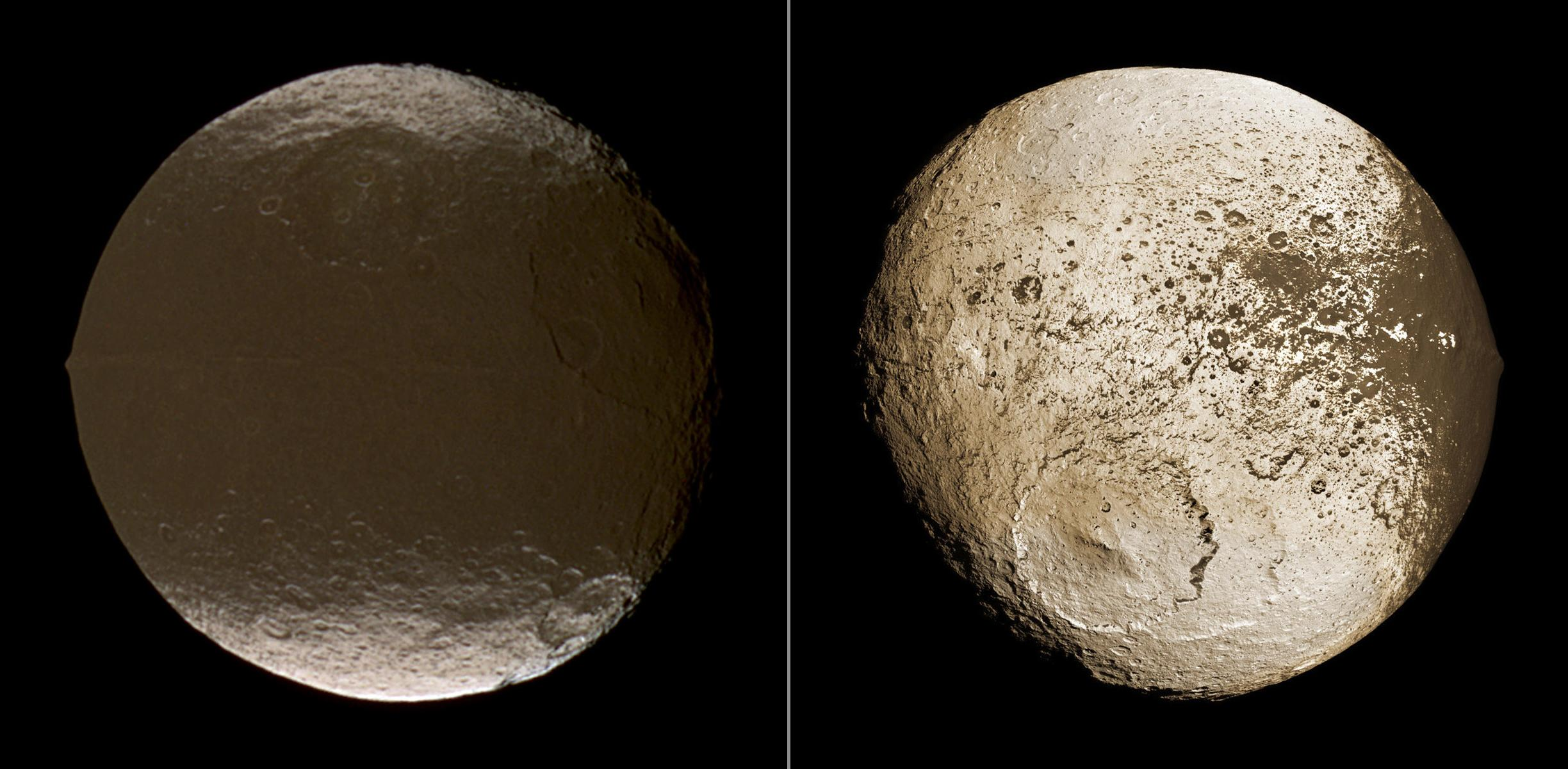
Although we know why Iapetus maintains its contrasting tones, how it got started is another matter. One likely hypothesis is that captured asteroids further out in Saturn’s system shed dark material when hit by space rocks, and this material drifted around Saturn until it was swept up by the leading edge of its moons.
So why then do none of the other moons of Saturn show a similar contrast? Perhaps because the others have shorter orbits. Since all these moons are tidally locked and nearer to Saturn than Iapetus is, their days and nights are shorter than its, and therefore the temperature differences never get large enough to be self-sustaining.
Besides all that, there’s the question of why Iapetus’s orbit is strangely tilted relative to Saturn’s equator and all the orbits of the other large and medium-sized moons, and what the hell is going on with its bizarre ridge.
Overshadowed by its little siblings
Dione is more interesting for its relationships to other objects than for itself. Most importantly, its orbit takes exactly twice as long as Enceladus’s, which is thought to keep Enceladus in a slightly eccentric orbit. This creates tidal flexing of Enceladus that provides the internal heat needed for the existence of its partially liquid interior, the reason it’s such a target for quests for extraterrestrial life.
Besides its effect on Enceladus, Dione has two of the four known Trojan moons in the solar system. These are moons that share Dione’s orbit, with Helene 60 degrees ahead and Polydeuces 60 degrees behind. Polydeuces appears particularly uncertain about this thruple, moving up to 30 degrees away from its point of stability, as if seeking a way to escape its Dione dependency. A third reported Trojan of Dione remains unconfirmed.
If moons had feelings, Dione would probably be quite aggrieved by how overlooked it is. It probably has a salty internal ocean like Enceladus, but because it doesn’t spray its contents over everything nearby, it’s much less interesting for future exploration.
Tethys not only has the solar system’s only other two known Trojan moons, Telesto and Calypso, it also has possibly the most reflective surface of any astronomical object we have encountered, a consequence of sandblasting by particles from Saturn’s E-ring.
Despite this, the surface of Tethys isn't all equally bright, but its variation is the reverse of Iapetus, with the leading edge being the brightest, while it gets darker and redder the further you go towards the center of the trailing hemisphere. This may be because particles from the E-ring, which mostly hit the leading edge, are so bright.
In 2026, we can’t talk about Tethys without noting that the giant crater on its surface, almost 40 percent as wide as Tethys itself, is named Odysseus. A lot of features of the Saturnian system are Homeric references – the aforementioned Helene is named after Helen of Troy, for example.
Tethys also has an enormous valley called Ithaca Chasma that is 100 kilometers (60 miles) wide, 3 kilometers (1.8 miles) deep, and 2,000 kilometers (1,200 miles) long. That dwarfs the Grand Canyon and is about half the size of Mars’s Valles Marineris in each dimension. On a world only as wide as Montana, those are epic proportions. We don’t really understand how Ithaca Chasma formed, but it is hypothesized to have something to do with the object that formed Odysseus, given how close it is to the crater.
Dione may also have had a hand in Tethys's past. It’s thought that at one time Tethys made three orbits in the time Dione made two, thus producing similar orbital eccentricity to Enceladus today and potentially forming an internal ocean that has since frozen solid.
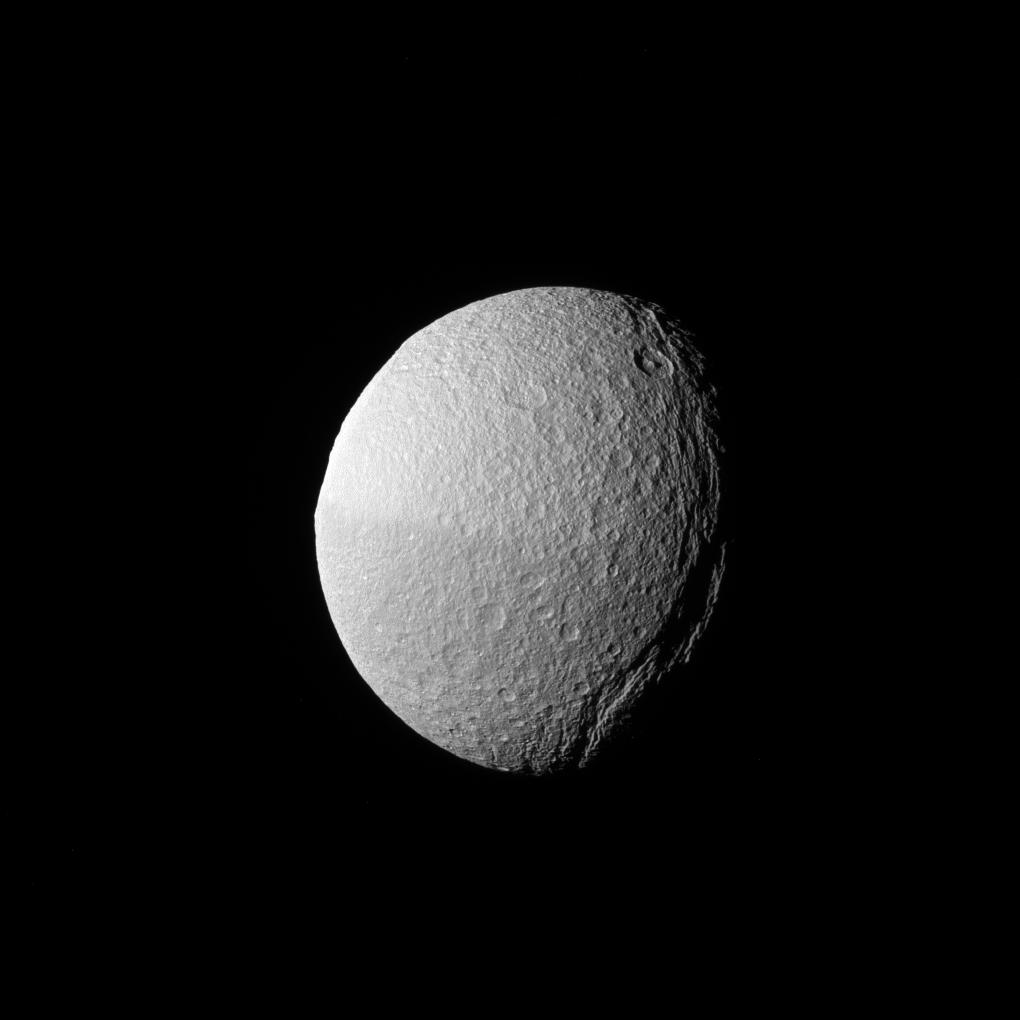
Another curious feature of Tethys is the expanse of smooth plains roughly opposite Odysseus, which may be the product of seismic waves produced by whatever enormous impact made the huge crater. We don’t know how much bigger the impact that made Odysseus would have needed to be in order to shatter Tethys entirely, but it probably wasn’t much.
The Death Star moon and other oddities
Until we learned about Enceladus’ potential for life, Mimas was the most famous of Saturn’s moons, besides Titan, because of its resemblance to the Death Star, with Hershel Crater as the superlaser.
It’s the only major moon smaller than Enceladus, and at less than 400 kilometers (250 miles) wide, the term major is a bit of a stretch. The Voyager missions revealed the distinctive look less than three years after Star Wars became a cultural phenomenon, so the images became one of the highlights of the mission.
Thirty years later, a temperature map of Mimas produced another familiar shape, this time resembling Pac-Man, with Hershel as an edible dot.
That wraps up the true major moons, but there are a couple of other objects we should talk about before we're done, starting with Hyperion. Although Hyperion is sometimes referred to as a major moon, that's partly because of its location between Titan and Iapetus. It’s not big enough to have become spherical under its own gravity. Its long axis is almost as wide as Mimas, but it's barely half the size in any other dimension.
The most distinctive thing about Hyperion is the way it tumbles. Instead of rotating consistently, like most objects, its axis wobbles chaotically, so you can't predict how it will orientate itself in space more than a month ahead. We know a few other moons that do this, but the main two orbit Pluto, not a planet.
Aside from captured asteroids, Hyperion is also the only moon of all those we know that isn't tidally locked – i.e. with one side always facing its planet.
Probably the weirdest part of the whole system is the relationship of the smaller moons Janus and Epimetheus, which share an orbit and swap places every four years. There’s nothing like this pair in the solar system, with their behavior a masterclass in orbital dynamics.
Further out, there are more than 200 moons that go around Saturn backwards, relative not only to the larger moons, but to Saturn’s own spin. These are all thought to be captured asteroids that came too close to Saturn, and never got out of its gravitational well.
Then there is the way some of the moons not only affect the rings, but in one case look like ravioli.
Earlier this year we covered a paper that provided an explanation for both Saturn’s mighty rings and some of the odd things about the moons we’ve mentioned above. The idea is that there used to be another moon orbiting Saturn, which had the misfortune to run into the much larger Titan, throwing up vast amounts of material, some of which became Hyperion, while most of the rest formed the rings. If Hyperion is such a recent creation, it would explain its unique tidally unlocked status.
Prior to this, the theoretical ill-fated moon is suggested to have flirted with Iapetus, disrupting its orbital plane, the authors propose, while instability caused by these events may have triggered a second collision, which produced Rhea. This would explain why some features of Rhea and Mimas appear to be curiously young. The whole thing could even explain Titan’s atmosphere.
Although this idea would explain a remarkable amount, it’s still very much unproven.
We need another mission
Although explanations exist for most of these moons’ oddities, confidence in them varies, and some are very speculative. A mission that could visit many of these worlds, equipped with technology far beyond what was available with Cassini launched, would confirm or refute much of this, as well as no doubt throwing up many new questions.
Such a voyage could probably also sample Enceladus’ spray. However, its design would be very different from Dragonfly, or any other mission focused on Titan. Given the limited budgets available, NASA had to choose between exploring the most interesting of Saturn’s moons, or learning more about all the rest.
Hopefully the other Saturnian moons will get their place in the spotlight soon.