Space and Physics
 PUBLISHED
 1
1



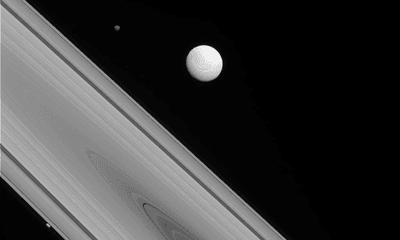


A single scenario could explain some of the odd features of Saturn's cosmic neighborhood. A project that set out to seek the origin of the planet's rings and why Titan’s orbit is expanding may have answered much more, possibly including why Titan is the only moon with an atmosphere denser than Earth's.
The origin of Saturn's rings has been a mystery for four centuries. The Cassini mission showed they aren't as dusty as we would expect if they were very old, adding them to the extensive list of things that are younger than sharks.
One proposed origin is a cataclysmic collision between two moons, but it’s tricky to find proof of something that happened hundreds of millions of years ago and whose primary legacy is ice chunks that range in size from marbles to cars.
However, Dr Matija Ćuk of the SETI Institute thinks such a collision could also be the cause of many of the system’s other puzzling features, in particular: the orbital plane of Iapetus and the changing nature of the other moons' orbits.
Saturn undergoes a slow wobble of its axis, known as precession. Earth does the same thing, a phenomenon that has driven ice ages, so this wasn't a surprise when it was discovered. The precession was attributed to Neptune, but during its final sad swan dive, Cassini revealed Saturn’s mass is more concentrated close to the center than had been thought, which changes how we see its angular momentum. That might appear like an obscure topic, but the dynamics of a planet affect its moons, so the Cassini data conflicts with previous explanations for changes in some of Saturn’s moons' orbits, requiring a new theory.
In 2023, the precession and origin of the rings were brought together in a single explanation – that Saturn once had an extra moon with the misfortune to orbit too closely to another, and orbital changes caused them to collide. In this scenario, the rings are the debris resulting from this collision, and some material also affected several of the planet's other moons, changing their orbits.
This hypothesis has the advantage of explaining why the rings have a lot of ice and little rock, in contrast to models where a moon strayed inside Saturn’s Roche limit and was pulled apart. Nevertheless, Ćuk and co-authors think the explanation is incomplete, and misses something big.
Where the original version of this model proposes a collision between two mid-sized moons, Ćuk and colleagues think the collision was between a smaller moon and Titan, Saturn’s largest moon and the second-largest moon in the Solar System.
Instead of an encounter of near equals, this would have resembled how the object known as Theia hit Earth in the distant past. Theia’s collision threw up the material that created our Moon, and it also messed with Earth’s composition. But with Saturn’s gravity to reckon with, Titan didn't acquire its own moonmoon. Instead, much of the material lost in the collision became the rings, while the part that condensed became the moon Hyperion, which orbits Saturn, not Titan, as the next moon out.
To get to this conclusion, Ćuk and co-authors had to consider all of Saturn’s other inner moons
"Hyperion, the smallest among Saturn's major moons provided us the most important clue about the history of the system," Ćuk said in a statement. "In simulations where the extra moon became unstable, Hyperion was often lost and survived only in rare cases. We recognized that the Titan-Hyperion lock is relatively young, only a few hundred million years old. This dates to about the same period when the extra moon disappeared. Perhaps Hyperion did not survive this upheaval but resulted from it. If the extra moon merged with Titan, it would likely produce fragments near Titan's orbit. That is exactly where Hyperion would have formed."
Other Cassini observations also make sense in this model. If a smaller proto-Titan’s surface was wiped clean by a collision so large it melted the outer layers, it explains why we don’t see a lot of impact craters on Titan today. It’s not just the atmosphere and the hydrocarbon seas causing erosion more rapid than on most moons, it’s also that there hasn’t been as much time for impacts to accumulate compared with other moons.
Titan’s orbit is also expanding, which is a common phenomenon among moons, but it is happening curiously fast. That becomes less surprising if something shook Titan up recently, at least by astronomical standards.
The lost moon appears to have been something of a wrecking ball in Ćuk’s model. Prior to smashing into Titan, it may have had a close encounter with Iapetus, the next moon beyond Hyperion. Neither object was destroyed, but if Hyperion’s predecessor was more massive, this could have tilted Iaeptus’ orbit, which is strongly angled compared with the plane of all the other large moons.
Perhaps most importantly of all, the collision could be the reason Titan is the only moon in the Solar System with a thick atmosphere. People who have compared its atmosphere to the one that surrounded the early Earth may have been closer than anyone realized; it may be only a few hundred million years old – around the age of Earth’s atmosphere when life began.
The effects of this hypothesized event extend to Saturn’s other inner moons as well. Like Titan, the moon Rhea’s orbit is also migrating rapidly, but in its case an inner boundary indicates it can’t have been doing so for more than 300 million years. Rather than having formed with Saturn, or having formed directly from the impact with Titan, the authors think Rhea condensed from material thrown up in a second collision. This, perhaps having happened as recently as 100 million years ago, would be the result of disruption triggered by the original hit on Titan.
Mimas, Saturn’s Death-Star impersonator, was recently discovered to have an internal ocean like those within Europa and Enceladus. However, Ćuk and co-authors argue that unlike for Europa, this ocean shows signs of being a recent phenomenon, likely another consequence of the destabilization set off by the original collision.
Provided NASA’s Dragonfly mission is sufficiently far along not to fall victim to budget cuts, we may be eight years away from finding out if all this is correct, or if it is an explanation that is just too perfect. Although intended primarily to seek the possibility of life on Titan, Dragonfly should be able to tell us how old many aspects of the giant moon are, which would go a long way to confirming or rejecting these ideas.
The paper has been accepted for the Planetary Science Journal, and a preprint is available on ArXiv.org