Space and Physics
 PUBLISHED


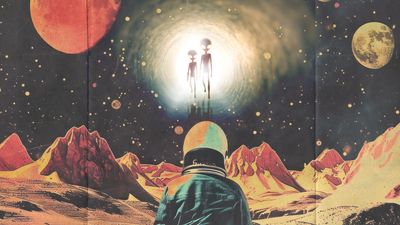


In the hallowed pages of this not-very-serious opinion column, my esteemed colleague James Felton argued just last week that we are alone in the universe and that is the best case scenario! It’s poppycock, I say! It’s balderdash! It's whatever other adjective the editor has come up with to cover my swearing.
We cannot possibly be alone in the universe! This is not even a debate. We find building blocks of life everywhere. In random molecular clouds across the galaxy, in asteroids near and far, in meteorites that have fallen on Earth.
Yet, we are supposed to believe that only here, in the whole wide universe, those common-as-muck ingredients have given rise to life.
It’s a numbers game
Let’s assume that what the Earth has is special and necessary for life. Its distance from the Sun gives a nice temperature range; its magnetic field protects us from cosmic particles; and our large Moon has stabilized the seasons. Let’s throw in Jupiter as a shield against comets and the like.
There are 100 billion stars in the Milky Way, probably just as many planets. About 200 billion galaxies in the universe. The number of planets is enormous – even if you put in place special conditions about the properties of these planets, the number that meets the criteria is never going to be one.
So even when all that is considered, there are many planets out there that share similar characteristics with our home in the cosmos.
But are those properties truly necessary for life? We assume they are because we have literally one example for it here. I am not kidding when I call it cosmic narcissism. Are we truly the one and only life that the universe can produce?
Just look around you
Even in the Solar System, over the last several decades, we have started to significantly rethink where life could exist or could have existed.
The best evidence for ancient life is on Mars. A rock called Cheyava Falls shows features that if it were on Earth, we would assume had been made by ancient microbes. It is possible that this is the case on Mars too; we know that the conditions on Mars used to be a lot more conducive to life as we know it.
It is also possible that it’s just some geological mechanism that we have not seen on Earth.
While that is the best we have discovered, in the last few decades we have seen that the moons of Jupiter and Saturn are also potential places where life could exist.
Europa and Enceladus have large oceans, and in the case of Enceladus, there are hydrothermal vents and complex chemistry there. We are sending missions to both in the coming years and decades, and we will get answers about habitability.
Maybe there is life in more extreme environments, like the clouds of Venus. An unexpected detection of the chemical known as phosphine (produced on Earth by living beings) had people wondering about the possibilities.
It might be that none of these places are good for life in the end, but we need to go there and check before making bold claims that we are alone!
Research is hard
Felton points out that we have been looking for alien life for decades without success. That’s true, as long as we stress that it has been done under tight budgets, technology constraints, and with limited best guesses as to where alien technological signals might be hiding.
Do not think for one second that we have been freely spending money on the search for extraterrestrial intelligence (SETI). Most of SETI has been focusing on a narrow range of radio waves, where the universe is pretty quiet, so an alien signal would be easy to spot. That assumes that aliens are purposely sending out messages and on particular frequencies.
Only recently, scientists have started looking at broader frequencies. The research on expanding that search is from just this summer.
The whole field of exoplanets is only three decades old, and the first confirmed rocky world orbiting a Sun-like star is Kepler-10b, announced by NASA in 2011. That’s 15 years ago! I have t-shirts older than that!
If we consider the signals humans are sending out, it’s mostly cellphone masts and airport radars. The former could be detected up to 10 light-years away, the latter 200 light-years away. The problem is that we have not had airport radar for 200 years. The signals that would make us visible are still extremely local.
There could be a civilization like us relatively close by, and we might have completely missed it for now.
It’s only a paradox if you believe it is!
Now, let me take the fight to my fellow Italian physicist Enrico Fermi. The “paradox” that bears his name is usually simply reported as “Where is everyone?” but the paradoxical part is implied.
The question comes at the end of a conversation about all these high probabilities of planets around Sun-like stars and life eventually giving rise to a civilization. The civilizations could then travel through the galaxies and spread across the stars, even within the known laws of physics. Yet, we do not see it happen.
Fermi asked, "Where is everyone?" – I want to ask, why would anyone do that?!
I want to live in a Star Trek universe, exploring new worlds and seeing new stars, but this is not the one we inhabit. Humans have been going to space for decades, and the farthest we have gone from our planet was this year. And it was not that far.
Deep space is a deadly environment, and it is enormous. You, a single human on a generational ship, would maybe cross a couple of light-days in your lifetime if you’re lucky. The closest star is 4.1 light-years away! Why would any member of a civilization embark on this journey?
Ultimately, the answer to life elsewhere in the universe lies with the limits of how we look for it.
Do we understand what life is? No.
But have we been thorough with the ways we have looked for that type of life? Not a chance!
Can we then make some generalized statement about the possibility of life in the universe? We most certainly will!
IFLScience Hot Takes is a semi-satirical Opinion column where we take a silly or outrageous idea and argue for it as if it's our earnestly held belief… as long as we can find good scientific reasons to back it up.
Do you agree with Alfredo? Is the Fermi paradox not a paradox at all? Let us know!