Space and Physics
 PUBLISHED



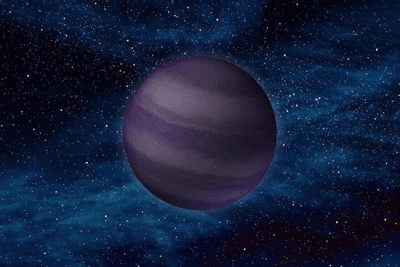


Changing water clouds have been detected in the atmosphere of a brown dwarf 7.5 light years away, the first time this has been seen outside the Solar System.
Water is the basis of all life we know, and whatever Ryland Grace from Project Hail Mary might say, most astrobiologists agree it’s the key to finding life elsewhere in the universe. Finding H2O molecules shouldn’t be that hard, it being composed of two of the universe’s most common elements, but having light years between us and those molecules is quite the impediment.
We’ve found water’s spectrum in the atmospheres of exoplanets, but confirming it forms clouds is a way of making the universe feel more like home, so astronomers have been on the lookout. Now that search has produced results, in a very un-Earthlike environment: the high atmosphere of a brown dwarf.
By having the JWST to check in on the brown dwarf WISE 0855 every 15 minutes for 11 hours, astronomers detected change in the thickness of clouds high in its atmosphere, and convection cycles deeper down.
"This is the first time we've been able to confirm that water clouds are becoming thinner and thicker on a nearby world," said Dr Brittany Miles at the University of Arizona's Steward Observatory in a statement. "Before JWST, we only had photometry, which mixed up the effects of clouds, chemistry and temperature all together. Now we can actually distinguish them."
Brown dwarfs have something of a fuzzy definition. Some have masses large enough that their gravity fuses deuterium atoms in their cores, but they can't do the same with ordinary hydrogen like a true star.
Deuterium fusing dwarfs sit in a window between 13 and 80 times the mass of Jupiter and form hot from the release of energy from their components. The slow release of that initial heat, supplemented by some fusing deuterium, keeps them warm for a long time, but not forever.
WISE 0855 is a little smaller than that, sitting at between three and 10 Jupiter masses, but it is still classed as a brown dwarf because it falls at this fuzzy borderline between definitions.
A keen eye on the clouds
The galaxy probably has a lot of very cold brown dwarfs, but they’re hard to find. WISE 0855 would be undetectable at a greater distance. But because it is just 7.5 light years away – closer than every star system besides Alpha Centauri, Barnard’s Star and Luhman 16 – WISE 0855 makes up for being just -8°C (17°F). The fact it doesn't orbit an actual star makes it even more remarkable that we noticed it, but also means it is easier to study, since its light isn't lost in a brighter object’s glare.
The possibility of clouds on WISE 0855 has been proposed since 2014, the year its detection was announced, but no Earthly telescope could see well enough to be sure.
Even JWST doesn't have the resolution to see cloud patterns on such a distant world, but it doesn’t need to. Instead, it detects the interference the clouds impart on radiation emanating from deeper in the object.
"It's like looking at the world through a screen door, where the screen is filtering out some of the light,” said Professor Mark Marley of the University of Arizona. “We're learning about the world on either side of the screen—but we also have to understand the screen itself."
In this analogy, the screen is the clouds, and they keep changing, just like on Earth. The changes we see require both convection and shifting clouds to explain them.
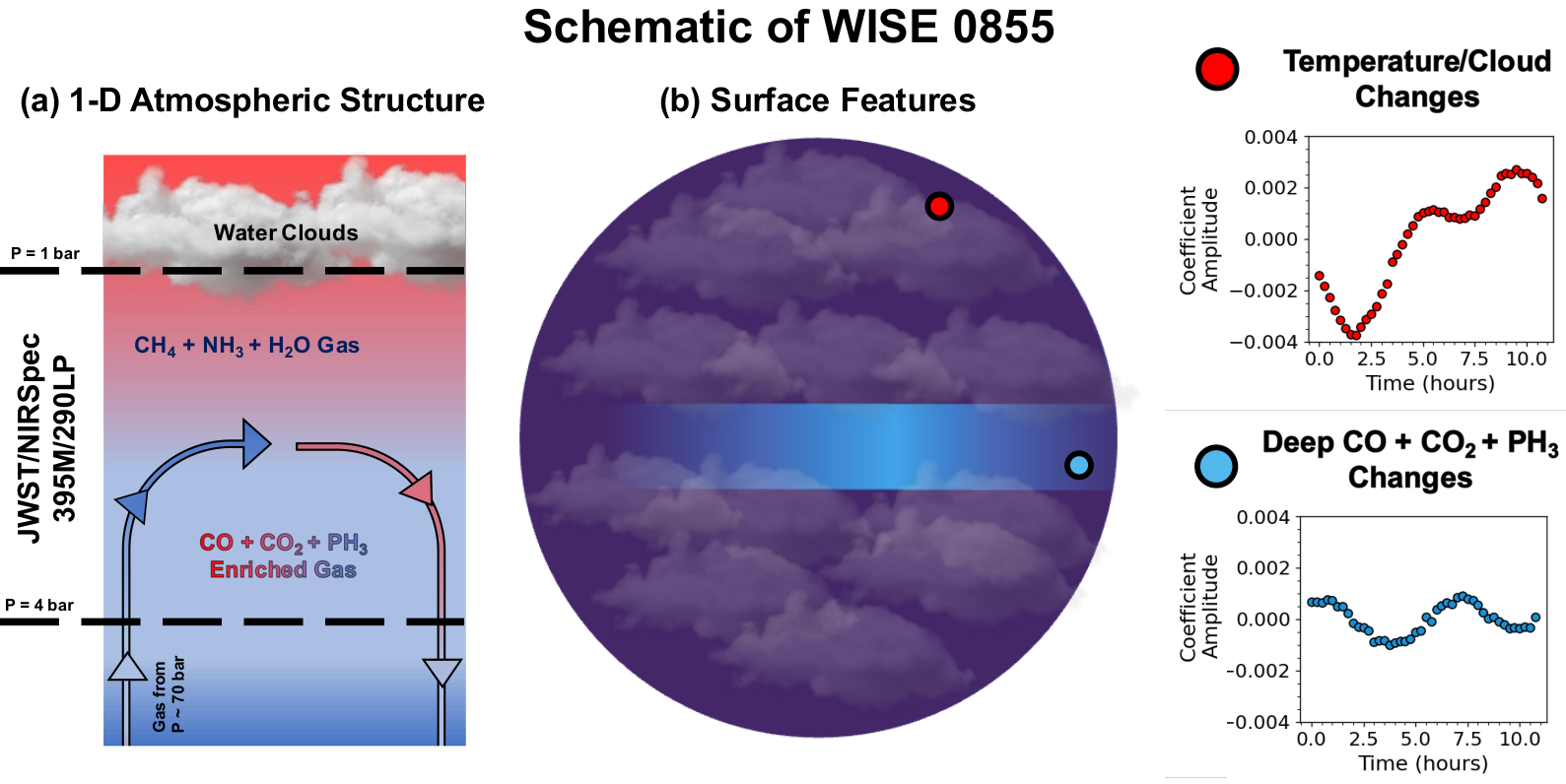
The convection cycles bring carbon monoxide and phosphine high enough in the atmosphere to be detected, before they fall back again as they cool. The authors compare what is going on to the clouds and convection patterns we see on Jupiter, while noting WISE 0855 is too warm to allow ammonia, which dominates Jupiter’s clouds, to condense.
The team hoped to learn WISE 0855’s rotation period, so they could recognize when the same part of the object was pointed towards us. However, while the team did detect a period to their observations lasting 9.33 hours, they are uncertain whether this represents the time it takes WISE 0855 to spin.
"Even though brown dwarfs are not true planets, they exhibit planet-like behavior," Miles said. "There is a spectrum of behaviors—not a hard line between brown dwarfs and planets. Jupiter and this object look distinctly different, but they have similar weather patterns. There are basic physics and chemistry that can be applied across all of these worlds."
The study has been accepted for publication in the Astrophysical Journal, preprint on ArXiv.org.