Space and Physics
 PUBLISHED


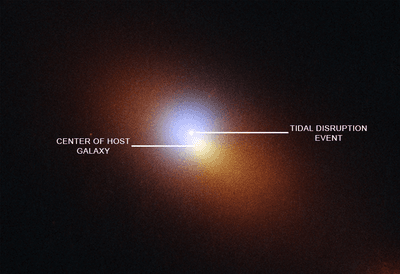


Supermassive black holes sit at the center of galaxies, but not exclusively. Due to mergers and other cosmic interactions, it is possible for some supermassive black holes to end up elsewhere. An inopportune snack has now revealed the position of one of these roaming black holes.
The object is located in a galaxy 600 million light-years from us. It would have been completely invisible to us but it interacted with a star, ripping it apart, signaling its presence across the universe.
What has happened is a tidal disruption event, or TDE. This one in particular is called AT2024tvd, and observations from the Hubble and Chandra telescopes have allowed us to understand it.
About 100 TDEs have been observed so far, but this is the first time that they have found one that is unrelated to the central supermassive black hole.
The host galaxy in question has its own central black hole. It weighs 100 million times the mass of our Sun, and 23 times the mass of the one at the center of the Milky Way. But the TDE has an offset of 2,600 light-years and is consistent with being created by a much smaller supermassive black hole. It has the mass of 1 million Suns.
"AT2024tvd is the first offset TDE captured by optical sky surveys, and it opens up the entire possibility of uncovering this elusive population of wandering black holes with future sky surveys," lead author of a paper on the event, Yuhan Yao of the University of California at Berkeley, said in a statement back in 2025.
"Right now, theorists haven't given much attention to offset TDEs. I think this discovery will motivate scientists to look for more examples of this type of event."
A new paper published this year has now strengthened the initial result, confirming the size and wandering nature of this black hole.
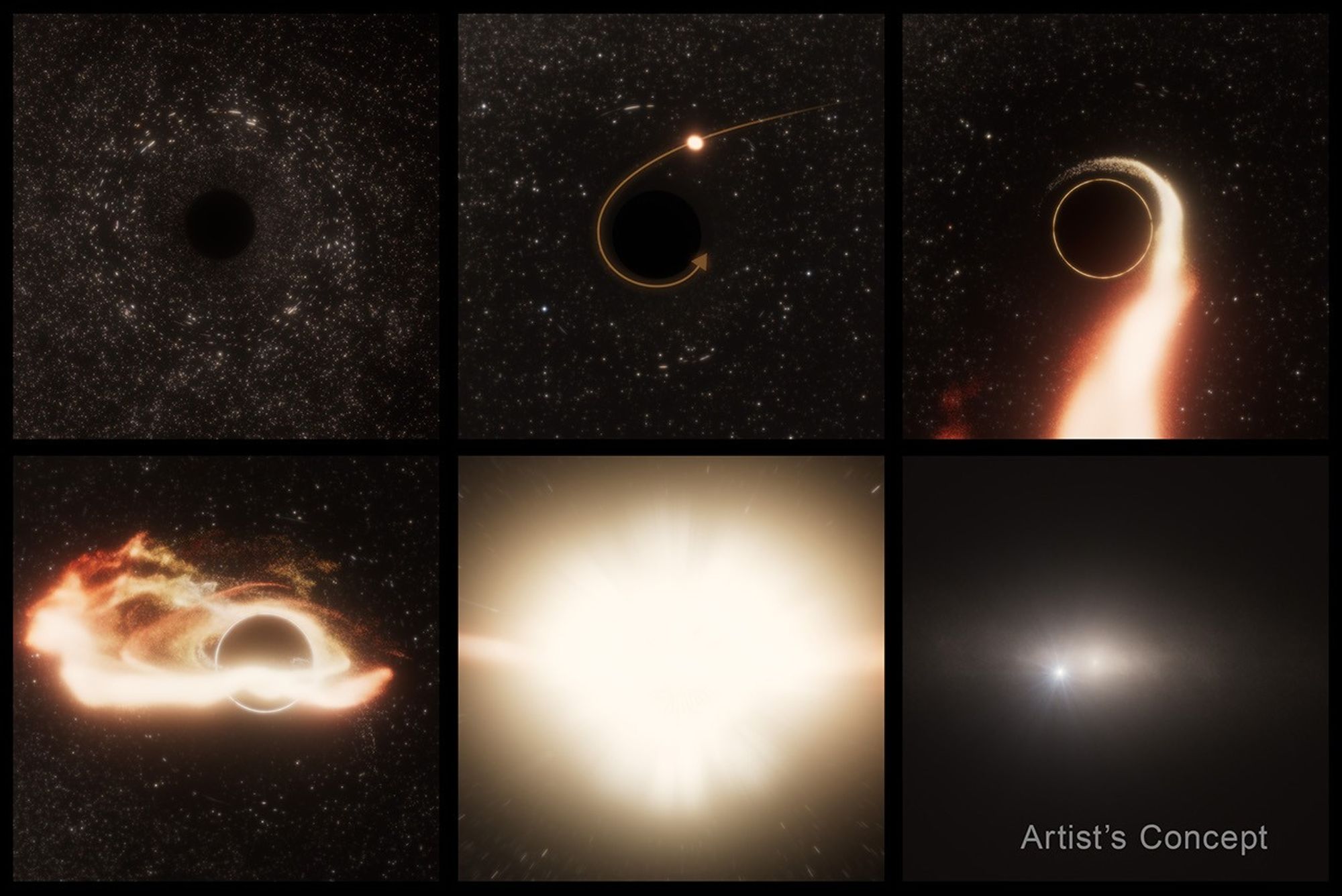
When anything gets too close to a black hole, the intense gravity of the object starts stretching it. This process is known as spaghettification. In the case of a TDE, as a star is spaghettified, the plasma that made it glows and can be seen across multiple wavelengths.
The Zwicky Transient Facility at Caltech's Palomar Observatory witnessed AT2024tvd. The discovery shows that invisible roaming black holes can be found in such a way.
"Tidal disruption events hold great promise for illuminating the presence of massive black holes that we would otherwise not be able to detect," said Ryan Chornock, associate adjunct professor at UC Berkeley and a member of the ZTF team, in the 2025 statement.
"Theorists have predicted that a population of massive black holes located away from the centers of galaxies must exist, but now we can use TDEs to find them."
The question is: why is this massive black hole not in the center of this galaxy? It is possible that it was in the center of another galaxy that merged with this one, then was either kicked out from the core or never got close to the center.
There is no evidence of a merger in this galaxy, but galaxies can have minor mergers and then lose most apparent signs of this interaction.
"There is already good evidence that galaxy mergers enhance TDE rates, but the presence of a second black hole in AT2024tvd's host galaxy means that at some point in this galaxy's past, a merger must have happened," added Erica Hammerstein, another UC Berkeley postdoctoral researcher who looked at the evidence for the merger.
The latest study is published in The Astrophysical Journal Letters.