Space and Physics
 PUBLISHED





What you'll discover in this article
- Pickles grow orange when an electric current passes through them, but only at one end.
- Hydrogen gas release and the influence of electrical sparking play a part, but the color has a different explanation entirely.
- “I don't think we should start using pickles as lightbulbs anytime soon,” Dr Josh Méndez told IFLScience.
The bright orange glow produced by pickles when they conduct electrical current is caused by a combination of hydrogen gas and electrical sparking, new research has found.
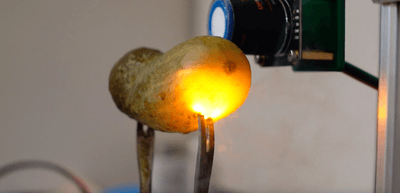
Many science teachers have given their students a break from the harder parts of the topic by turning off the lights and making a pickle glow by putting an electrode into each end. When this happens, the pickle fizzes and smokes, and then curiously only one end will light up with an orange glow.
However, unlike many of the other standard demonstrations, this one has lacked a clear explanation.
Some chemists attributed the glow to the release of hydrogen gas, which then combusts, while others say it’s about the current itself, a little like an incandescent lightbulb.
No doubt many teachers have told their students one version or the other, while the best would have presented it as an unsolved problem requiring the discipline of scientific investigation to solve.
Now, Dr Josh Méndez of Portland State University is on the way to a rigorous answer. It turns out that it combines the two long-standing explanations that had traditionally been seen as in competition with each other.
Méndez and his colleagues are now “close to resolving this long-standing mystery,” but the explanation may not yet be entirely complete and is yet to undergo peer review.
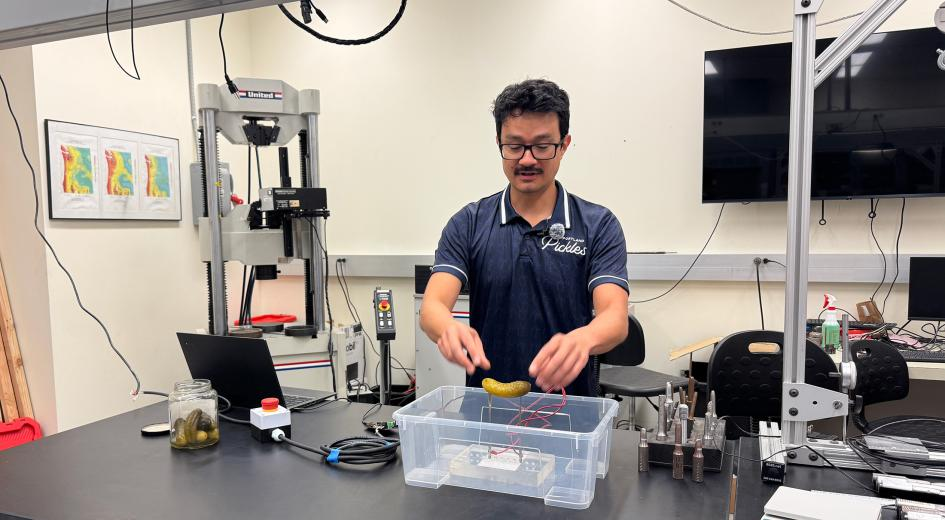
Part of the answer is due to the pickles’ salt which makes them highly electrically conductive. Méndez found that the current initiates electrolysis, splitting the vegetables’ water into hydrogen and oxygen, with the hydrogen being released at the negative electrode.
Hydrogen is unstable in the presence of oxygen, and the two gases mix enough that combustion takes place, releasing heat and light. However, hydrogen and oxygen alone are not enough, as a trigger is required to start the reaction.
“There is hydrogen involved, but it's actually not heat that's igniting it — it's the spark,” Méndez said in a statement. “It's just like why you don't light a cigarette at a gas station. You're producing a spark that ignites the gas.”
The spark-discharge and hydrogen-based explanations may be complementary rather than mutually exclusive.
Dr Josh Méndez
The sparks are a product of the way the pickle responds to having electricity passed through it, which is why you don’t get a similar color from sea water.
Since the pickle is not a perfect conductor, its resistance produces heat, which boils off some of its water, leaving gas pockets that don’t conduct electricity, and therefore cool down. The pockets shrink, allowing surrounding brine to take their place.
“As that water comes back in toward the electrode a little arc crosses between the liquid and the electrode, just as when you reach for a doorknob and you get a zap,” Méndez said.
The hydrogen/oxygen mixture explodes in the presence of a spark, releasing enough heat to cause the pickle to glow. The presence of so much sodium, also excited by the sparks, means the glow has the orange shade that element is that element’s calling card.
Méndez notes that those who need to watch their sodium and so they pickle their cucumbers in potassium chloride would get a different color.
Research in(to) a pickle
Méndez is not the first to consider the pickle glow worthy of investigation. In 2015 Professors Michael Vollmer and Klaus-Peter Möllmann published the succinctly named paper “Light-Emitting Pickles”, exploring the pickles spectrum and confirming the presence of hydrogen.
This phenomenon highlights the diversity of electrostatic effects that can arise in everyday objects, as well as the complexity of electrical discharges themselves.
Dr Josh Méndez
Previously, a separate paper by Hamburgen et al. (nominative determinism striking again, but disappointingly not published online) had proposed electric spark discharges as the cause of the glow, Méndez told IFLScience .
“The spark-discharge and hydrogen-based explanations may be complementary rather than mutually exclusive,” continued Méndez. The experiment has parallels with the grape in a microwave party trick.
“They are similar in that they both potentially involve gas breakdown,” says Méndez. “In the grape experiments this comes in the form of a plasma generated by focused electric fields. In the pickle experiment, the discharge is more likely an arc.”
Modern scientists may often be motivated by the same curiosity that drove their predecessors, but funding agencies seldom see things the same way, demanding practical outcomes.
“I don't think we should start using pickles as lightbulbs anytime soon,” Méndez told IFLScience. “Nevertheless, this phenomenon highlights the diversity of electrostatic effects that can arise in everyday objects, as well as the complexity of electrical discharges themselves.”
Consequently, it’s probably just as well the experiment could be done with common lab equipment and some produce from the local farmers’ market. Nevertheless, the team did use high speed photography cameras and spectroscopes.
A bigger reason not to try to replicate the work at home, however, is the dangers of a short circuit or the build-up of too much hydrogen.