Space and Physics
 PUBLISHED





In this article you'll discover
- PLATO has an innovative design to keep tabs on 1 million stars for possible Earth-like planets.
- The space telescope will also be used to study starquakes, giving scientists a glimpse at the interior of those stars like never before.
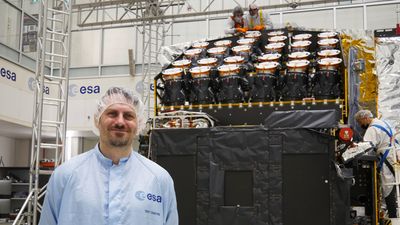
- IFLScience was allowed a special look at the space telescope being assembled at the European Space Research and Technology Centre in a clean room.
Nothing really prepares you for seeing a space telescope up close. You can look at all its measurements, but once you are standing next to it, you suddenly realize that they are a lot bigger than you thought they would be.
IFLScience recently traveled to the Netherlands to the European Space Research and Technology Centre run by the European Space Agency (ESA). We had an appointment with a truly special guest: PLATO, the PLAnetary Transits and Oscillations of stars.
PLATO is a fascinating mission because we are trying to find Earth-2 out there.
Thomas Walloschek
The backronym was inspired by the ancient Greek philosopher Plato, but while a disputed fact is that Plato was not his real name but an allusion to his “broad” and robust figure, it's indisputable that the broadness is definitely the case for his telescope namesake. The device is huge.
And it has to be. The space telescope will attempt something we've not been able to do before: it will look for Earth-sized planets going around Sun-like stars in about one-year orbits.
“PLATO is a fascinating mission because we are trying to find Earth-2 out there,” Thomas Walloschek, PLATO’s project manager, told IFLScience.
To discover planets with the transit method, as many planetary missions have done so far, you need to observe a star many times and spot little eclipses when a planet passes in front of it from our point of view.
This makes it easier to spot planets around smaller stars with shorter orbits. That is because a planet of a smaller star will cover more of its light and so give a clearer signal, while shorter orbits mean you don't have to wait as long to see this signal repeated.
[This] is really a new paradigm that we're entering by doing asteroseismology where we can much better understand the stars and we can actually get the ages of those systems.
Maximilian Günther
But there are just too many stars out there, and previous instruments could not keep track of all of them and their changes with high enough precisions over that many years to spot those Earth-like planets around Sun-sized stars. PLATO is designed to do what these previous telescopes could not.
While finding something like the world we're stand on would be fantastic, PLATO won't just focus on yellow stars like our own but on a large number of objects. It is expected to search for planetary transits across up to one million stars including yellow suns, subgiants, and red dwarfs.
There's power in numbers
Its innovative design, made of four clusters of six cameras each, plus two fast cameras, provides both the precision and the wide field of view to observe a large area of the sky at the same time, monitoring so many stars simultaneously.
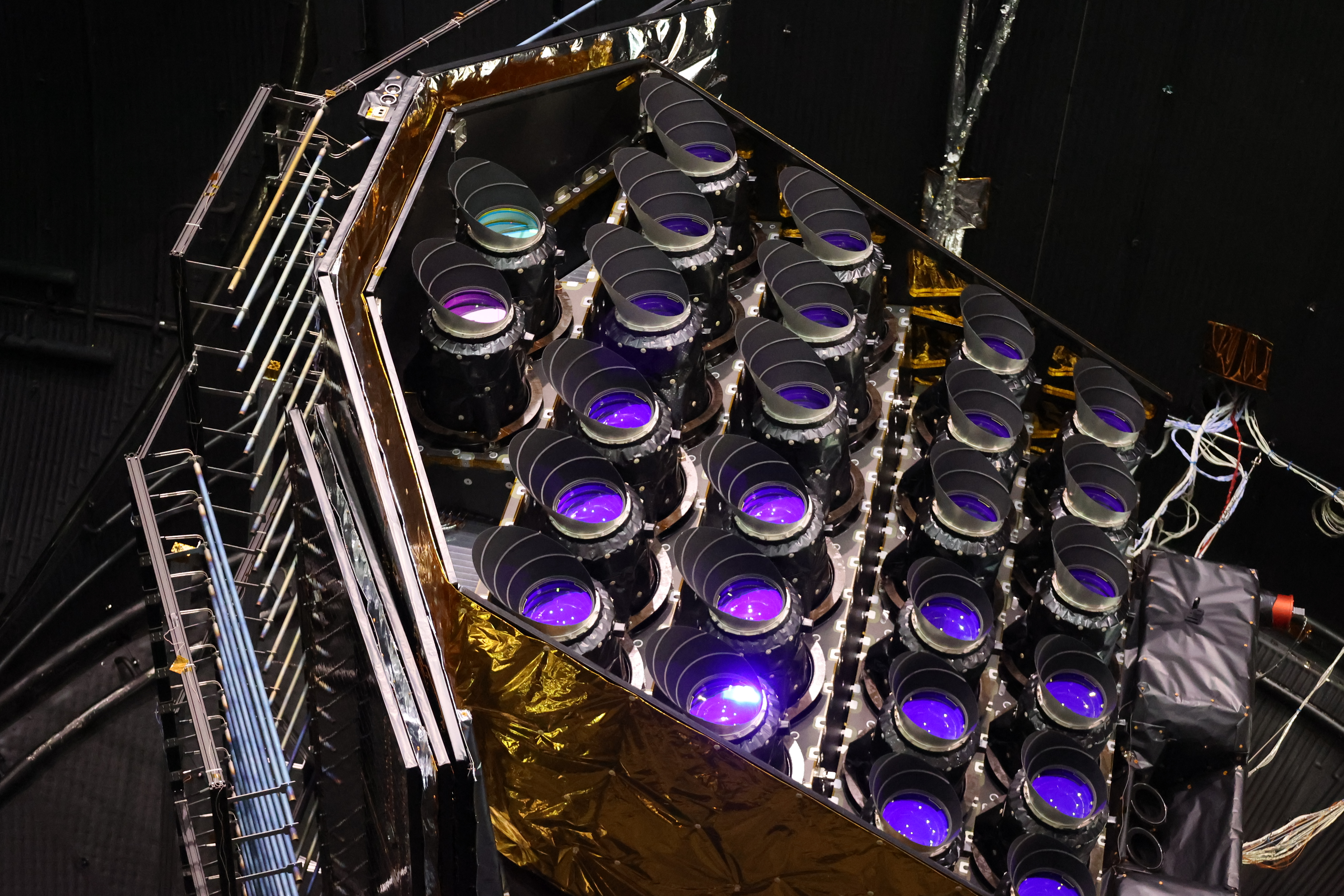
“Instead of building one big instrument, we built 26 smaller instruments,” Sami Niemi, PLATO mission performance engineer, told IFLScience.
“These are largely independent of each other. If you have some instrumental effects, they should not vary in the same way across your 26 normal cameras. So you can average over the cameras, and the signal gets stronger that way.”
The 26 ultrasensitive cameras can measure the variation in a star’s luminosity with a precision smaller than 80 parts per million.
The song of the stars
But PLATO won't just be planet spotting. Stars’ light can vary due to internal starquakes, waves moving through the interior. The field of study, known as asteroseismology, can use those changes to get a clearer measurement of several stellar properties.
“[This] is really a new paradigm that we're entering by doing asteroseismology where we can much better understand the stars and we can actually get the ages of those systems,” Maximilian Günther, PLATO project scientist, told IFLScience.
PLATO will deliver accurate stellar ages from the study of starquakes combined with the discovery of new planets on wider orbits. This combination will allow a paradigm shift in studying systems with planets in similar configurations as the Earth. And will let us understand our own planet much better.
This is not all. The telescope has such precision that it might lead to the discovery of exomoons and exorings around these distant worlds. There is also a guest-observing program where 8 percent of the science data rate will be allocated to complementary science projects.
The mission is currently slated to launch in spring 2027, and you can see our full mini documentary above.