Space and Physics
 PUBLISHED


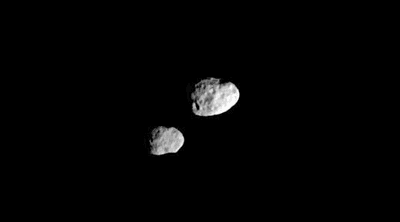


Jupiter’s big four moons are famous for their unique features, but when it comes to true distinctiveness, it’s the Saturnian system that really stands out. The atmosphere and lakes of Titan, and the geysers of Enceladus, get most of the attention, overshadowing an abundance of other oddities, of which the orbit-sharing Janus and Epimetheus might be the most remarkable.
On their own, Janus and Epimetheus are very ordinary objects. They’re 203 and 130 kilometers (122 and 78 miles) long at the largest, 178 and 117 km (110 and 72 miles) on average. That makes them the 10th and 11th largest moons of Saturn but outside the top 20 of the Solar System as a whole. They’re closer to the planet than most of the moons, but there are several closer. Their density and brightness suggest they are mostly ice, but also quite porous, probably like the rubble-pile asteroids we keep finding.
What makes the pair unique is that Janus’s orbit is currently 50 kilometers (31 miles) further from the center of Saturn than that of Epimetheus, a difference of just 0.03 percent. That, as you may have astutely noticed, is less than the radius of either of them, let alone both combined. That would appear to suggest that when Epimetheus overtakes Janus, they should collide. Given the minuscule difference in orbital speed, such a collision might cause them to stick together, rather than blast them apart, but we’d also expect it to have happened long ago.
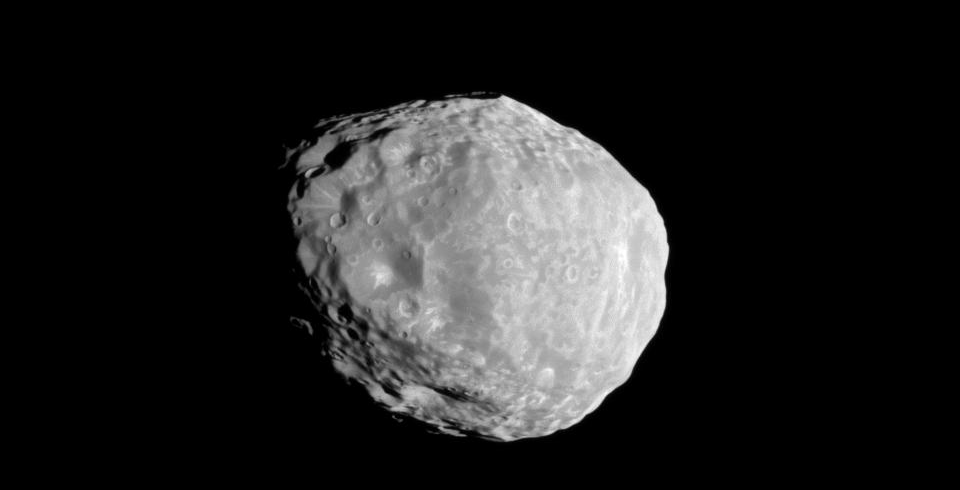
Instead, the orbital dynamics of the pair are far more complex. The mass of each moon is so small their gravity is tiny – it wouldn’t do for an astronaut to jump too hard lest they fly off and never return. Yet their orbits are so close that the gravitational forces between them cause the pair to swap places. That is, whichever previously had the inner track now moves out slightly, while the outer moon moves in. At this point, the new inner moon slowly pulls away from its counterpart. Eventually, after more than 2,000 orbits and about four Earth years, it catches up with its partner and they swap again.
Little wonder they are known as The Dancing Moons. One such swap occurred early this year, when Epimetheus reclaimed the inner orbit after being on the outer since 2022.
It’s tempting to imagine the pair passing so close to each other they almost touch – maybe allowing that imaginary astronaut to jump from one to another or at least wave to a colleague on the other world. It doesn’t quite work like that, however; the pair never get closer than 10,000 km (6,000 miles), at which point they would not look like more than a bright dot without a telescope.
How the swap happens
Whichever moon is on the shorter orbit at the time will circle Saturn more quickly than the other, although only by a matter of seconds. Gradually, it gains on the outer moon and eventually approaches close enough for the gravitational effects between them to become substantial.
The outer moon pulls the inner one forward, while the inner moon pulls the outer one back. The extra energy the inner moon gains in the process boosts it into a higher orbit, as if someone had fired attached rockets. This energy has to come from somewhere, and that is the orbit of the previously outer moon. Having shed a little of its energy, the outer moon must drop slightly towards Saturn, becoming the new inner moon.
Although the pair are relatively close in size, Janus still has about four times the mass of its dancing partner, making it less affected by the dance. Its orbital radius varies by only 20 km (12 miles) between inner and outer cycles. Epimetheus, on the other hand, has an average distance from Saturn that is a whole 75 km (44 miles) greater when it is on the outer orbit than the inner.
Origins of Saturn's dancing moons
Janus and Epimetheus are the only moons we know in the Solar System that behave like this. However, the situation is not entirely unprecedented. Something similar to the “horseshoe orbits” the pair undergoes is seen with quasi-moons of Earth and Venus, like Kamo’oalewa and Zoozve. The difference is that the Earth has trillions of times the mass of its quasimoons, so when they approach us, almost the entire gravitational effect falls on the quasimoon. Earth’s orbit barely budges.
Such a rare pairing requires an explanation, but no one knows for sure how this got started. The preferred hypothesis is that the pair was once a single object, which was blasted apart in a collision. You might imagine that this was fairly recent – surely all this dancing can’t be stable for long?
However, if this is how they formed, Janus and Epimetheus have been at it for a long time. Certainly, both are old enough to have collected an impressive set of impact craters, and most likely, they have been dancing for billions of years.
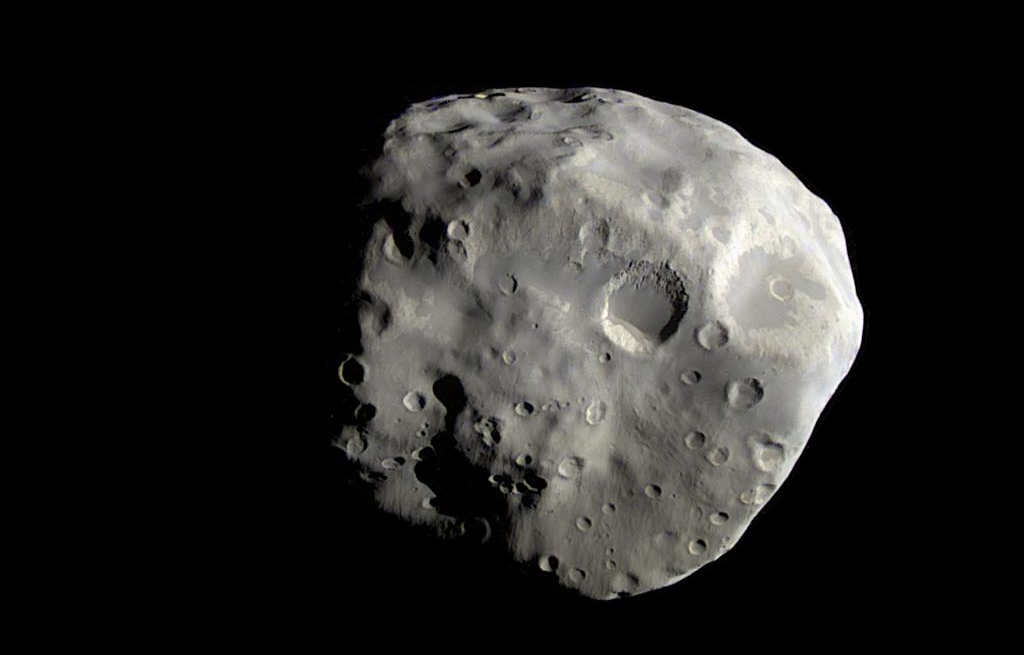
The components of the A ring, while tiny compared to the two moons, are also locked in a gravitational interplay with the shepherding pair. This is slowly forcing the moons outward, and causing the A ring to shrink slightly in response. It is anticipated that this interaction will eventually transform the dance. Epimetheus will eventually form a stable orbit 60 degrees ahead or behind Janus, becoming a Trojan of the larger moon, although the timing of this is not known.
Discovery
The shared orbit places Janus and Epimetheus between Saturn’s F and G rings. These are much fainter than the famous A and B rings and were not discovered until Pioneer 11 and Voyager 1, respectively. Nevertheless, they’re also so close to the outer edge of the A ring that they are quite hard to see from Earth.
Visibility is best when the rings are edge-on, as they were late last year. One such edge-on event occurred in 1966, allowing Andouin Dollfus to discover Janus. It was the 10th moon of Saturn discovered, and initially didn’t appear particularly interesting. Three days later, Richard Walker reported a moon at the same distance from Saturn. This was initially assumed to be the same moon.
However, comparisons of the observations found the moon in conflicting locations, leading to it being named Janus after the two-faced Roman God of doorways and various other items. Discrepancies continued. After 12 years of confusion, Stephen Larson and John Fountain provided the initially barely believable proposal that there were in fact two moons sharing an orbit. Two years later, Voyager 1 confirmed this wild hypothesis. The Cassini spacecraft not only got close enough to each moon to photograph their surfaces in some detail, but to confirm the 2006, 2010, and 2014 orbital swaps.
As if things were not messy enough, the orbit is also shared by an exceptionally faint ring, which is thought to be composed of dust coming off the pair under micrometeorite bombardment.